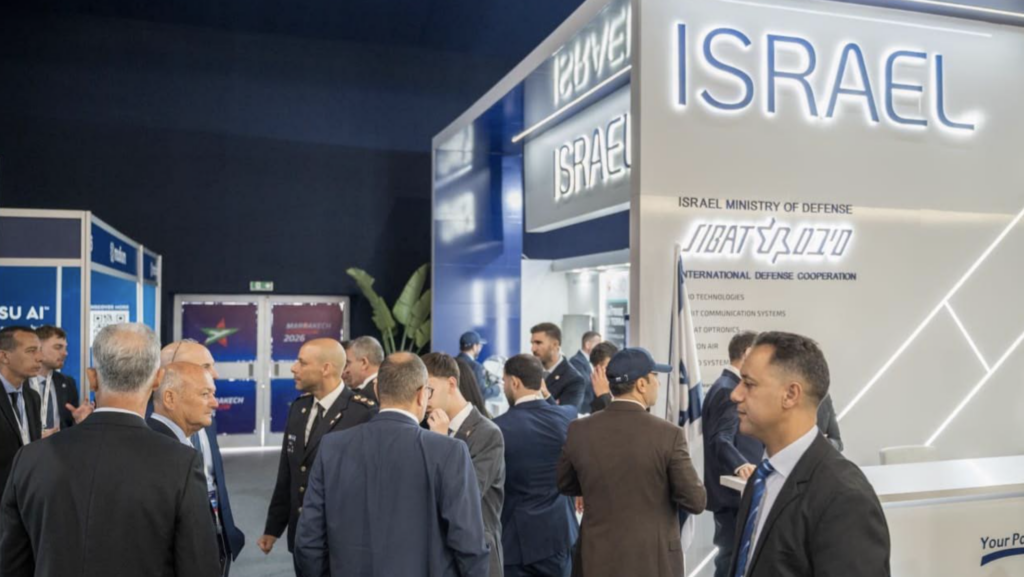
JERSUALEM — For the first time, Israel’s Ministry of Defense has sent a delegation and a national pavilion to the Marrakech Airshow, which opened today.
“This marks Israel’s first official participation in the defense exhibition held in Morocco since the signing of the Abraham Accords,” Israel’s Ministry of Defense said. Yair Kulas, the head of the ministry’s SIBAT office, praised this first participation in the Moroccan exhibition, calling it a “milestone” for Israel’s defense industry.
The ministry continued that the “opening of the Israeli national pavilion at the Marrakech Airshow is part of the IMOD’s strategy to increase defense exports and defense cooperation with countries worldwide.” The ministry added that this strategy will also strengthen the Israel Defense Forces and influence foreign policy, noting, “During the exhibition, meetings were held with delegations and government officials from various countries.”
Morocco joined the Abraham Accords in December 2020, three months after the United Arab Emirates and Bahrain agreed to the historic Accords to normalize ties with Israel.
Despite almost six full years of official relations, Moroccan-Israeli defense ties are often not mentioned in either country’s media for security and sensitive reasons. Some of the rare instances of the countries’ media presence include in 2023 when a dozen Israeli soldiers joined the US-led African Lion exercise. And reports over the last year have indicated that Morocco acquired IAI’s Barak MX air defense system, may have acquired Israeli drones and partnered with an Israeli drone maker and may have other partnerships with Israel’s defense industry.
Hence, Israel highlighting its presence at the Marrakech Airshow stands out. Israel’s defense industry has seen historically high exports over the last several years, even though Israel has also faced some controversy at arms shows abroad. France, for instance, banned Israel from Eurosatory in February.
Eight Israeli companies exhibited at the Marrakech Air Show, which has taken place biennially since 2008 and attracts more than 200 exhibitors from two dozen countries. Morocco is the second largest spender on defense in Africa, spending over $6 billion on defense last year, according to SIPRI figures.

The Army’s Digital Transformation
AI is reshaping the Army’s approach to cyber, electronic warfare and command and control. At TechNet Augusta 2026, leaders outlined how they’re turning emerging technology into capabilities for the battlefield.
Israel’s Ministry of Defense noted in a statement that the Israeli companies showcased combat-proven technologies “including loitering munitions, AI-powered robotic systems, autonomous navigation capabilities for UAVs, laser guidance for FPV drones, satellite communications, and more.”
The Israeli pavilion included ASIO Technologies, Orbit Communication Systems, Shilat Optronics, Uvision Air and Xtend Systems. Speaking broadly, all five companies provide the kind of small drone or loitering munition systems that have come to define battlefields in Ukraine and Gaza.
Additionally, the three largest Israeli defense firms — Rafael Advanced Defense Systems, Elbit Systems and IAI — have their own booths set up at the show.
Rafael showcased its air defense systems in Morocco, including its Spyder system which has been sold to Greece and Romania recently. The company noted that the system “integrates radar, command and control and launcher on a single vehicle, together with the interceptors for its common launcher.” In addition to other systems, such as targeting pods and missiles, Rafael also mentioned an interceptor drone called Hunter Eagle as part of its solution for smaller drone threats.
“Rafael builds for the battlefield as it is now and as it will be in the future. Every system we brought to Marrakech, from laser interception to long-range precision strike, was shaped by operational battlefield experience,” Yoav Tourgeman, Rafael’s CEO, said in a statement, adding that the company views its participation as laying the groundwork for future collaboration.
Elbit brought its large Hermes drone, as well as its entire line of smaller drones under what it calls its FUSE line of “military-grade autonomous systems designed for scalable deployment.” In addition, Elbit highlighted its Mini-MUSIC airborne self-protection system, which uses directed-energy countermeasures.
“At Marrakech Air Show 2026, Elbit Systems will showcase capabilities spanning unmanned and autonomous systems, precision fires, airborne protection and electronic warfare, intelligence, surveillance and reconnaissance (ISR), electro-optics, communications and digitalization, as well as advanced training and simulation,” the company said in a statement.
IAI did not put out a statement detailing the wares it’s showing off.
Breaking Defense Video