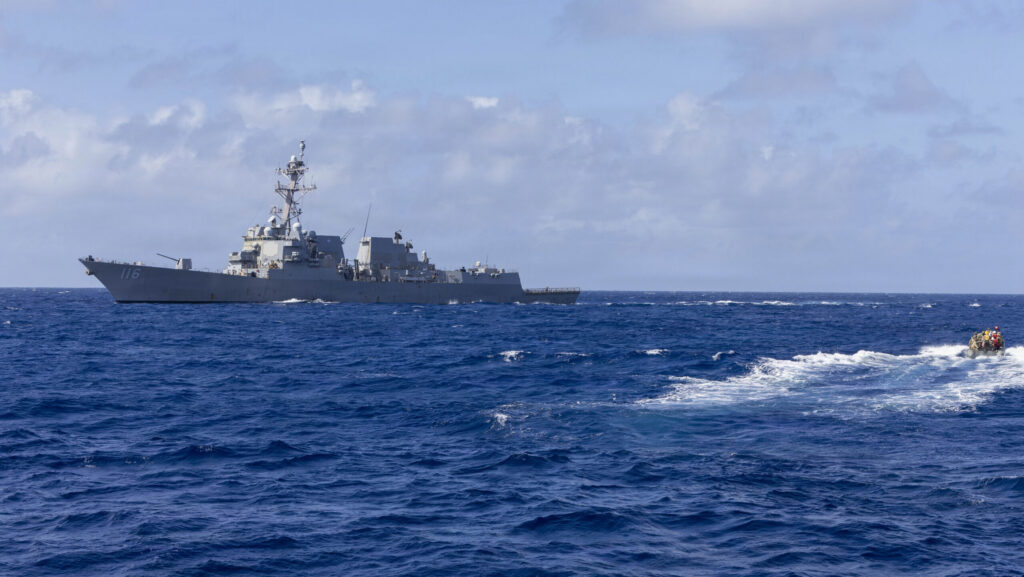
WASHINGTON — Applied Intuition has won a $25 million contract from the US Navy to begin deploying AI-powered sensor fusion on warships, starting with five Arleigh Burke-class destroyers but potentially expanding “across the fleet,” the company announced this morning.
The new Intelligent Perception System (IPS) will do two jobs at once, Applied said in its announcement and a blog post. In near real time, IPS will pull in data from various cameras and infrared sensors — many of which were never designed to work together — and synthesize a single, coherent picture for the sailors. It’ll even offer helpful features like “automated alerts” when another vessel is approaching on a collision course.
Sailors aboard the USS Fitzgerald and McCain definitely could have benefited from such a capability during their back-to-back collision incidents in 2017, which killed 17 sailors and severely damaged both ships.
Meanwhile, IPS will also record the sensor data and — when bandwidth is available and security conditions permit — transmit it back to shore. There, the system’s land-based component can analyze the collected data and use it to train improved AI models for both manned and unmanned vessels.
The system even allows ships to receive updates over the air while still at sea, instead of waiting for maintenance and modernization in port, the company said. That could enable multiple refresh cycles in a single deployment.
That kind of fast-paced adaptation is reminiscent of the drone war in Ukraine and fits with Defense Secretary Pete Hegseth’s push for rapid upgrades. It also jibes with the Pentagon’s desire to piggyback off advances in commercial tech rather than waiting for bespoke military developments.
Applied originally focused on self-driving cars — still a major part of its business — before it branched out into defense. At its core, the technology it’s bringing to the Navy draws on that dual-use foundation.
“The amount of data the Navy collects, and the operating environments it is constantly engaged in, [are] very similar to what we do gathering data to develop driverless cars,” Jason Brown, general manager at Applied Intuition, said in a statement to Breaking Defense.
While details obviously vary, the essentials are the same for “any autonomous system that needs to perceive environments in order to feed planning and control algorithms,” he argued. “We built those data engines for our commercial business and applied the same technical approach to naval operations.”
This new contract isn’t the first time Applied has brought its technology to the Navy. IPS builds on an earlier pilot program called DECK — short for Data Edge Collection Kit— that was tested on at least one Navy vessel earlier this year.
“DECK was massively successful,” Brown declared. “It collected data, transported it — all with commercial technology — and did it securely and within Navy operational constraints.”
Breaking Defense Video