WARSAW — Poland’s national defense minister is calling on Europe to develop an “enduring, predictable” alliance with the US, encompassing information exchange, military capabilities and defense industry collaboration.
“I believe that within the ‘NATO 3.0’ strategy, it is worth emphasizing a strategy for the defense industry,” Władysław Kosiniak-Kamysz told the Warsaw Security Conference on Monday. “Relocating production lines and maintenance facilities to Europe, for instance, for Patriot missiles and systems, is crucial for the independence of both the United States and Europe.”
The comments arrived on the same day that Polish army operational commander Gen. Ireneusz Nowak noted at the event that Patriot deliveries are set to be held up. “At this point it looks like we are going to be affected as well,” he said. “That’s very visible in the area of PAC-3 MSE Patriot missiles, they’re going to be delayed for sure.”
Ukraine has called on European partners to supply it with additional Patriot missiles to fend off Russian attacks. Kosiniak-Kamysz said the current situation in Ukraine shows how dangerous a breakdown in supply chains would be in a crisis scenario, so Europe must do everything to be strong and independent enough to take action toward greater reindustrialization.
Additionally, he warned that the European Union has been grappling with the issue of military mobility for years, and “yet, there are still no decisions in place to allow for the free movement of our troops without requiring the consent of individual regions.”
The matter needs to be resolved as soon as possible, he stressed, through the adoption of sound legislation. “It should be automatic: if someone calls for help, they want those troops to reach them, and everyone else should provide support,” he explained.
From a big picture perspective, Europe cannot wait until 2035 to become strong, said Kosiniak-Kamysz, as he argued that NATO’s 5 percent GDP defense spending pledge should be brought forward to 2030.
Kosiniak-Kamysz said Europe must make its defense industry supply chains independent, and this is a task that needs to be addressed as a matter of urgency, because “we cannot rule out equipment from outside the European Union if it is critically needed.”
In his view, it stands to reason that collaboration with the US on items like low-cost, long-range precision strike capabilities, drones and anti-drone systems, as well as artificial intelligence, could prove worthwhile.
“So let us not rule out the possibility of creating Polish-US or European-US joint ventures, that could also tap into [SAFE] European funds,” he said. Of the €44 billion ($49 billion) from the SAFE program, nearly one-third went to Poland, and two-thirds of that amount has already been allocated to the Polish defense industry.
At a strategic level, he also declared that Poland is stronger with Washington’s backing.
“The more American troops there are in Poland, and if we have a permanent base and a lasting American military presence, the better equipped we are to shoulder responsibility for NATO’s eastern flank,” he said.
Kosiniak-Kamysz said also Warsaw will be ready for full-scale deterrence, thanks to investments in the defense industry, military mobility, transatlantic cooperation, relocating production to Europe, and joint investments in critical defense capabilities.
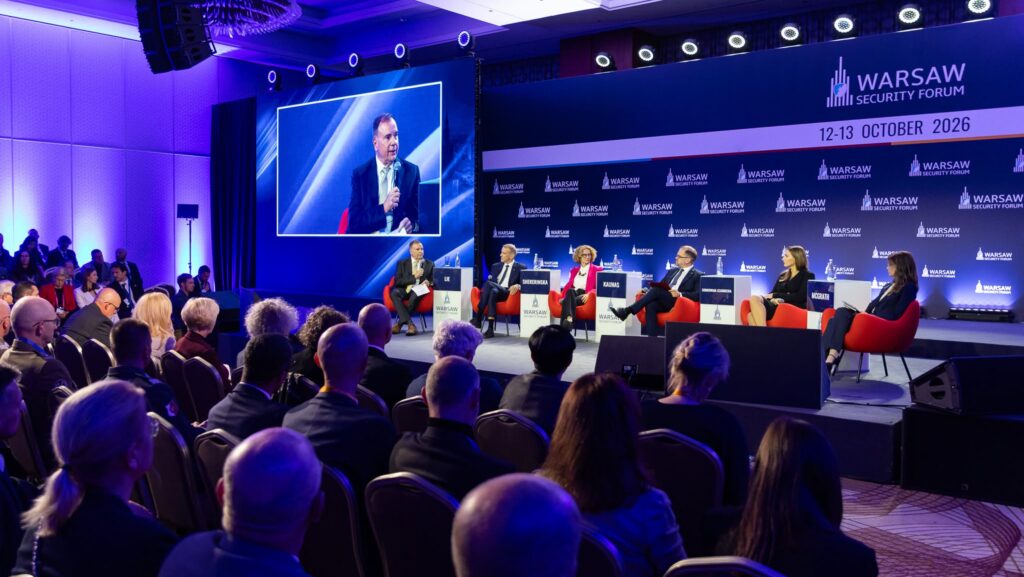
Speaking alongside Kosiniak-Kamysz, Minister of National Defence of Lithuania Robertas Kaunas said in the case of a Russian attack against Lithuania, it might be two weeks before US, Polish, German, British troops could arrive and reach the Soviet border to Lithuania. He echoed Kosiniak-Kamysz words, saying his country is investing in a national division, and an anti-drone air defense system, combining all different types of sensors, under a single ecosystem, backed by artificial intelligence.
Elsewhere, NATO Deputy Secretary General Radmila Shekerinska said that different things required to implement the alliance’s newly unveiled “theory of victory,” includes logistics, procurement and intelligence. “NATO is able to defend us. … But in order for all of us to keep this strategic advantage that we have [to] invest, create the capabilities, apply them, employ them, train the troops,” she said.
Shekerinska said NATO needs to speed up procurement procedures “to prepare [a] completely new approach in what is the capability, and how to make sure that NATO will have them when it will be needed.”
Rounding off panelist contributions, Magdalena Sobkowiak-Czarnecka, Poland’s Secretary of State for Defense, said she hopes the moment has come for the US government and US companies to finally agree on co-production in Europe, as US warehouses are empty. According to her, Warsaw is open to other countries, setting up shop in Poland for maintenance, logistics or production.
“If there’s any foreign company trying to sell something to us, we are not only looking on the quality and price, we give four extra conditions: the maintenance center, co-production, local suppliers or at least investing in education here,” Sobkowiak-Czarnecka stressed. She added that the issue of standing up local maintenance centers is one the Polish government is trying to resolve with from Washington.
“We are open for co-production, we are open … [to] companies from different parts of the world, but the condition is you have to work with our industry,” she concluded.
Breaking Defense Video