
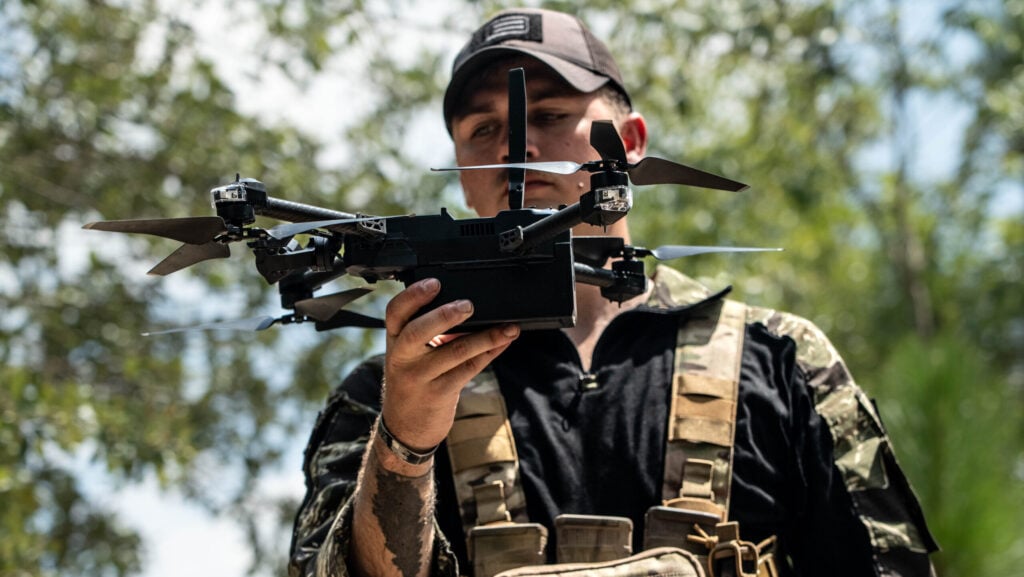
WASHINGTON — Small drones have so far proven their utility in the commercial sector and on the modern battlefield, but even as the systems proliferate, most are still limited in one key area: the ability to move cargo.
That’s why the Pentagon’s Defense Advanced Research Projects Agency is launching a new Lift competition that seeks to revolutionize multirotor drone operations, with the goal of designing unmanned systems that can carry up to four times their own weight. By comparison, DARPA says the payload-to-weight ratio for most small drones typically comes in at around one-to-one or less.
“When I’ve talked to military and industry, they have big dreams for drones, and they see a lot of applications. But then when they actually get down to it, the payloads that they want” often require a much larger, more expensive aircraft, Phillip Smith, DARPA’s lead for the Lift contest, told Breaking Defense in an interview.
“So if I can switch that, if I can make them very small and therefore cheap, this challenge can actualize the dreams that a lot of people have of using drones in both the military and civilian sectors,” Smith said.
DARPA aims to hold the contest in the summer, where participants will have to fly with a few parameters. First, drones must weigh less than 55 pounds. Then, in under 30 minutes, they will have to take off unassisted and carry a payload of at least 110 pounds for four nautical miles (4.6 miles), safely drop it off, and fly an additional nautical mile before making a precise landing. Competing teams will have two separate, 90-minute windows for the task with the goal of posting their best score.
The drones must also consistently fly at an altitude of roughly 350 feet (each has some wiggle room of +/- 50 feet), go the distance by making several laps between two points in a narrow circuit and remain within visual line-of-sight of the person piloting it. Teams must be led by either US companies, or citizens or permanent residents if competing as individuals, but can have foreign teammates — so long as they do not reside in any countries deemed restricted by the Pentagon.
Participants will primarily be scored based on their payload-to-weight ratio. For example, since drones must carry a minimum of 110 pounds, a competing system that weighs 20 pounds and carries the required payload would score better than one that achieves the same but weighs 30 pounds. The requirement for 110 pounds is just the floor, as DARPA wants to see the max amount of weight that can be carried by a less-than-55-pound drone.

Military & government leaders: Share your perspective
Share your insight in a 10-minute survey—$10 donated to Homes For Our Troops for every response.
The prize? A cool $2.5 million for first place, $1.5 million for second and $1 million for third. DARPA also plans to hand out three, $500,000 prizes for “subjective categories” like a “most revolutionary aerodynamic design.”
Smith was quick to emphasize that the competition is not supposed to be easy but is theoretically possible, explaining that the ambitious goal of a four-to-one payload-to-weight ratio was decided on after collecting input from industry. Some advances that make the target more feasible, according to Smith, include those concerning flight controls, structures and materials and powertrains. And in the event of a successful design, it’s possible it could be scaled up.
Notably, eligible drones do not have to be NDAA-compliant, which Smith said was intended to remove barriers to entry for more competitors in an industry dominated by cheaper, Chinese-sourced components. By doing so, Smith said that DARPA is attempting to “highlight that there is an American industry gap here” and underscored that excitement generated around new designs could pave the way for investment.
He also acknowledged the quick timeline DARPA is asking for, alongside the competition’s constraints, means there are plenty of ways things could go awry for competitors. Still, he said that the public nature of the event could expose “out-of-the-box thinking designs” to a wide audience, prompting some to maybe “continue on” and create combinations of different ideas.
“If we show a four-to-one ratio, or even a three-to-one ratio, there’s going to be massive interest,” Smith said. “I’ve already got people saying, ‘I’m going to show up, because I don’t believe this can work,’” he added. “But if it does, if somebody pulls it off, then you know, it’s off to the races.”