

Managing logistics in contested environments comes with numerous challenges, and unmanned systems can help meet them.
Unmanned systems reduce risks to human operators. They can be used to extend communications chains to allow for the delivery of critical materials, bypassing opposing forces or reaching locations which present a challenge for manned systems.
Breaking Defense spoke with Tim Saffold, Vice President, Autonomous and Unmanned Systems, Amentum, about the role of autonomous and unmanned systems in modern logistics.
Breaking Defense: What role do you see unmanned systems playing in maintaining things like operational reach and tempo?

Saffold: That’s an important question. The answer lies in the unmanned system’s ability to increase or expand reach, reduce risk to personnel, and enable more distributed, resilient operations. Increasing this reach and tempo enables persistent presence and rapid cycling of desired outcomes to achieve an objective repeatedly with the available resources and ensure success.
Specifically, unmanned systems can extend logistics lines of communication in areas that were previously denied, enable ISR operations, and allow greater reach with reduced risk to both personnel and mission success.
Can you expand on what role unmanned systems are playing in logistics and extending communications chains?
Unmanned systems are becoming central to the Pentagon’s contested logistics initiatives, enabling resilient, distributed resupply in and around denied environments through the employment of autonomous multi-domain systems. Logistics in contested environments require precise and integrated air, land, and sea operations. By effectively employing aircraft systems, ground systems, and sea-based systems that are operationally integrated with broader campaign objectives, warfighters can deliver on logistics requirements in areas where manned platforms would face significant risk and/or costs.
Ongoing initiatives focus on integrating multi-domain systems, leveraging technologies like artificial intelligence (AI) with other intelligence and logistics enterprise systems for real-time logistics, situational awareness, predictive supply chain resilience and redundancy across the joint logistics enterprise.
How are autonomous systems handling the challenges of operating in contested or denied environments?
Autonomous and semi-autonomous systems reduce risk to crewed assets by sustaining logistics where significant vulnerabilities exist. These systems use onboard sensing and pre-planned behaviors when communications are degraded. Autonomous convoys and robotic cargo vehicles move along interior lines of communication when GPS and long-haul comms are disrupted.
Maritime unmanned surface and undersea connectors can follow low observable routes and operate with minimal emissions using inertial navigation and preplanned waypoints to mitigate disruptions. Semi-autonomous cargo unmanned aircraft systems (UAS) could fly pre-planned routes at low altitude, using terrain following profiles, if necessary, with enough autonomy to complete missions when data links are intermittent.
In a nutshell, autonomous systems enable low signature resilient resupply while mitigating risk to humans and reducing the need for human operators. The desired outcome is sustained logistics for sustained operations in contested environments.
How are these systems able to work with legacy systems?
Integration is key. Autonomy and AI enhance mission planning, route optimization, and local decision making, reducing dependencies on continuous communications and allowing unmanned assets to react to threats and failures as they arise. These technologies also support demand forecasting that can more accurately align the payload with the requirements.
Along with this, we must consider the effectiveness of autonomy stacks like sensor fusion for GPS-denied navigation and blockchain for tamper-proof tracking. These technologies sustain operations in multiple theaters and allow flexibility for planners and warfighters who face serious challenges in contested logistic environments.
To work within legacy systems, communications and networking require resilience. Multipath nodes and secure data links allow unmanned platforms to share status, leverage data, and integrate effectively within legacy systems.
Positioning, navigation, and timing (PNT) and advanced power systems are important. Sensing and survivability are essential when we talk about low observable designs.
Ultimately, success depends on how autonomous and unmanned systems are integrated in a multi-domain environment where operators can effectively employ these systems in air, land, and sea operations either remotely or autonomously.
How are tools such as digital engineering or MOSA being used to speed up testing, development and deployment of these platforms?
High fidelity digital models, simulations, and virtual integration speed up testing, iteration, and implementation of unmanned systems, enabling early discovery of design and integration issues. For logistics, they enable rapid exploration of concepts like unmanned convoy behaviors, maritime connector routes, or multi-platform swarming with air vehicles.
Model-based systems engineering gives us virtual prototyping which can reduce physical tests while still allowing us to learn how autonomous and unmanned systems will behave in various contested scenarios. This can be done through software and hardware integration labs, simulation, software in the loop, hardware in the loop, and contested scenarios. All those things are being worked and developed today.
We’ve talked about a number of different technologies, but what technologies in particular are showing a lot of promise?
It really has to do with integrating all these systems and multi-domain operating environments where the systems can communicate — not only with autonomous and unmanned systems— but also with manned or crewed platforms as well. Those are showing an incredible amount of promise.
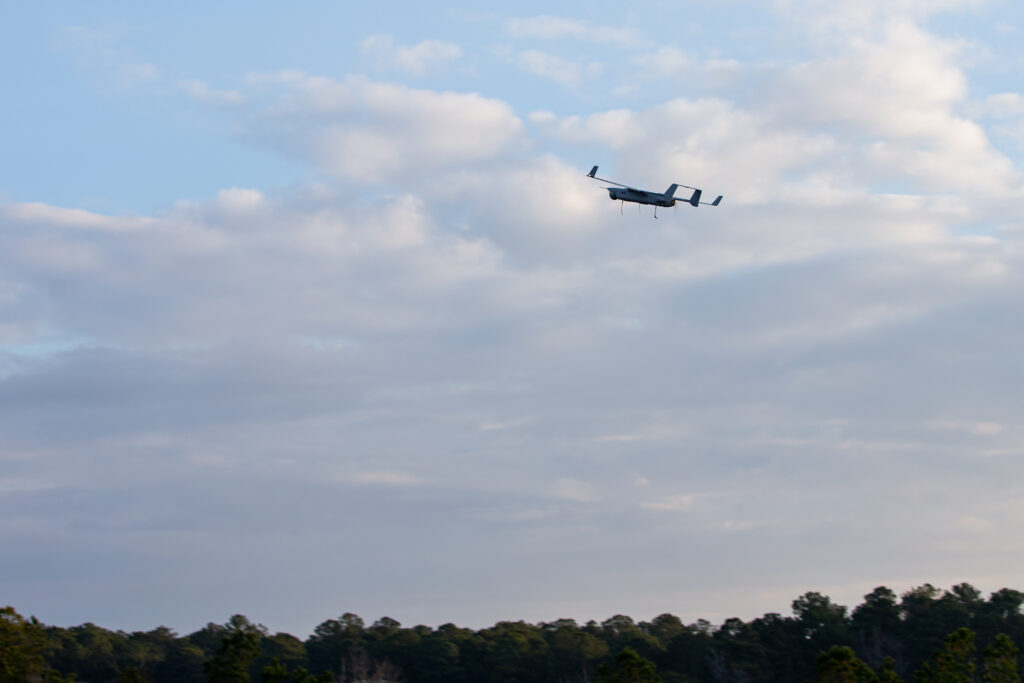
Combined maritime and aerospace systems are also advancing operational reach and tempo, especially for ship-to-shore resupply chains. Even the ability to adapt and modify larger aircraft to become unmanned systems is showing a lot of promise.
How do you protect these systems against jamming/spoofing or other kinds of cyberattacks?
Cybersecurity techniques and technologies can be incorporated into unmanned systems as well as the broader networked architecture these systems operate in. Inertial navigation remains a key method for overcoming GPS denial, while vision-based positioning and linkages to near-Earth assets offer promise as well.
Holistic defenses combine these technologies to enhance system survivability and reduce vulnerabilities. The key is to create layered protections that ensure unmanned platforms remain operational even under cyber or electronic attack.
As you look forward, what are you most excited about in unmanned logistics systems?
I’m really excited about integration of autonomous and unmanned system technologies with legacy logistics architectures. This is going to enable logistics to overcome access-denial strategies and deliver across a modern battlespace with precision. I’m excited about how we can prioritize our logistics allocations and delivery for multi-domain support, and how AI and machine learning will further enhance prioritization and allocation, ensuring our warfighters have the resources needed to execute their missions.
I can envision orchestrated, multi-domain swarms that integrate air systems, ground systems, and maritime systems working together for seamless predictive logistics, slashing resupply times in contested spaces while improving payload delivery success.
The technology is indeed evolving. But then the question becomes how technology will integrate in cohesive ways that deliver the most effective results for the users who require it delivered precisely on time where needed.