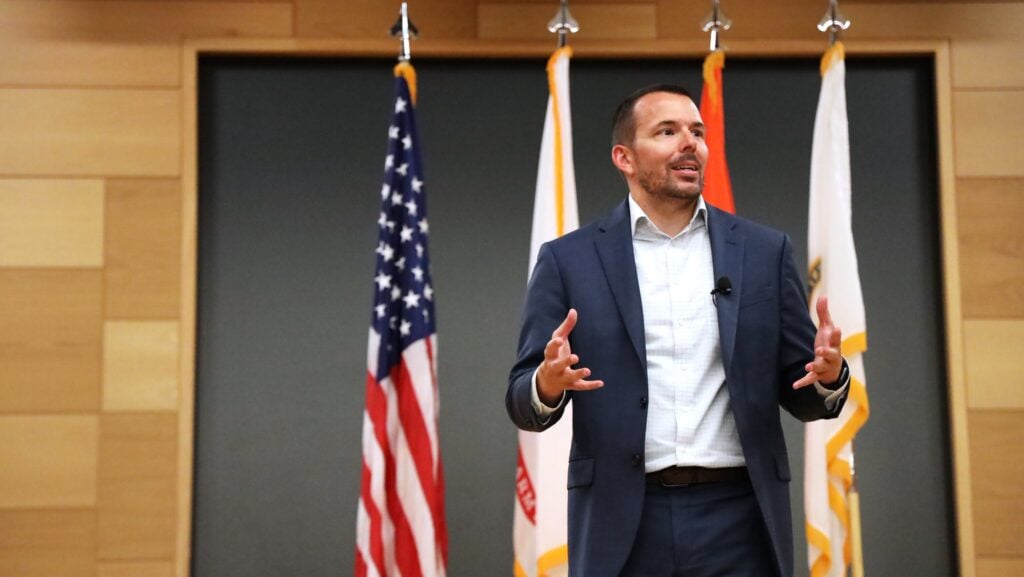
WASHINGTON — Later today, at a defense conference in Phoenix, Ariz., the Army’s Software Engineering Center (SEC), traditionally tasked with maintaining legacy software for the service, will unveil a new logo, a new business model, and a new name: the Army Software & Innovation Center (ASIC).
So what?
That might sound like yet another reshuffling of deck chairs on the bureaucratic Titanic. But, as the center’s director explained in an exclusive interview with Breaking Defense, it’s meant as a bold bid to reinvent the organization and keep it relevant, competitive, and above all funded in a time of sweeping change.
“It’s more than a rebrand,” said Garrett Shoemaker, executive director of the now-ASIC (part of the Communications-Electronics Command, CECOM), which he joined in 2001 fresh out of college. “My message to my workforce has been, this is a new organization, it’s a new name, it’s a new mission…to provide those new technologies, to provide innovation, and deliver modern software solutions to the Army.
“You mentioned funding,” he said. “It absolutely changes our resources to do that.”
RELATED: Pentagon rolls out major reforms of R&D, AI
The context is critical. As the Pentagon pushes AI, streamlined acquisition, and rapid adoption of the latest off-the-shelf commercial products, the Army is phasing out aging “legacy” software — along with the associated line items in the budget that paid “sustainment” organizations like SEC to keep that old code running. In fiscal year 2024, SEC received just under $500 million; in FY25, it got $511 million. But its projected funding for FY26 is just over $290 million, a whopping 43 percent reduction.

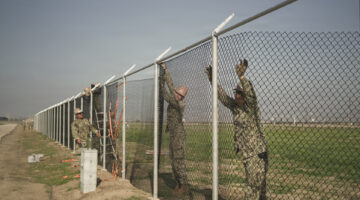
Why Bigger Fences Aren’t Enough in the Age of Drones
Traditional thinking about how to protect facilities must adapt to new threats such as drones or downstream attacks.
“Historically and even continuing today, the Army does directly fund us to do the software sustainment of fielded C5SIR capabilities, [but] that’s drawing down,” Garrett said. “All those systems divest over the next few years.”
That means the renamed organization will have to focus on a different source of funding: what it calls a “customer-funded ‘software as a service’ model.” Essentially, instead of relying on the Army to request funding to support specific software programs a year in advance — and on Congress to appropriate it in time— ASIC will pitch its services directly to Army programs and agencies.
When an Army organization needs new software, whether for its own internal use or as part of a weapons program it’s developing, it will have funding from Congress and a choice on how to use it, Garrett explained. They can hire a private-sector contractor to do the work, they can pay ASIC to do it, or they can do a mix of both.
The center already receives about a fifth of its funding this way, just under $23 million in FY25. That’s hardly insignificant but also hardly enough. So Garrett is focused on growing it.
The center already has a deal with the Army CIO and Army Cyber Command to build and run a “consolidated DevSecOps platform” for users across the service, for example. That’s essentially a software toolkit and supporting services to do software development the modern “agile” way. Instead of the traditional “waterfall” approach, where software developers, cyber security professionals, and the actual end users of the software (the “operators”) rarely interact, the Development-Security-Operations (DevSecOps) or “agile” model puts them all in close and constant contact, allowing rapid upgrades and patches in response to new user needs or cyber threats.
As the center evolves from SEC to ASIC, it’s shifting to a DevSecOps approach internally as well. Traditionally, the center was organized along the same lines as it was funded, with a dedicated team permanently assigned to each Army program it supported, focused on “sustaining” relatively static software rather than continually updating the code. The move to a more flexible business model requires a more flexible organization as well. That includes the ability to rapidly reassign software developers and other personnel to new projects as new customer needs arise, then re-reassign them when that work is done.
“As we’re doing agile software development, and we’re spinning up scrum teams, some of those requirements may last weeks, some may last month, some may last years,” Garrett said.
The permanent structure supporting these ad hoc teams will consist of four directorates, he explained: a central pool of software developers, another group of cyber/electronic warfare experts, a support branch to run the center’s IT infrastructure, and a front office for customer service — called “mission management” — to interact with the rest of the Army. But any given team serving a specific customer will draw personnel as needed from all ASIC’s directorates, Garrett said.
All these changes make the center operate more like a commercial business. But why would an Army organization needing new software go to ASIC instead of an actual private-sector software firm?
Because an Army organization knows Army needs, Garrett argued. He sees the reorganized center not as a competitor to industry but as a complement to it, standing with one foot in the software development world and the other in the Army, bridging the gap between private-sector innovators and government end users. Silicon Valley invents all sorts of great technology, he argued, but ASIC can help the Army adapt and adopt that technology to its highly specific purposes.
“I don’t see us necessarily competing with industry on this,” he said. “Our role is operationalizing the industry technology and industry innovation that the Army is investing in, not creating the new tech.”
What the center brings to the table, he argues, is its intimate knowledge of the Army’s unique needs. “As organic government civilians, we absolutely have that understanding of the environment, understanding of the domains, understanding of the tools and how the Army fights.”
So Garrett is confident that going through ASIC will often be more attractive to Army organizations than just going directly to a contractor. In fact, he said, the center’s own history shows it’s possible to move this work in-house.
“20 years ago, this organization was probably 80 percent contractors, 20 percent government [employees],” Garrett said. The small government cadre spent their time writing checks to contractors and overseeing them, while the contractors did the actual software work. Today, however, the numbers are near even: 864 government civilians and 1,030 contractors (plus four uniformed military personnel). What’s more, the center’s government personnel don’t just oversee software development, they actually do it.
“We completely flipped that script of how we used to do business in this organization,” Garrett said. Now he’s betting the center can get the rest of the Army to rely less on contractors as well — or at least enough of them to keep his 864 civilians on the payroll.
Updated 10:30 am on Jan. 21 to restore missing “&” to the name “Army Software & Innovation Center (ASIC).”
Breaking Defense Video