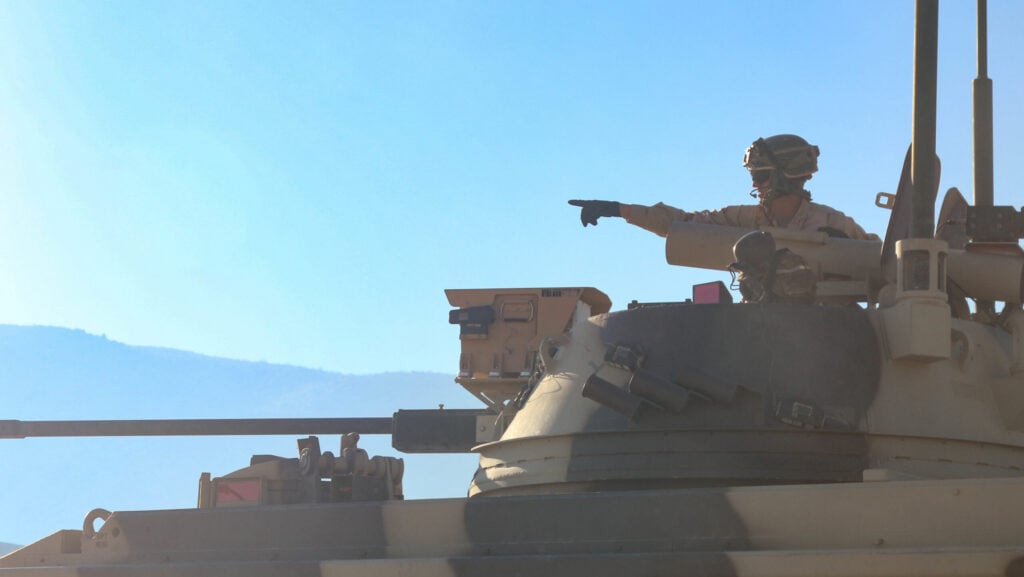
WASHINGTON — As high tech proliferates on battlefields from Iran to Ukraine, and the Pentagon wrangles with frontier AI firms, one unique Army unit has embraced the virtues of simplicity.
Drones, electronic warfare, and even artificial intelligence are all valuable tools, officers from the 11th Armored Cavalry Regiment told Breaking Defense. But the organizations, plans, and processes that wield those tools need to be as simple and robust as possible, they warned, or else it’ll all fall apart under the stress of combat.
“Tech, as it advances, has certainly been a boon,” said Capt. Jake Thomas, an infantryman by training, who’s now in charge of the regiment’s electronic and information warfare assets. But the danger, he told Breaking Defense, is overloading soldiers with more bells, whistles, and information than ordinary human minds can manage.
“One thing that we absolutely have to do,” said Thomas, “is taking those systems, those processes, and stripping them down.”
The 11th ACR has learned this lesson fighting eight to 10 simulated battles a year as the Opposing Force (OPFOR) at the National Training Center at Fort Irwin in California. In mock combat across 1,200 square miles of the Mojave Desert, the OPFOR has a reputation for routinely drubbing visiting brigades that outnumber it in tanks — but not in drones or high-powered jammers, where the unit has cobbled together an eclectic collection of non-standard tech to emulate the latest threats.
“Today … the battlefield is much deeper, much longer, much more lethal, and you have to respect that,” said Col. Kevin Black, the regimental commander, who previously worked on assistance to Ukraine. To replicate real-life threats, he told Breaking Defense, “we have to combine all of our technology, along with our operational approach, which … boils down to simple plans, violently executed, that retain agility.”
In fact, the colonel’s tactical bible for managing his cutting-edge equipment is an Army pamphlet printed in the ancient days of 1997. Called Decision Point Tactics, the slim volume preaches intense wargaming and rehearsal before an operation, so commanders and their subordinates can build a common playbook of tactical responses to likely situations — which they can then execute on their own initiative, without waiting for permission or detailed instructions.
If a subunit spots a target identified as a high priority by the wargames and rehearsals, for instance, Black explained, “they have the authority to launch the munition to destroy that [target], because we’ve already thought through that plan.”
The goal is to react quickly to new information, seize the initiative, and keep the enemy off balance, reacting to your moves instead of you reacting to his. As one passage from the pamphlet puts it, “if we’re going to dance, we want to lead.”
Centralize The Tech
At the same time that the OPFOR seeks to empower its junior officers, however, it is also careful not to overload them with complex technology.
“As much as we want to push capabilities down to the lowest level … when you push down capabilities, you often push down complexity and additional work,” said Capt. Joshua Ratta, who commands the OPFOR’s headquarters company.
The challenge isn’t just operating and maintaining all the different specialized systems, he said. It’s also interpreting all the different kinds of sensor data they provide — video, infrared, radio — and integrating those jigsaw puzzle pieces into a coherent picture of the battlefield, without either missing something vital in all the noise or counting the same enemy multiple times.
“What we don’t want to have happen is 10 sensors looking at one platoon on a battlefield, and that gets recorded as 10 platoons,” Ratta explained. “That integration is one of the most difficult tasks out here. … You’re collecting so much intelligence, [you] may not have the ability to process it all.”
So instead of spreading its drones and jammers across its tank and infantry battalions, for instance, the regiment has concentrated such high-tech assets — and the scarce technical personnel adept at using them — in centralized, specialist formations. Most notable is one called Centaur Squadron, whose precise configuration changes from one wargame to the next, but often encompasses everything from long-range surveillance/strike drones to traditional Humvee-mounted scouts.
“That’s some of our secret sauce,” Black said. “We have found that the centralization of those specialties — centralization of our UAS capability, our EW and our recon/strike capability — is much more effective, rather than having it parceled out.”
That concentration of assets and expertise allows Centaur to fight its own battle at long range, ahead of the main defensive line of tanks and foot troops, the colonel continued. Jamming, drone strikes, and long-range artillery — hitting targets found by the drones — all combine to disrupt approaching forces and grind them down before they ever see the regiment’s human troops, which gives those humans an advantage when contact is finally made. (This layered approach recalls the drone-swept kill zones on either side of the “zero line” in eastern Ukraine.)
Centralizing those high-tech systems and highly skilled technicians also makes it easier to swap in new technology as it becomes available, Black said. Because of its unique mission and limited budget, the OPFOR has learned to improvise, beg, and borrow all sorts of gear that replicate reported or potential threats. Much of it comes free of charge from government labs or private companies eager for feedback from real soldiers trying out their tech in field conditions.
“We’re not able to buy a lot of exquisite, expensive equipment, but we can use it for a rotation or two,” Black said. As a result, each regular brigade that visits the National Training Center for wargames (a “rotation”) faces a different threat from the one before. That emulates the “constantly evolving operational environment” of real-life battlefields, he said, where a new system may suddenly surge to prominence only to be quickly countered, at least until someone develops a countermeasure to the countermeasure.
“We’re not yet fully reaching Ukraine speeds” of adaptation, said Ratta. But for many sensors and unmanned systems, whose performance is largely driven by software, he said, “if you have someone who’s capable of coding and you have the processing power to do that new line of code, you can change the software in a matter of hours.”
In such a rapidly changing world, Black and his officers argued, it’s dangerous to depend on any one technology or build your organization around a particular wonder weapon, however impressive it may look today.
“That shelf life is much shorter,” said Ratta. “In five years, we could look like old men talking about the Model T.”