The next Chief of Staff of the Army — whether it be Gen. Christopher LaNeve, currently filling the role, or a new nominee — will be walking into two live-fire Pentagon debates that threaten to derail the service’s much-needed modernization efforts.
The first debate is a political dispute among administration officials, a spat that reportedly helped remove his predecessor. The new chief will need to figure out how to handle this quickly. But once that is settled, the new chief will have to turn his gaze to a bigger, broader problem, one sharpened by the war with Iran and reinforced by the grinding reality in Ukraine.
The Army, you see, is caught between the interpretation of what modern warfare means for the service. On one side are critics who see new technologies as redefining war in a way that the Army is no longer as needed. On the other is a quieter, more uncomfortable reality: The United States still cannot achieve durable outcomes in war without controlling terrain, populations, and political end states. As seen in both Ukraine and Iran, stand-off strikes shape conflicts — it does not finish them.
The next Army chief’s bigger challenge therefore is not operational. It is intellectual. He has to disarm the argument that his service is becoming irrelevant without pretending the Army as currently built is adequate. That requires a shift in tone as much as substance.
The easy response would be to defend the Army’s traditional role. That will fail. The critics are not wrong about what they are seeing: the battlefield is more transparent, movement is more dangerous, and exquisite systems are more vulnerable than ever. Wars are longer and more industrial than the Pentagon planned for.
Where the critics are wrong is in their conclusion. The next chief needs to say, clearly and repeatedly, that these trends do not eliminate land power. Instead, they make it more demanding.
Drones are not a substitute for ground forces; they are now a prerequisite for using them. Attrition is not an anomaly; it is the baseline condition of serious war. The United States does not have too much Army; It has an Army that has been neglected of modernization funding for the wars that exist today and that will exist for the next decade-plus.


Voyager is fortifying the U.S. Defense supply chain
Answering the Pentagon’s call to bolster defense industrial base.
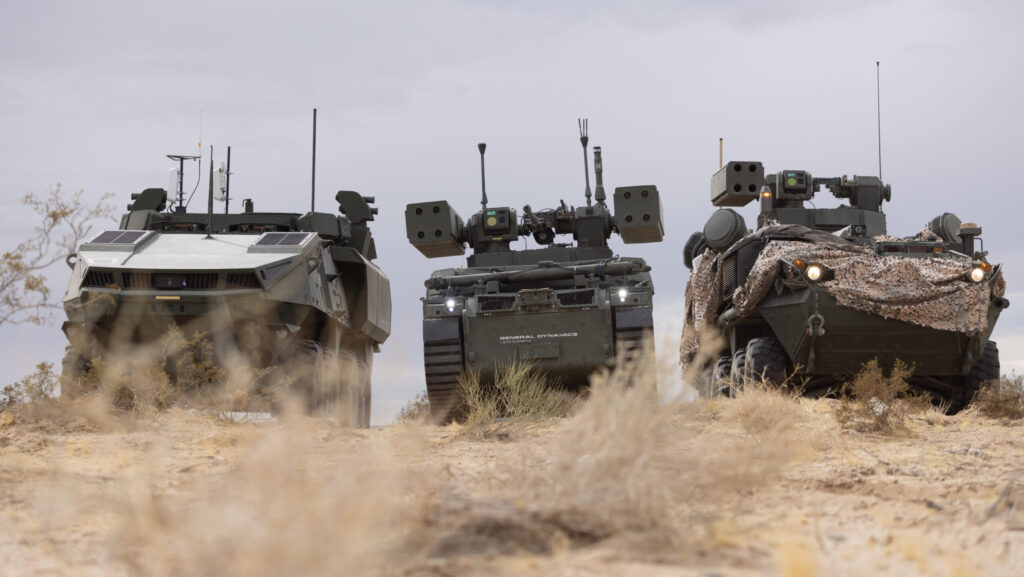
This framing matters, because it sets up the second, and harder task: turning argument into budget authority. The Pentagon is already moving billions of dollars into autonomy, artificial intelligence, and next-generation systems. The fight is not over whether that money exists. It is over where it goes. The FY27 request features tens of billions of dollars in flexible mandatory funding, including $54 billion for “drone dominance.” If those resources flow primarily to air and maritime applications, as has been the case with CCA and MC-25 funding increases, the United States will field a force that is more technologically advanced but less capable of achieving outcomes that the president wants.
The next Army chief has to make a different case: that the fastest way to make investments in autonomy is to embed them in Army formations at scale.
This is not a plea for a larger share of the budget in the abstract. It is a specific proposition to fund drones, autonomy, and sensors where they directly enable units that seize and hold ground; shift from boutique procurement to systems that can be produced, lost, and replaced in volume; and tie modernization dollars to formations experimenting in real time, not to programs optimized for distant futures.
In short, connect technology to the part of the force that actually decides wars.
There is a foundation to build on. The reforms that began under the previous Chief, Gen. Randy George, all point in the right direction. But since he left the job early, the reforms are both incomplete and, more importantly, under-resourced relative to their importance. The next chief inherits both the progress and the gap.
He also inherits a strategic environment that removes any remaining ambiguity. The war with Iran underscores a point the United States has repeatedly tried to sidestep: stand-off strike can impose costs, but it cannot impose outcomes. If the objective is anything beyond disruption, if it includes control, stability, or leverage, then land power is unavoidable.
The opportunity for the next Army chief is to use that constraint to his advantage. Rather than defending the Army as it was, he can redefine it as the platform that makes the Pentagon’s largest investments in technology actually matter. He can argue that autonomy without land power is incomplete, and that land power without autonomy is obsolete. That synthesis is the path to both relevance and resources.
But it requires discipline. The Army cannot ask for more money while protecting every legacy system and structure. It must continue making visible, credible trade-offs by cutting what does not scale, prioritizing what does, and demonstrating that additional resources will be translated into usable combat power, not absorbed into existing inefficiencies. In other words, the Army must prove it can spend differently before it is allowed to spend more. That is the job.
The next Chief of Staff will not be judged on whether he wins the argument in Washington. He will be judged on whether he changes it by showing that the Army is not the alternative to the Pentagon’s technological future, but how that future becomes decisive.
Because the lesson from Ukraine and Iran is not that land power is fading — it is that the United States has less margin for getting it wrong. The next Army chief is walking straight into that reality.
John G. Ferrari, a retired Army Maj. Gen., is a senior nonresident fellow at AEI. He previously served as a director of program analysis and evaluation for the service.