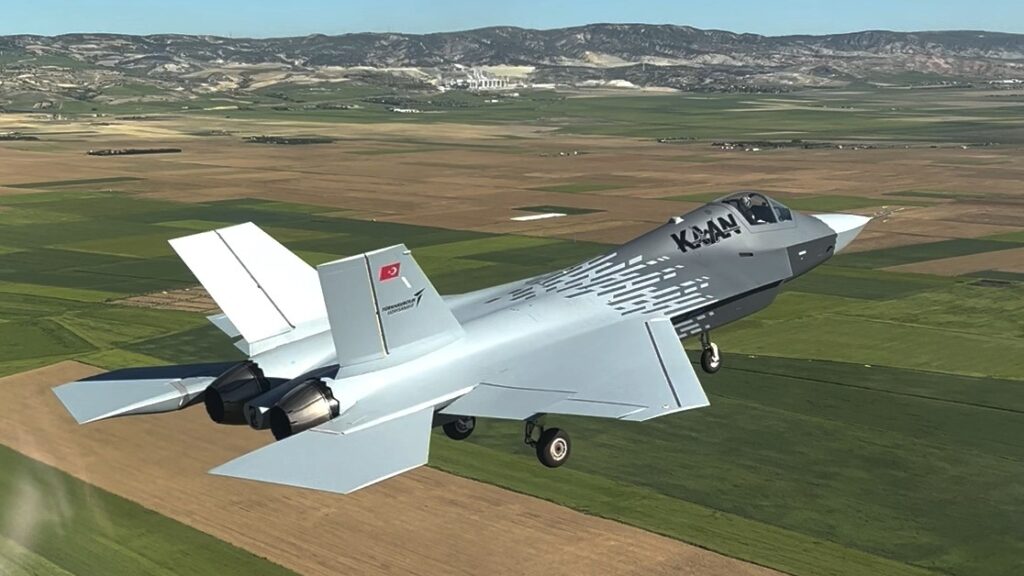
ISTANBUL — The Turkish air force has formally inked a deal to procure 20 fifth-generation KAAN fighter jets from Turkish Aerospace (TA), with plans for more in the future.
“The initial sale was made for the first batch of 20 Block 10 aircraft. This is the first order. Over time, we expect the numbers to increase,” TA CEO Mehmet Demiroglu told Breaking Defense today, following the official signing at the SAHA defense expo here on Wednesday.
The national deal is not the first contract for the Turkish fighter jets, coming a few months after Indonesia contracted 48 fighters last June.
The new contract was signed between TA and Turkey’s Defense Industries Secretariat, according to Turkey’s state-run Anadolu Agency.
“We are proud to develop the products listed here locally and nationally, and to deliver them to our heroic security forces,” Secretariat chief Haluk Gorgun said after the signing, referring to the KAAN and a number of other domestically developed defense products.
The KAAN is perhaps Turkey’s most high-profile defense program, a prototype of which first took to the skies in February 2024. In addition to Indonesia, TA is courting a potential export deal with Saudi Arabia.
Beyond the signing for the jets, Turkish industry took the opportunity at SAHA to show off various components that will go into it, including domestically made engines. The current KAAN prototypes and test articles are powered by GE F110 engines, but TA hopes to use Turkish-made TF35000 Turbofan engines produced by TEI by 2032.
At SAHA, TEI was displaying its concept of the TF35000 engine, and company officials said it is still in the design phase. Prototype production is expected to start in 2027. (The question of domestically made engines has come to the fore since Turkish officials reportedly previously said US lawmakers were holding up transfer of additional US-made engines.)
Sascha Bruchmann, research fellow for defence and military analysis at IISS, told Breaking Defense today that it appeared Turkish defense firms had gone out of their way at SAHA to put to rest any concerns about the KAAN’s production.
“It seems that second, third and sometimes further layers of suppliers are present and ready to show the parts, products and materials used, sometimes even insights into the manufacturing process,” he said. “This is a good indication how far the Turkish industry has come in the last decade, even though some doubts will always remain until the [production] jet flies.”
Beyond the KAAN, TA showed at SAHA a model of its ANKA 3 unmanned combat aerial vehicle, its Gokbey helicopter and a number of small models for the aircraft it develops. The company this week inked an agreement with General Electric to procure GE Aerospace F404 engines to power its Hurjet trainer and light attack aircraft.
For both the KAAN and the Hurjet, Turkey hopes to introduce unmanned Collaborative Combat Aircraft, or drone wingmen, like those pursued by the US.
“As for the manned-unmanned teaming concept, work is ongoing. For KAAN, testing has not started yet. For HÜRJET, only the initial tests have begun. We will gradually intensify these tests over time,” Demiroglu told Breaking Defense.