
The United States has entered an era of high-technology warfare against advanced adversaries, where range, persistence, payload, survivability, and scale are non-negotiable.
Winning that fight demands large, capable Uncrewed Aircraft Systems (UAS) that can fly from friendly skies into the teeth of enemy air defenses — and do so affordably, without risking U.S. aircrews.
General Atomics Aeronautical Systems, Inc. (GA-ASI), the company that introduced the world to uncrewed warfare, has overhauled its lineup to meet that challenge head-on.
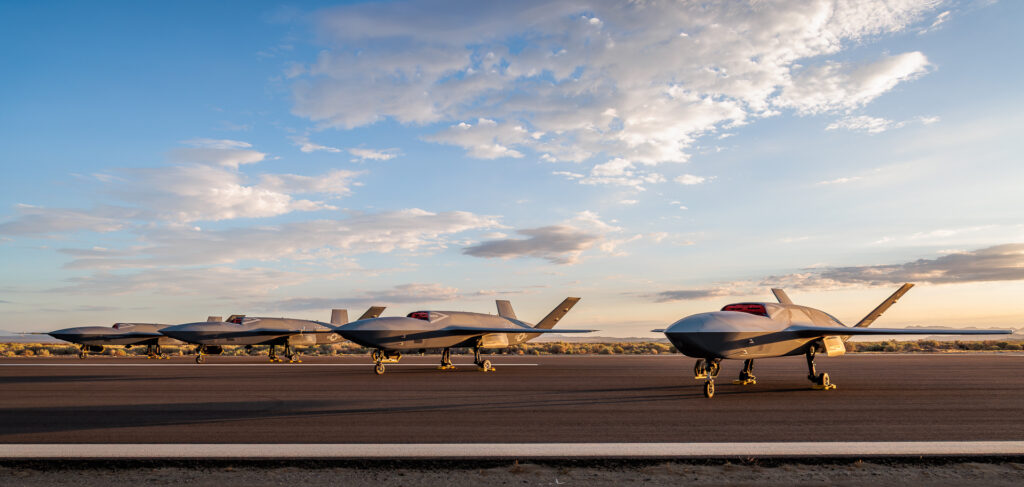
Enhancements to its MQ-9B SkyGuardian and SeaGuardian and the short takeoff and landing Mojave STOL are now joined by two new systems: the FQ-42A Collaborative Combat Aircraft (CCA), a highly advanced uncrewed air-to-air fighter jet, and the Wildfire Massed Modular Aircraft (MMA), a scalable theater-range platform designed for massed effects.
“We’ve never been a company that rested on its laurels,” said GA-ASI President David Alexander. “The conversation around uncrewed systems has changed, and frankly, it should. The battlefield has evolved, threats have evolved, and so have we.
“We’re keeping ahead of the game, and, in the case of our FQ-42A and Wildfire aircraft, we’ve designed them from the start to overmatch threats today and into the future.”
The company’s ever-expanding portfolio is tailored to the realities of high-end conflict, ensuring that the unique advantages of large uncrewed aircraft remain central to U.S. airpower.
“Can’t Change Physics”
Recent losses in contested environments are sometimes cited as proof that it is time to “move on” from large UAS like the MQ-9 series of aircraft. Alexander argues the opposite — those same campaigns show the value of traditional UAS. They must evolve, not disappear.
“Yes, we’ve seen losses in contested environments,” he said. “We’ve also seen Pentagon leaders call it the ‘MVP’ of the campaign. That tells you something important. When a system consistently delivers decisive effects, you modernize it and build on it. And I believe that’s where the Department of War is headed.”
Alexander said Reaper was purpose-built to provide persistent long-endurance surveillance and precision strike. It delivers these capabilities at scale and at a fraction of the cost of manned platforms that put pilots’ lives at risk.
Despite the hype for small drones, it’s clear that quadcopters, gliders, and short-range rockets “can’t change physics,” Alexander said.
“Long-range, high-payload, high-endurance missions require large, hefty airframes with significant wingspan, fuel capacity, and payload volume,” he went on. “If we are serious about surveilling and targeting across wide ocean areas, tracking mobile missile units, and holding adversary assets at risk from standoff distances, large UAS — modernized for contested environments — are the decisive advantage.”
Alexander said changing battlefield conditions have continually driven the company to advance.
“When you look at the threats we’re seeing in Ukraine and Iran, we already knew our aircraft would need to evolve, and we’ve been pushing ahead there for years now,” he said. “But it seems like every morning the news puts fresh urgency behind delivering that vital combat capability while finding ways to strip out some of what drives up costs.”
MQ-9B: The Flagship for Multi-Mission ISR and Strike
MQ-9B SkyGuardian and SeaGuardian remain GA-ASI’s flagship multi-mission ISR platforms, now upgraded for long-range contested operations:
- Long-range weapons: New pylons with 30-inch lug spacing accommodate larger standoff weapons such as the Long Range Anti-Ship Missile and the Joint Strike Missile. Combined with MQ-9B’s ISR suite, these weapons turn the aircraft into a long-range strike and maritime interdiction platform able to engage far outside adversary standoff ranges.
- Resilient communications via pLEO: Integration with proliferated low Earth orbit satellite constellations provides low-latency, high-bandwidth, jam-resistant connectivity. In combination with DoD-standard cybersecurity, MQ-9B can maintain secure command-and-control and sensor links from pole to pole in the face of electronic attack.
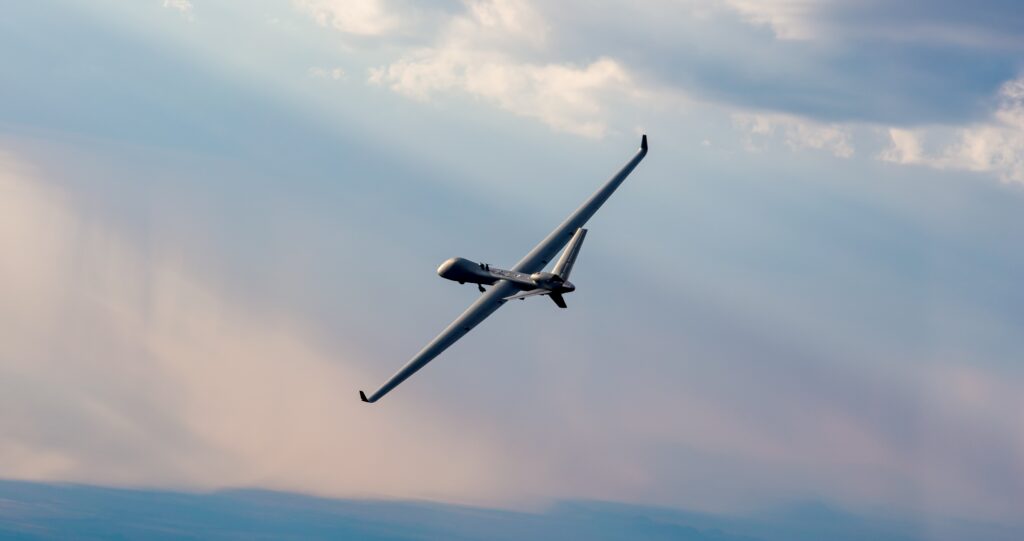
For Air Force and joint planners, MQ-9B has moved beyond counterinsurgency. It is now a standoff sensor-shooter that slots into a resilient, distributed kill chain.
Mojave STOL: Expeditionary Airpower Without Fixed Runways
Building on GA-ASI’s other pioneering aircraft, Mojave STOL is designed for modern contested theaters:
- Short Takeoff and Landing (STOL): Mojave STOL operates from austere, unprepared locations — open fields, dry riverbeds, even the decks of amphibious assault ships. This advantage generates uncrewed combat airpower from places adversaries cannot easily target.
- Advanced sensor integration: Using human-portable, laptop-based ground control, Mojave STOL carries cutting-edge radar, electro-optical/infrared, and signals intelligence payloads. It provides a comprehensive operational picture to enable precise targeting and situational awareness for dispersed forces.
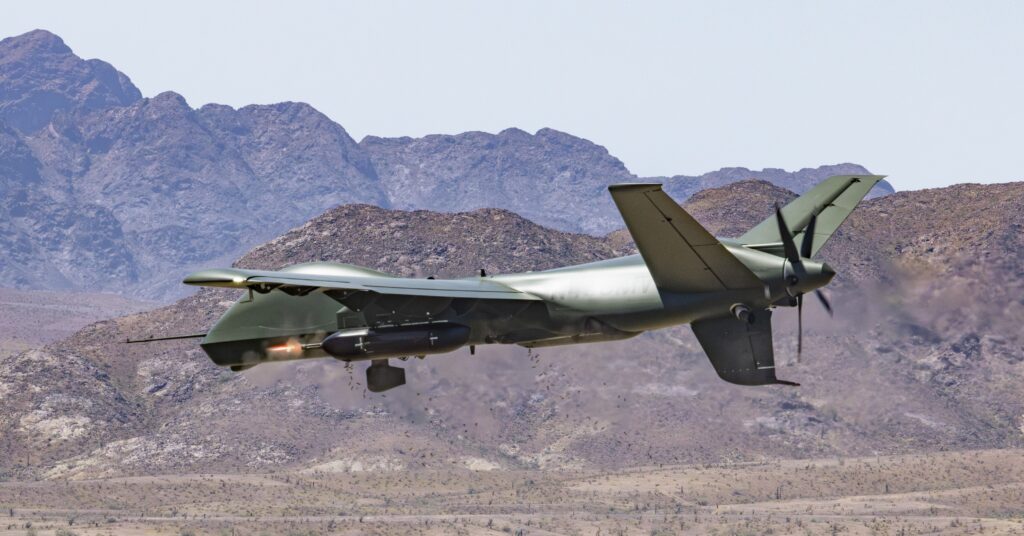
In a combat environment where large runways are vulnerable, Mojave STOL supports airfields without airports and delivers persistent ISR and strike sourced from improvised launch and recovery sites.
Gambit and FQ-42A: Collaborative Combat Aircraft for the Peer Fight
The Gambit Series is GA-ASI’s family of autonomous jets for high-end contested operations, built around a common core that comprises roughly 70 percent of key components. This commonality lowers cost and simplifies production, logistics, and sustainment.
Recently selected by the U.S. Air Force for its CCA program, FQ-42A is the Air Force’s first uncrewed fighter and a member of the Gambit family. Across six missionized variants, Gambit aircraft can support:
- Long-endurance ISR in contested airspace
- Air-to-air combat and escort missions
- Adversary training
- Stealth reconnaissance
- Carrier-based operations
- Penetrating air-to-ground missions and suppression of enemy air defenses
All Gambit aircraft are designed for human-machine teaming with advanced fighters and other UAS, extending sensors, adding weapons capacity, and imposing dilemmas on adversary defenses — precisely the type of effects envisioned in modern Air Force planning.
Wildfire: Theater-Range Attritable Mass
Wildfire is GA-ASI’s theater-range, high-production UAS designed to deliver affordable combat mass in high-threat environments:
- Range and payload: Wildfire can carry two Long Range Anti-Ship Missiles or four Joint Strike Missiles for meaningful combat distances and has a ferry range that exceeds 8,000 nautical miles, allowing the aircraft to deliver weapons, sensors, electronic warfare, or communications relay deep in contested battlespace.
- Modular design: Open interfaces and hard points that enable modularity support the rapid swapping of payloads so that commanders can adjust quickly to changing missions and threats.
- Rapid production: Leveraging more than 5 million square feet of GA-ASI manufacturing capacity and advanced processes, Wildfire is designed to be built and fielded in numbers sufficient to absorb attrition while maintaining persistent pressure across the theater.
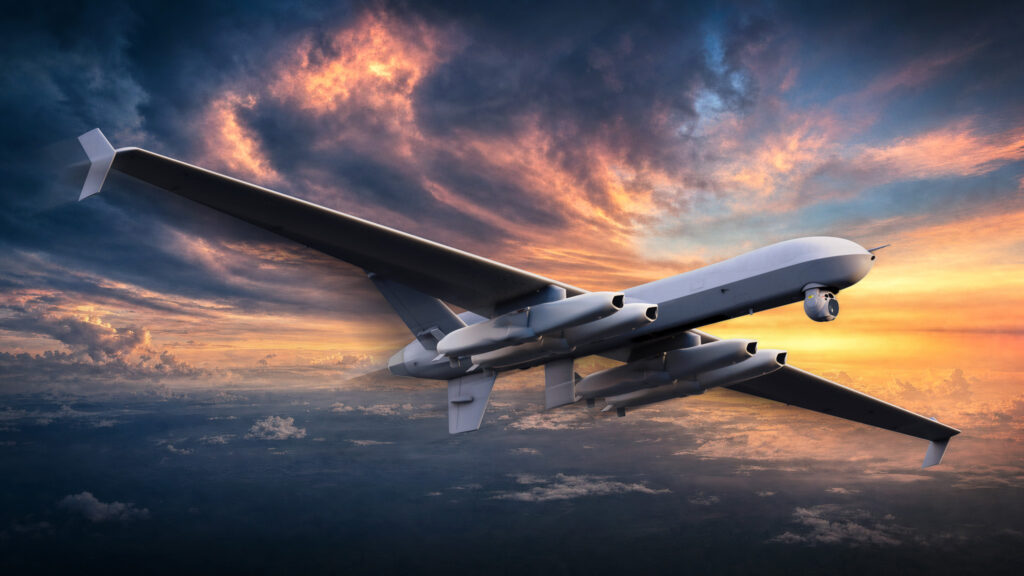
Wildfire and Gambit together deliver what defense leaders call “attritable mass” — large numbers of capable systems whose loss does not equate to strategic setback because they are affordable, uncrewed, and replaceable.
Taken as a whole, Alexander said, the aircraft portfolio shows that GA-ASI is serious about retaining its position as the leading provider of UAS to the United States and its allies.
“We’ve got nearly 10 million flight hours under our belts, and the vast majority of those were in combat operations,” Alexander said. “We know, to our core, what it takes to deliver relevant systems. We have the people, infrastructure, and capacity in place, today, to do it at scale. GA-ASI is ready to answer the call.”