
Amazon, OneWeb slowly stalk SpaceX for piece of Pentagon SATCOM pie
Amazon recently launched the first two prototypes for its Project Kuiper; OneWeb now has all 634 satellites it needs to provide global internet access.

Theresa Hitchens is the Senior reporter, Space at Breaking Defense. The former Defense News editor was a senior research associate at the University of Maryland’s Center for International and Security Studies at Maryland (CISSM). Before that, she spent six years in Geneva, Switzerland as director of the United Nations Institute for Disarmament Research (UNIDIR).
A sci-fi geek, voracious reader, enthusiastic cook, dabbler in poetry, Theresa is also the proud mom of a wonderful young man by the name of Nicholas.
Amazon recently launched the first two prototypes for its Project Kuiper; OneWeb now has all 634 satellites it needs to provide global internet access.

The lawsuit is the latest in a decade-spanning battle between Ligado and opponents in government.


Why edge and endpoint security can’t be an afterthought.

One of the questions the Army's ISR Task Force is grappling with regard to sensing is how best to "leverage the vast proliferation of commercial satellite providers," said task force director Andrew Evans.

While the NRO has never revealed exactly how many satellites it operates, historically its imaging and signals intelligence constellations have been made up of handfuls of very large birds.
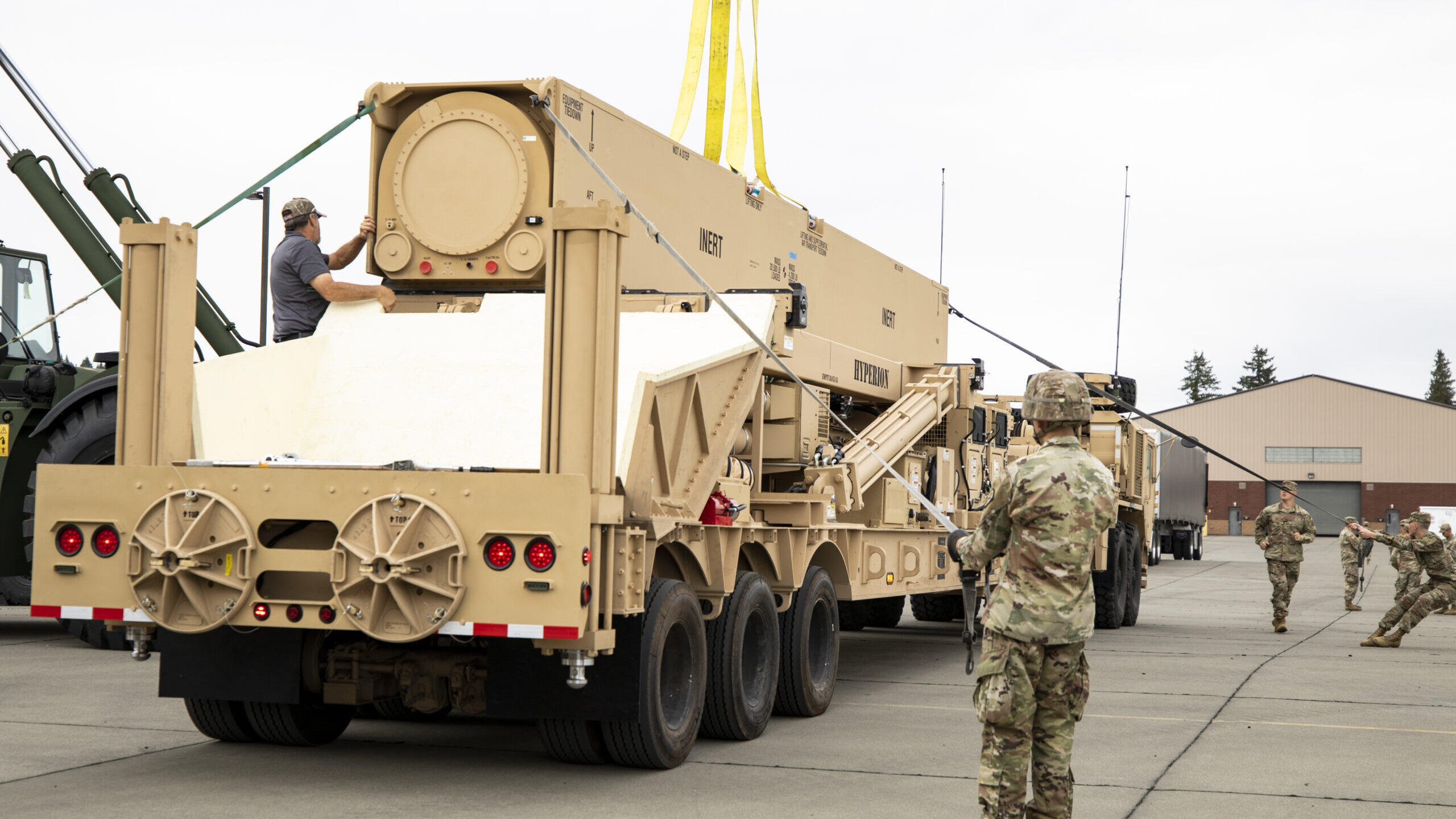
Despite the current supply chain obstacles, the Army is confident it can fully field the first Long Range Hypersonic Weapon (LRHW) units by the end of this calendar year, said Chris Mills of the service's Rapid Capabilities and Critical Technologies Office.

"While many of us may typically think of maritime operations as maybe more of the domain of the Navy or the Marine Corps, it's really the Army that is charged with moving our troops or equipment or supplies across the land-water interface in order to enable early theater entry as well as support and sustain DoD operations," said senior researcher Kate Brodie.

The network transport architecture for NGC2 could be a hybrid approach that combines high assurance communications with 5G, WiFi, and multi-orbit satellites.

The Army and Lockheed Martin already have seen early interest among US allies and partners in the new Sentinel A4 radar.

"Right now, the position of my combatant commander is: 'I wanna move, I wanna refuel, I wanna have life-extension and I wanna live'," SpRCO Director Kelly Hammett told Breaking Defense.

Interested companies have until Dec. 15 to respond to the service's dual requests for proposals: one for the critical, high-dollar NSSL Phase 3 Lane 2 launches; and the other for Lane 1 small launches.

Comtech President and CEO Ken Peterman told Breaking Defense the contract for the Army's Enterprise Digital Intermediate Frequency Multi-Carrier (EDIM) modem paves the way toward helping the Space Force in its struggle to figure out how to integrate ground systems for the myriad military and commercial SATCOM networks used by US forces around the world so as to ensure 24/7 access to needed communications bandwidth.

The GPS network continues to prove its unmatched reliability, and it’s only getting stronger.

The contract, announced by the company today, will support Space Systems Command's Program Executive Office for Space Sensing, which is responsible for the service's missile warning, weather monitoring and "persistent tactical surveillance" programs.

The Space Force sees nuclear fission reactors as a solution to replace solar panels for operations in the darkness of deep space.

"It will provide commercial SATCOM subscription services, which include SATCOM coverage in different locations, terminals, bandwidth, training if required by the unit and help desk services," Paul Mehney, public communications director for Army PEO C3T, told Breaking Defense.

Amid the political clash and a lawmaker's call for yet another investigation, Air Force Secretary Frank Kendall revealed that he and SPACECOM leader Gen. Jim Dickinson also disagreed over where the new HQ should be.