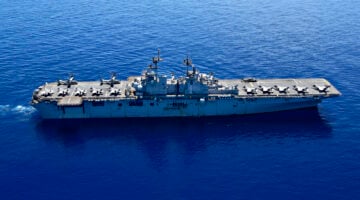
Navy, Marine Corps back longer amphib readiness cycles, request more ships
The Navy currently utilizes a 36-month Optimized Fleet Response Plan (OFRP), but leaders want to stretch it to 56 months.
The Navy currently utilizes a 36-month Optimized Fleet Response Plan (OFRP), but leaders want to stretch it to 56 months.

Congress should not shoot the messenger, but help the Navy and Marine Corps explain why 31 amphibs is the right number, CSIS's Mark Cancian argues in this op-ed.


Answering the Pentagon’s call to bolster defense industrial base.

Concerns over a new Okinawa airfield, and how to get Marines across vast swaths of ocean, are complicating American plans to spread forces across the Pacific.

The Navy has created a new fleet, and is sending it straight into the Baltic Sea to test new ways of doing business.

The pivot to the Pacific started more than a century ago. The United States first became a Pacific power in 1898, the year the US first annexed Hawaii and then gained Guam and the Philippines (as well as Puerto Rico) from Spain after a “short, victorious war.” The United States is at a turning point […]
After repeated delays, an industry team led by Textron Inc. has won a $212.7 million contract for the next-generation hovercraft transport to carry Marine forces from ship to shore, the Navy announced at 5:01 today. The blandly named “Ship to Shore Connector” (SSC) will replace the aging Landing Craft Air Cushion (LCAC), also built by […]

From emerging data networks to missile tracking and cyber resilience, Breaking Defense’s latest eBook brings together essential reporting on the evolving role of satellites in national security.
Libyan rebels, Somali pirates, Osprey tiltrotors, and a long, long time at sea: The future of the Marine Corps post-Afghanistan can be seen in what you might call “Yoda and Bart’s Great Adventure,” an extraordinary ocean journey that began a year ago Friday. This Yoda and Bart aren’t fictional characters, but the radio call signs […]