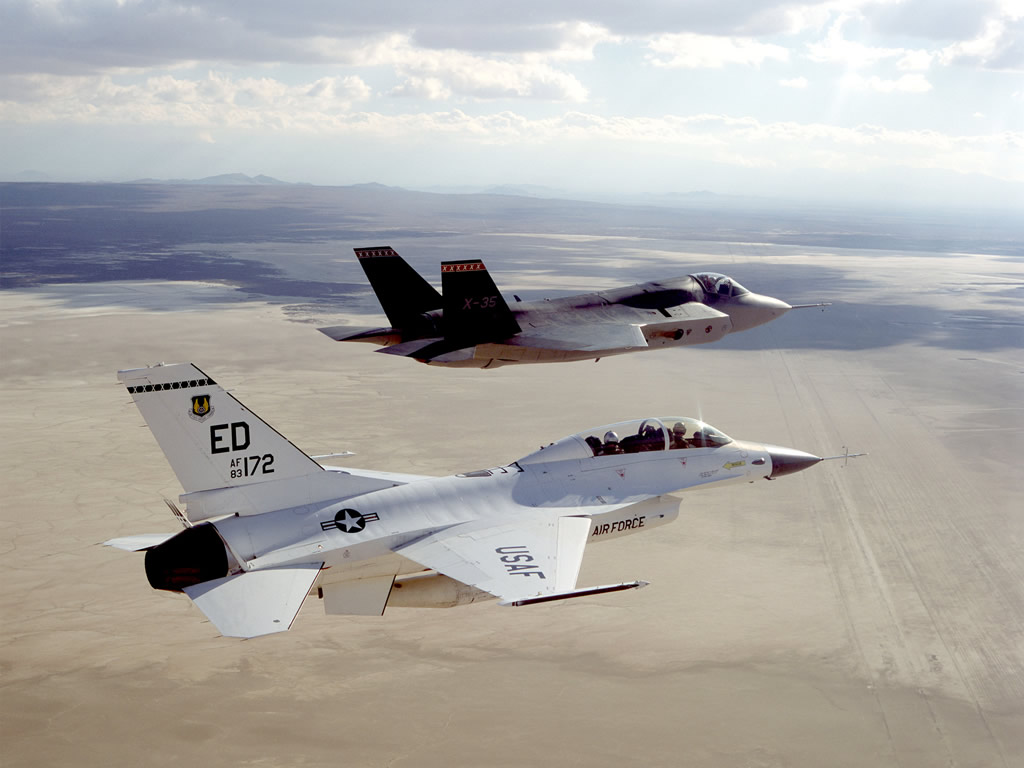
F-35 and F-16

When the story broke about the Joint Strike Fighter’s shortcomings as a dogfighter, the reaction among JSF advocates was swift and predictable. Most objected that the F-35’s poor performance is perfectly acceptable and even expected because that jet was never supposed to do air-to-air combat anyway. That claim does not hold up well to scrutiny and rather begs the question of why the Air Force staged the mock air battle between an F-35 and an F-16 in the first place. Probably because, as the Chief of Staff of the Air Force General Mark Welsh explained in December of 2013, “You have to have the F-35 to augment the F-22 to do the air superiority fight.” In other words, the USAF needs the F-35 to be a dogfighter.

Other defenders explained that the scenario in question was just one test and the leaked report was taken out of context by people who don’t really understand these things, so everyone should hold off on rushing to judgment about the plane’s worth. Since the JSF development contract was signed in 1996 and we’re just now putting it through Basic Fighter Maneuver tests (with full-rate production not planned until 2020), I’d say nobody is rushing to anything on that particular aircraft. But speaking as someone with experience and expertise in testing military gear, I can confirm that it is possible for a single test to provide meaningful, definitive performance data. I suspect the F-35 supporters would have agreed with that perspective if it had won the dogfight.

But a different line of defense caught my eye, one that is simultaneously more relevant, more convincing, more important, and more damning for the JSF. In a piece published at FighterSweep that dismisses Axe’s report as “garbage,” C. W. Lemoine points out that the real reason the F-35 lost the dogfight has less to do with technological shortcomings and more to do with pilot experience. Lemoine would know – he’s flown both the F-16 and the F/A-18 – and he explains:

“a guy with maybe 100 hours in the F-35 versus a guy with 1,500+ Viper hours? I’ve seen thousand-hour F-16 guys in two-bag D-models beat up on brand new wingmen in clean, single-seat jets. It happens. It’s the reality of the amount of experience in your given cockpit.

“Let’s see how it [the F-35] does when guys who are proficient in developed tactics do [sic] against guys with similar amounts experience–the realm of the bros in the operational test or Weapons School environment.”


Sexist word choice and speculation about specific flight hours aside, the author brings up an important point. The critical factor in determining combat performance is “the amount of experience in your given cockpit.” While Lemoine is arguing that we should withhold judgment until F-35 pilots become more proficient, I see the lack of proficiency itself as an important data point. This is an area where the F-35 comes up profoundly short, not just now but for the foreseeable future.

Developing effective tactics and producing “guys” who are know how to employ them requires flight hours – lots of flight hours. However, the F-35 community faces several significant barriers that will prevent pilots from gaining the experience necessary to create, validate, and disseminate effective tactics for any type of combat mission, dogfighting or otherwise.

For starters, the ever-growing price tag and the constant developmental delays means the Pentagon is buying fewer jets and receiving them later than planned. It’s pretty hard to train pilots if the jets aren’t available in sufficient time and quantity. On top of that is the F-35’s high cost per flight hour, which can severely limit cockpit time for training flights, particularly in eras of tight budgets. These factors directly translate to fewer opportunities for pilots to actually fly the thing, and as Lemoine explains, pilots with fewer flight hours tend to get beaten by pilots with more.

Then there is the issue of complexity, which is my area of expertise. Complex aircraft are harder to learn, harder to test, and harder to maintain than simpler alternatives, and the F-35 is undeniably the most complex aircraft ever developed. For example, it runs 8.3 million lines of code, four times more than the F-22. The difficulty associated with managing all that complexity drives up the cost and slows down the pace of development and testing, which reduces flight hours – again.

From a purely technical perspective, complexity reduces reliability on multiple fronts, such as increasing the number of possible failure modes and increasing the number of potential sources of any given failure. This means more things can go wrong, and when they do go wrong, it will take longer to find and fix the problems. Complexity also drives up maintenance costs, and in times of reduced budgets some maintenance will get delayed which further reduces aircraft availability. The bottom line: complexity equals less time in the cockpit.

In the immortal words of the late Col. John Boyd, machines don’t fight wars. People do. This is the real heart of the story. Let’s be clear: an F-16 did not beat an F-35 in a dogfight. Instead, an experienced pilot in an F-16 beat a less experienced pilot in an F-35. The only way to prevent such outcomes in the future is to produce experienced F-35 pilots who can create and master new tactics, but the current trajectory makes this tremendously difficult.

So forget the question of whether the F-35 should expect to engage in close-in aerial combat or whether this specific test report should carry any weight. If the Joint Strike Fighter is ever going to be good at anything, dogfighting or otherwise, it will require a cadre of professionals who are “proficient in developed tactics.” That means the pilots need experience in the cockpit, but given the enormous costs, continual delays and tremendous complexity involved, experienced pilots is one thing the F-35 isn’t going to have any time soon.

Dan Ward, a retired Air Force lieutenant colonel. holds three engineering degrees and earned the USAF Master Acquisition Badge as well as top-level certifications in Program Management and Systems Engineering. He is the author of The Simplicity Cycle and FIRE: How Fast, Inexpensive, Restrained, and Elegant Methods Ignite Innovation. And the White House thinks Dan has some pretty hot ideas about acquisition.

Comments

  • Ztev Konrad

    Experience is fine, maneuverability is better ! isnt that what Mae West used to say ?

  • Christopher Gamboni

    Maybe we should take some lessons from the defeat of the Spanish Armada. Spain’s main tactic was for her ships to get in close and grapple with the English, getting her troops to board the English ships. The English had longer range cannons that allowed them to fight from greater distances thus avoiding the danger of boarding. Of course this was not the only reason for Spain’s defeat – bad weather and luck were major factors but its something to think about. Times change. Just maybe the dog fight may no longer have the importance it once had. Yes, we remember the whole Vietnam thing when un-gunned F4s had bad times but that was more than forty years ago.

    • Ctrot

      Exactly. The Vietnam argument would only apply if we were still flying F-4D’s armed with AIM-7D / AIM-9D. Comparing 1960’s AAM’s to modern AAM’s is like comparing a transistor radio to an iPhone.

      • SMSgt Mac

        And just as importantly, Look-Down Shoot-Down radars. It was a top requirement for the F-15 for just that reason. People who use the ‘missiles didn’t work in Vietnam’ story usually fail to also mention that when attempts to initiate a gun attack are factored in to success rates, the gun was no more effective than the missiles. IMHO, the gun nowadays (for A2A) is a JIC weapon to keep the enemy from trying to get inside your missile engagement zone.

  • NeilMarshall

    It’s a well-argued piece, but it’s still defending the indefensible – this aircraft is a dog.

    • SMSgt Mac

      Care to tell us why the ‘aircraft is a dog’ without feeding us mindless ‘copy-pasta’ (that’s no typo) or linking to other documents you don’t really grasp either? I’ve grown tired of waiting for you to do it on your own, As I’m certain I’m not alone in that regard, I thought I’d ask.

      • Ken N

        Numerous CRS and DOT&E reports. They’re not that hard to find…

        • SMSgt Mac

          Heh. Those are exactly the kinds of documents he normally copy-pastes excerpts from that I am talking about.
          Here, have a GAO report. http://elementsofpower.blogspot.com/2014/10/hello-gao-about-that-f-35-report.html . Its the 2014 F-35 hit piece. I regret not doing the same to the 2015, but may do so soon just to be caught up before the next cr*ptastic edition.
          CRS reports are the odd ones out in the mix BTW. Some good stuff sometimes, but did you ever notice how many references are to media outlet sources? talk about ‘phoning it in’.
          Referring to these reports should usually be labeled “fallacious appeal to authority”.

          • NeilMarshall

            Oh dear…..let’s not allow facts to get in the way of blind loyalty, or worse – a complete inability to stay with the plot. When even the US departments and agencies charged with oversight of this disastrous program point out the endless deficiencies with the F-35, and the confirmation that the JPO has been outrageously cooking the numbers, is your ranting because you think that it’s all some kind of Commie conspiracy, SMSgt??

          • Uniform223

            Or how about the job of the GAO and DOT&E is to find everything wrong with what ever system or program. They can look at a project as simple as selecting the next type styrofoam cups to be used in the Pentagon’s cafeteria and STILL find something wrong with it.

          • Jonjon

            Sorry but when we are talking over a trillion dollars I hope they are picky as hell when it comes to the F-35.

          • SMSgt Mac

            Why no (silly little man!. Not a conspiracy per se. That would require some secretiveness on someone’s part vs. overt collusion that most media simply doesn’t bring up (nudge nudge wink wink). Commies are involved somewhere I’m sure, but among the Loyal Babblers, Pawns, Fellow Travelers, and the Old Guard Losers of the ‘Military Reform Machine’, they would be found in the cooperative Fellow Traveler networks. http://elementsofpower.blogspot.com/2015/01/loyal-babblers-pawns-fellow-travelers.html.
            So one must be constantly vigilant against any of the actors, even the ‘Pawns’. For they frequently use rhetorical misdirection, such as calling assertions ‘facts’, labeling established accounting methods that provide numbers that don’t support their memes ‘cooking the books’, and criticisms that shine a spotlight on their inanity as ‘rants’. Find your seat now…

          • NeilMarshall

            You do have your problems….

    • Uniform223

      What kind of dog? If the F-16 is like that little beagle that runs around all day and everyone loves, the F-35 is that misunderstood German shepherd that no one really bothered to train and keeps shitting on the patio.

  • Kenny Everett

    How is it that the F-35 is promoted as a ‘package’ with the F-22 to be effective? The US Navy and USMC will most likely be operating without F-22’s and the partner nations like us (Australia) are solely relying on this as its only fighter. Even in the US AF area of ops the very limited numbers of F-22’s simply will not stretch that far in a real conflict. I want to believe in the JSF because the future of our RAAF is reliant upon it…but even my belief in Santa and the Easter bunny came to an end.

    • Jeffery Surratt

      We have not have a real conflict since Vietnam and I think we will not have any in the future. The F-35 is just one more purchase to keep the MIC awash in money, period.

      • Fabius

        Odd, then, that all defense corporations combined have a much smaller share of the economy than they did during Eisenhower’s presidency.

        • Jeffery Surratt

          But, it is a bigger economy than it was in the 1950s.

          • Fabius

            Yes we do, but that means that all the other non-defense companies should hypothetically have a lot more leverage to influence the government. Apple, Coca-Cola, and Walmart have a much greater chance at capturing the government than LM.

          • Uniform223

            OH NO!!! COCA-COLA CHANGED THEIR FORMULA AGAIN! If we don’t let them have a seat in congress our children will never enjoy Coca-cola classic.

          • Fabius

            “New Coke.” Another failed crony-capitalist boondoggle.

      • Uniform223

        Yet Apple has more gross profit than Lockheed. DAMN EVIL SMART PHONE INDUSTRIAL COMPLEX!!

        • Jeffery Surratt

          That is because LM is good at concealing gross profit in overcharges. I could care less what the phone industry makes, it is not funded by wasted tax dollars on an A/C we do not need.

          • Uniform223

            ah isn’t that cute. a biased mindset backed with unsubstantiated claims. what about other companies that have defense contracts like Boeing or BAE. What about Colt that which was recently filing for bankruptcy. Surely all these companies have concealed gross profits in overcharges too. i’ll tell you what when you actually make a comment that looks like you didn’t get by reaching around and digging deep, then maybe i can take you seriously.

          • Jeffery Surratt

            I sure cannot take you seriously, when you use language of a 6th grader to try and make a point that has no real basis in tact, just attack, attack attack. Not much of value in anything you say.

          • Uniform223
          • RedStatePatriot

            Pretty obvious you have never worked on a military contract for a big company like LM. I can assure you every penny is charged to a proper government code and well monitored. LM does not charge one penny more then congress tells them to.

            Hell, I remember having a requirement that even when I was traveling I had to have a written number on a piece of paper of the government charge code I was using in my pocket at all times.

            Companies like GE or Lockheed “ripping” off the government is a myth… grow up.

          • Jeffery Surratt

            Keep drinking the Kool-Aid! A friend of mine who drove big rigs in the 1970s delivering things to Long Beach, CA harbor for shipment to Vietnam told me he made double and the company made triple because it was a government shipment. I call that a rip-off. You cannot BS me there are cost over runs all the time when dealing with the MIC.

          • RedStatePatriot

            Well with all due respect to your friend, who I am sure would never exaggerate, I hardly call a anecdotal story from one source over 40 years ago evidence of anything. But I have worked my entire career on military contracts and I know exactly how they are charged. So if anyone is drinking anything, i am guessing its you,

          • Jeffery Surratt

            I spent 20 years in the USAF and saw many things in base supply that were 5 to 10 times the cost of the same things at Office Depot or Home Depot. Also, working on F-15 Avionics, I saw circut boards with prices of $11,000, that you could replace all the circuits for $500. So, that real world experience showed me the gmint always over pays.

      • Uniform223

        “We have not have a real conflict since Vietnam and I think we will not have any in the future.”

        Are seriously F-ing you kidding me?! What rock have you been living under or cave have you been hiding in!? You must be a special breed of asshole to think that recently the US hasn’t been in a real conflict in the past decade. If you honestly believe that then you are douche fuck.

        • Jeffery Surratt

          Maybe, I should have said we have only been in fabricated conflicts since Vietnam
          You by all the propaganda that the government spews.out of D.C. Read USMC General Smedley Butler’s 1935 book War is a Racket.

          “I spent 33 years and four months in active military service and during that period I spent most of my time as a high class muscle man for Big Business, for Wall Street and the bankers. In short, I was a racketeer, a gangster for capitalism. I helped make Mexico and especially Tampico safe for American oil interests in 1914. I helped make Haiti and Cuba a decent place for the National City Bank boys to collect revenues in. I helped in the raping of half a dozen Central American republics for the benefit of Wall Street. I helped purify Nicaragua for the International Banking House of Brown Brothers in 1902–1912. I brought light to the Dominican Republic for the American sugar interests in 1916. I helped make Honduras right for the American fruit companies in 1903. In China in 1927 I helped see to it that Standard Oil went on its way unmolested. Looking back on it, I might have given Al Capone a few hints. The best he could do was to operate his racket in three districts. I operated on three continents.”

          I am not sure we even needed to fight the Vietnam War, The Gulf of Tonkin lie that got us into to the war???? What have we accomplished in afghanistan and Iraq? Thousands dead and wounded, Trillions of dollars wasted. You are the biggest A-Hole, Kool-Aid drinker I know!!!!!!

          • RedStatePatriot

            LOL, 1935 book.

          • Jeffery Surratt

            People who do not study history are doomed to repeat it’s mistakes, period.

          • RedStatePatriot

            Yeah, and people that think will still do things the way we did in 1935, think that Social Security is a great idea too.

          • Jeffery Surratt

            No it is far worse today, than it was in 1935 We are now the United States of, by and for the corporations and special interest. 2008 to big to fail is a prime example of the government bending over backwards to help the corporations. GM and Chrysler also.

      • Uniform223

        “We have not have a real conflict since Vietnam”

        Are serious? What rock have you been living under or cave have you been hiding in. If you think that US hasn’t been in a major conflict for the past decade then you must be a special breed of asshole or new level of stupid.

    • 10579

      This not about building air superiority aircraft, but to give taxpayer money to Lockheed/Martin for a boon doggle.They built the F-22 when Northrup Gruman put up a more sensible fighter in the F-23,but L/M had to be paid off.Then again in 1996 they did the same thing for L/M. just check and see how many politicians got a bump in their savings account.I’m truly disgusted and disalusioned.L/M is no longer a builder of super aircraft but has morphed into a money laundering entity.

      • Uniform223

        The problem with conspiracy theories is that they are unproven and unverifiable. They are the product of paranoid conjectures with no form of measurement or evidence to support them. So why do so many people choose to believe in them? Logical answer… general distrust and lack of information.

        • Joe Blow

          Conspiracy theories aside, let’s be honest in that this program was set up specifically to be “un-killable”, spread out among as many legislative districts as possible. Given this fact, even if the program HAD tanked (which is clearly a matter of subjective opinion at this point), the possibility of it being terminated were virtually NIL (simply too much influence supporting it….right or wrong). As such, it may be less a function of L/M greasing the process (which may/may not have taken place), but of shrewd (or skewed) business practices….depending on ones perspective.

  • George King

    “Sexist word choices”. Really. How pathetically PC.

    Yet If the author wants good pilots I guess he will work to stop affirmative action.

    • Chris Cloutier

      AGREED!!!!

    • Art Corbett

      And gentlemen in England now-a-bed
      Shall think themselves accurs’d they were not here,
      And hold their manhoods cheap whiles any speaks
      That fought with us upon Saint Crispin’s day.
      Some indeed “would hold their manhood cheap” in the face of a PC world. Guess some think manhood doesn’t matter if you get the code and tech right.

    • thelaine

      Agreed. How exquisitely keen are your sensitivities, Dan. Kudos for protecting the most delicate feelings of the legions of US female fighter pilots. You are a feminist warrior.

  • Benjamin Oliver

    You know, someone somewhere in the world of journalism
    should really READ the report!

    The purpose of this test was clearly to expand and
    reconfigure the flight control laws. To GET the kind of capability in this
    situation to match the F16.

    The report talks extensively about the nature of the flight
    control laws and how they are preventing the 9g plane from ascertaining more
    than 6.5g in the engagement.

    It talks about unintuitive manoeuvring when cross connecting
    controls as one might in a fight. Again because of flight control computer.

    They are after this information to open up and perfect the
    laws. Right now they are set to SAFE, plenty for many rolls, but for air to air
    to the max we are now going to push the limits of those laws and the air frame.
    And also redefine some laws to give intuitive control in a dogfight situation.

    It’s not really significant that it did badly in its first
    dogfight test just that it does well in its last.

    Beno

    • jack

      there isn’t any click bait in that. a doom and gloom headline wins every time.

      In pilot in the loop sims the f-35 has better than..
      air to air 4 vs 8, the f-35 has a 4 f-35s vs 8 red air LER of 1:6
      1 f-35 to 6 red air

      http://parlinfo.aph.gov.au/parlInfo/search/display/display.w3p;query=Id%3A%22committees%2Fcommjnt%2F3cb4e326-70e4-4abd-acb7-609a16072b70%2F0001%22

      • Larry

        could you put your comments into language the layman can understand?

        • jack

          the link will give a better understanding of what was said.

          Mr Liberson : Our current assessment that we speak of is: greater than six to one relative loss exchange ratio against in four versus eight engagement scenarios—four blue at 35s versus eight advanced red threats in the 2015 to 2020 time frame.
          .. And it is very important to note that our constructive simulations that Mr Burbage talks about without the pilot in the loop are the lowest number that we talk about—the greater than six to one. When we include the pilot in the loop activities, they even do better when we include all of that in our partner manned tactical simulation facility.

          Mr Burbage : We actually have a fifth-gen airplane flying today. The F22 has been in many exercises. We have one of the pilots here who flew it and they can tell you that in any real-world event it is much better than the simulations forecast. We have F35 flying today; it has not been put into that scenario yet, but we have very high quality information on the capability of the sensors and the capability of the airplane, and we have represented the airplane fairly and appropriately in these large-scale campaign models that we are using. But it is not just us—it is our air force; it is your air force; it is all the other participating nations that do this; it is our navy and our marine corps that do these exercises. It is not Lockheed in a closet genning up some sort of result.

    • http://www.breakingdefense.com/ Colin Clark

      And the software version loaded in the plane would not allow many maneuvers they will be able to accomplish. Gen. Hostage and several military F-35 pilots I’ve spoken with say the plane will be at least as good as the F-16 in its flight characteristics.

      • http://thedanward.com/ Dan Ward

        Maybe the plane “will be at least as good,” but what about the pilots (which was the point of my article)? Will the military be able to give F-35 pilots enough flight hours to really develop & master effective tactics? The cost, development schedule, and complexity of the F-35 all contribute to significantly reduce cockpit hours. It doesn’t matter how good the jet is if the pilot doesn’t have enough stick time.

        • http://www.breakingdefense.com/ Colin Clark

          One element we’ve all ignored is what the pilots say is the impressive performance of the F-35 simulators. A great deal of training for this fighter will not take place in the aircraft.

          • http://thedanward.com/ Dan Ward

            I believe in the value of simulators, glad to hear this one has a good sim. That’ll help a lot. But as my friends at NASA tell me, pipes never lead in the sim, always leak on the launchpad. I’m still skeptical the pilots will get enough IRL stick time.

          • Charles Hixon

            All they need to do is compensate for the amount of flight time lost by expensive maintenance. So if you can get through a lot of the basics in a simulator and practice the things that need to be practiced over and over but aren’t necessarily high G maneuvers, then you can spend more of the actual in flight time on tactics that would benefit from being in the air.

          • NR Taylor

            Simulators are better than no training at all, of course. But they aren’t as good as the real thing.

            Before I am asked to link evidence supporting this claim, I am just using common sense.

            LockMart is ‘hoping’ to get the flight cost per hour of the F-35A (the cheapest version to fly) down to $32,000 per hour. Right now, it is at $42,200. Even IF it gets down to $32,000 per hour ( I doubt it), it will still be about 2x as expensive as the F-18 SH…which has 2 engines!) The F-35 will greatly diminish western air power!

            https://www.flightglobal.com/news/articles/f-35a-cost-and-readiness-data-improves-in-2015-as-fl-421499/

    • david

      @Benjamin, I’m with you. No one reads the report, they only react to the article by the author that didn’t read or understand it in the first place.

    • jon

      well said

    • Larry

      What are flight control laws? I have a very vague idea of what You are saying, but I would certainly like to know more. Any chance of an explaination for dummies like me?

      • jack

        this gives a good overview. when you move the joystick, you are asking the computer if this is ok to do. the computer flys the plane.

        https://en.wikipedia.org/wiki/Flight_control_modes

        • Larry

          Thank you very much. You certainly helped me understand .

    • M&S

      The F-35 was flying without anything in the weapons bays. That means a MINIMUM of 4 AMRAAM @ 347lbs each and a MAXIMUM Of 2 AMRAAM and 2 GBU-31 JDAM @ 2X 347lbs and 2X 2,232lbs was not absent and thus not affecting a forward CG limit as the bays extend well forward of the MAC.
      Yet it was pitch deficient.
      That right there ‘tells a pilot something’ that no FIGHTER driver wants to hear. In an airshow configuration with max fuel aft to essentially turn the stabs into upforce generators (on the tail) the nose would not pitch up fast enough to be competitive.
      It is also ludicrous to assume that this jet has ‘unnecessarily tight limiters’ on it’s basic handling and controls mixing because, if the test pilot can feel the slop in the controls and the AFLCS dampening his control movements as he tried to play across, he _knows_ that that dampening is happening for a reason.
      Probably related to yaw effects of outboard weapons due to the centerline STOVL module requirement and/or weak (too many holes) structural box-in.
      That said, having a tight machine is not necessarily bad. The F-16 is a tightly limitered in it’s achievable alpha. You roll and you point and the sideforce controller almost seems to almost lead your thoughts it’s so connected to your hand movements as where you want to go. And within the limiters of the FLCS code, you don’t have to worry about what happens when you get there.
      Thus the F-16, despite having a high wing loading in the 78-85lb/sqft regime will play variations of the same sprint, bat turn, sprint ‘right angle game’ from 10,000ft to 30,000ft and love doing it. At least until you run out of gas.
      The F/A-18, depending on where it is in the flight envelope is a loose machine (the C doesn’t have any energy beyond 25,000ft and 1.25 Mach which is where ‘dogfights’ begin, post BVR in an ARH world where height grants speed and missile pole dominance); the E doesn’t have any smash beyond about Mach 1 and 20,000ft. While both jets _prefer_ to fight at or below 15,000ft which is where they have the thrust trust and lift to do their alpha pointing and get quick kills without completely falling off.
      Of course, over a threat GBAD over a target ingress where you are statistically most likely to find threat air, this is a damn fool idea bound to get you Red Baroned from below as above.
      Which is to say that it doesn’t matter if you can command a helluva nose rate which you _cannot pay for_ because you’re down to 180-200 knots when you stabilitze and are ten seconds or more from being back in the fight while tanked and weaponed.
      Indeed, the only jet that comes close to combining the superman stuff with a decent EM curve is the Raptor and that only because it STARTS OUT SUPERSONIC and bleeds E like a flung brick while retaining sufficient lift to come around that last 60-80` of turn at 31dps to bag the bad guy before speeding out the other side.
      The F-35 is a tight (hard limiters) machine in an airframe which is too heavy to USE that ‘carefree’ capability to drive a G curve around the sky. The AOA freedom it’s _supposed_ to have, it cannot generate because, as Jon Beesly (LM Chief Test Pilot On The F-35) admitted: “Holes are Heavy” and the need to keep structures simple and STOVL within (post-SWAT) CG limits highly debited the airframe’s agility by putting the fuel so far forward as past the MAC line to be unable to trim into turn as the F-16 does, even when the jet is fuel-light.
      This is likely because the use of small wings to enable STOVL, four feet above the pancake with forms the other 20-30% of effective lift means you in fact have two lift curves as effective AOAs and one is in sharp decline as the other is peaking and so you cannot generate the baseline AOA (15-20`) to get benefit from LEF up and stabs neutral reduction in trim drag.
      While the low AOA pancake lift off the belly of the jet nominally provides a total viable lift that is closer to a fighter than a tanker, too much of it is simply not not available in the transient lift regime where you can use it, as the nose rises through 25` and beyond.
      Low transient lift for AOA likely also effects controllability as the means to stop the backflip as the nose comes up (no TVC) which means you are ‘high centered’ on a rocking on fuselage lift alone with those tiny horizontals barely able to creep the jet through the 20-25 transient range which is low, even by teen generation numeration.
      Calling such an aircraft a ‘fighter’ based on this is absurd because it means the FLCS is reconfiguring itself, based on speed loss and lift curve changes into a ‘high’ mode it cannot reach except in a very narrow period of airspeed as total lift curve -and rate- before the jet simply starts to dig and skid. It will also, again, effect recovery rates after you miss your shot opportunity.
      And why bother?
      You’re flying a jet which has _NO SRM_. So pointing is worthless as a means to energize weapon poles. And you’re stealth evaporates like a vampire in sunlight as soon as you start flat plating the airframe like it was an airshow display.
      Now add in the fact that the F135 is sucking down JP-8 at .9lb/lb/hr and so you _cannot afford_ to waste a single ounce feeding burner in a dogfight 600nm from home and 300nm from fence-out tanking. Remembering, that the aircraft is also such a drag pig that even the fastest variant, at 36 seconds to achieve Mach 1.2 from Mach .8, is more of an F/A-18 (42 seconds) than an F-16 (28 seconds).
      And ask yourself: if that 20% improvement in pole (time for distance) that comes from pre-punching the Mach clock can only be by early use of burner in a prolonged sprint, how much do you want to play into that when the threat has increasingly effective IRST?
      The F135 is the hottest fighter core on the planet outside of perhaps the D30F6 on the MiG-31. You plug in burner and your signature goes from 18nm/30km to 80km/43nm _instantly_. Providing sniff-cue to the radar lockon for missiles.
      And because the F-35 has all of TWO AMRAAM, it pays the enemy to push the F-35’s nose in, early, with low percentile shots, because your typical Su-35BM has 8-10 more such weapons and will absolutely slap that F-35 pilot with turn signal if it gets weapons in-air, first.
      In truth then:
      1. The F-35 cannot win a dogfight for which it doesn’t have a missile to be worth pointing.
      2. It has hard lateral stability limiters because it cannot afford to cheat Alpha rate with G-rake on both allowable yaw and a likely weak fuselage.
      3. It is too heavily loaded, too far forward, to be a G-machine like the F-16.
      4. It can only do what the F/A-18s have been doing for decades, by hitting an early limiter on pole yank and then waiting for the bus-to-skid as speed winds down and the G rises like a draw bridge. As the G rate falls off, pulling through that limiter in a very leisurely manner then leads to pushing back the same way. Which means it’s target will leave the guns or HOBS opportunity before the JST Pilot can get there and the F-35 will then proceed to fall out of the sky scrambling to get speed back under the wings: Low and Slow, the last places you want to be using burner with a heat equipped opponent arcing across above you.
      5. Without speed from acceleration to set dominant geometry (as goes the intercept, so goes the fight) the F-35 will have to rely a great deal on DAS, to save it’s pilot’s ass because it will NOT be able to keep targets from flying out side it’s response box, with simple ‘heart attack’, double envelopment (turn one way and that side breaks defensive while the other finishes you before you can crank back or play thru…).
      6. None of which should matter because the combined prerequisites of avoiding fights you don’t need to win so as to better preserve stealth and get-home gas means zigging when the other guy zags and yet, unlike the F-22, the F-35 _does not_ have the SSC energy to push beyond the enemy sensor cone, reliably.
      If ‘being clean’ meant that much, to the JSF’s overall boxy shape, it would not be 8 seconds lagged on acceleration through the Mach (16 on the B, 43 on the C).
      ARGUMENT:
      Comparisons with the Raptor are important here because, if you are dropping SDBs from 40-50nm, you may never even see the threat who now has an exponentially larger cube of airspace between BRL and DMPI to sanitize.
      However; as of now, the F-35 had no SDB capability while the F-22 can carry four plus four AMRAAM plus two AIM-9M/X. Which means it’s a superior multirole aircraft, even without supersonic cruise.
      Due to complexities with it’s shorter weapons bay, it’s likely the F-35B never will have SDB internal capability.
      Which means the GBAD and whatever DCA is brave enough to operate in it’s free fire zone, tags the F-35 out anyway. Because big JDAM is only good for 12.5nm and with multiple radars in cross-coverage, that’s effectively a laydown attack, same as any Cockroach.
      WHY we don’t hear about any new AIMVAL/ACEVAL testing on this 10 years flying ‘total system’ aircraft program is beyond me because it would certainly highlight the dire need for CUDA, SPEAR-3 and T-3 to give the jet some serious standoff sniper punch without IR exposure.
      CONCLUSION:
      There used to be a saying: It takes the Ace Factor (SA + intuitive OODA Loop understanding) to become a Steve Canyon. But you can drop hamburger into the seat of an F-15A and it will make him a good pilot.
      The crate still counts people.
      If you’re flying junk, you give confidence and initiative to the other side and that right there brings them to the fight more often with a belief they can be in it to win it that skills alone cannot overcome (see: Korean War 2:1 U.S. loss disparities when Russian Honchos were up).
      And we knew the F-35 was junk from the get go because CFD and Finite Elements studies, both of which are used to program flight sims with ultra realistic flight model behaviors, were up and running as long ago as 2004 when the Canadians first came to Ft. Worth to trial the F-35.
      There should thus have been ZERO surprise on the part of pilots when it came time to defend the flying brick.
      More than this, if you look at threat jets with similar installed T/Wr, 200nm base-radius fuel persistence and missiles with IMU, LOAL and increasingly untethered datalinks (enabling Shooter:Illuminator tactics), it is likely the entire nature of air combat is once again changing.
      Because if DRFM jamming + MAWS allows a jet to routinely beat two AMRAAM, so _why would they_ choose to close through the visual merge to make it a turning, close-in, fight? Something like 90% of all recorded gun kills were shot down from outside shooters whom they are not even aware of. Now imaging you are playing against targets which are not even at the visual merge.
      But to whom your (both missiles, now guns) own imminent Winchester Status is HIGHLY apparent as you go round and round, bringing metal sharks to your bleeding-E, 2-circle, fight at the tropopause.
      Since we don’t have the modern equivalent to AIMVAL/ACEVAL data we cannot say whether having DAS awareness of threat position will matter because the human mind tends to focus down on single event resolutions in close combat, so even if you have more missiles, (JDRADM included tail thrusters for 360` global defense…), you may not have the time or options to bring them into play on threats which ever come closer than 10nm separation.
      We do have the certainty that the F-35 is closer to an F-117 than an F-16. And since you cannot fix the brick at this point, it should be obvious that we needed to move towards longer ranging (air breating) ram-AAM weapons and a higher onboard shot density with Falcon-next (CUDA)..
      It hasn’t and that’s worrisome as AIMVAL in particular generated the spec recommendations for the AIM-120 AMRAAM which was itself, almost a decade and a half later.
      One thing we can be sure of is that threat will not stand still waiting for us to make the next move. In the 1970s that leap-ahead was the first-gen HOBS with the XAIM-95 Agile dogfight missile, and we abandoned it to stick with the sub pefroming AIM-9Lima.
      Only to end up facing the AA-11 Archer/Schlem combination a few years later. Both virtual clones of the VTAS and SS-2D which handily ‘won’ the Overland segment for the F-14 which could not turn with the agile F-5Es.
      Today the equivalent missiles are the Meteor, RVV-AE(PD) and PL-21C. And yet, if stealth works, at range, Stealth with LRAAM still beats LRAAM alone.
      It’s like we are asking to be beaten for want of taking the steps which -might- give the Lightning II some relevance or at least survivability.

  • n1hook

    It looks like a goat, it fights like a goat,and it costs like a goat.

    A drone would be a better fit. Replace the F-35 with a maintainable capable aircraft that is effective but less complex and does not take as much training and maintenance time. Updated F-5 tigershark or Gripen and make them in quantity.

    • muypro

      Why hasn’t anyone come up w/ an EPA Pulse capable support jet to stop Drones in there tracks? Don`t know much about flying and hope what I meant is clear enough.

      • n1hook

        Have not heard of a EPA pulse capable jet who is developing it?

      • bobsomm

        Perhaps you mean an EMP, Electro Magnetic Pulse?

        • muypro

          Absolutely correct. I wasn’t sure when I put EPA but ,lol, I held my nose and did it anyways. I figured someone would get it if it weren’t right and I humbly thank you! Been a while since I heard EMP and lol, I remembered it had a E and P though. lol. TY again Bob!

          • muypro

            Soooo yeeeees , I`ll bet someone(s) are working on an EMP capable weapon to neutralize Drones if its not already in the arsenal! Anybody?

          • Foton

            I’m guessing you’re referring to the counter-electronics high power microwave advanced missile project (CHAMP). The Russians have a similar styled microwave weapon. The main difference in news reports is that the US CHAMP version can be fired multiple times.

          • muypro

            Thank you Foton, I knew about the CHAMP! What I was considering was a jet equipped with a weapon that could blast an EMP wave at a Drone. A specific delivery of a sort of ray to a specific Drone. You know lock on and shoot type? Is that fathomable?

          • Foton

            It certainly is possible to have a microwave style pulse currently. The main issue is that appropriate shielding would need to be added to the craft. What kind of distance would it be affective from?

            From an engineering aspect a person might also want to consider more deeply penetrating radiation like soft x-rays or even shorter wavelengths. The issue with that is picking the source and if it would scale well.

            I wouldn’t know what kind of weaponry a ship from another planet might be toting around. Something that could travel to Earth from light years away might have an entirely different understanding of physics. Just from what we know of physics it might be using some type of entanglement to disrupt electrical flow, or altering the permeability and permittivity of space. That’s all speculation though.

          • muypro

            Yessss sooo thank you again for an insightful response Foton! I also thought of the shielding then deduced that if we could shield then most probably the receiver end could also! Its hard to believe since Tesla`s time that THIS hasn’t been tried. It may have been and it could be that it was found to be too profound for conventional warfare or it just was ,lol, too messy! Also think about this, what would stop someone from using such a device on say Air Force One, lol, God forbid! I don`t know, it just seems funny they didn’t try something on this line , I mean look at the Philadelphia experiment Photon! Strange but then again the Snow Board didn’t come along till a generation following mine and its so simply made (and fun too) , lol! Have a good un and TY again! PS Oh ya, I`m sure you`ve heard about those supposed UFOs in the 60s that “electronically” opened ICBM doors to some silos and shut DOWN all the missles’ capacity according to some Colonel! Sure beats my automatic garage door opener all to hell! ;0)

    • vincedc

      I’m sure the pilots who have to fly these birds into battle will appreciate that they are expendable like their aircraft.

  • originalone

    Over reliance and over confidence, something to think about. How long will it take to train the future pilots to fly the F-35 proficiently enough to engage any enemy of today? I understand the concept behind the so far stated tactics, but until there is actual combat experience, there is no there, there. Also, does anyone believe the two stated players the F-35 would be up against, are sitting on their butts? Considering how long this plane has been in development and the very high costs involved too, willing to bet the ranch really questions the mindset.

    • Mitchell Fuller

      Quantity has a quality all its own. A historical example is German tank design in WW 2. Later German models had superior armor and firepower then the Sherman and T-34. But they were overly complex and broke down a lot. And quantity of allied tanks overwhelmed their superior but too few numbers.

      • Fabius

        Yep, and the next-gen aircraft that’s going to be produced in numbers far beyond anything else is…the F-35.

      • Uniform223

        Yet despite this Sherman crews feared the Tiger and Panzer 4 and 5s. In the Yom Kippur War Israeli Centurions and Pattons were able to fend off and eventually defeat Arabian tank units equipped with T-55 and T-62s. In 1991 the M1A1 Abrams were outnumbered by Iraqi tanks. Quality often trumps quantity. In the instances where quantity does win quality, a good supply of body bags is not far behind.

        • Mitchell Fuller

          And in regards to First Gulf War, close to 2,000 M1A1’s were deployed, that’s a quantity, especially when combined with other armor and air power.

          Furthermore, the M1 has been produced in quantity, 8,800 units.

          Will we ever see the proposed number of F-35 models produced (a number that has already been scaled back)? Removing the plane’s failure to meet LM promises and operational dates, and adding B2 and F-22 experience with numbers due to increasing cost being sharply cut back I doubt it.

          • Fabius

            At this point, it’s hard to see the F-35 not being built in the 2,500+ numbers being talked about, it hasn’t been scaled back very much. The B-2 was cut by the “peace dividend” after the Cold War, and the F-22 was cut because the Pentagon (rightly or wrongly) believed the F-35 could do most of the work. The final production back of the F-22 actually came down a lot in price.

            The U.S. has to replace the several thousand teen-series aircraft over the next couple of decades, we don’t have any choice. The airframes will wear out, and replacing them with upgraded versions will be almost as expensive as the F-35 anyway. The Lightning is looking pretty good to hit the $80 million price point in the next few years.

            The international outlook for the F-35 also looks very healthy; far more of the likely partner countries have already committed to buying it instead of taking a pass. At this point, foreign sales will probably only grow (the recent chest-thumping over the Rafale in France looks pretty silly by comparison). The odds are pretty good that the F-35 will be the most widely produced jet of the next two decades.

          • Joe Schmoe

            Contrary to popular belief, the F-35 does not really cost more than our current F-16s, neither does it cost more to maintain. I know it’s hard to believe because Wikipedia and such sites love to quote things in 70’s dollars and not include the costs of various upgrades and maintenance for them, but it’s out there.

          • RedStatePatriot

            Exactly, a Block 60 F16 is between 60 to 80 million, LM is actually already offering a 10% cost reduction for an early large block buy that would bring F35 down to the 80’s.

      • Joe Schmoe

        In this case, the F-35 is both Panzer and T-34. Will Russia have 2000 T-50s anytime soon? No, more like 12. Will China? No, more like 50.

    • Fabius

      Even a generous reading of the Russian and Chinese next-gen programs have them about 10-20 years behind us. The PAK-FA and J-20 are nowhere near operational, and they almost certainly don’t have the stealth and avionics of the F-22 and F-35. Good kinematics probably, but nowhere near close to the sensor-procession and situational awareness.

  • Curtis Conway

    “You have to have the F-35 to augment the F-22 to do the air superiority fight.” In other words, the USAF needs the F-35 to be a dogfighter.

    The opposite analysis is the case. The F-22 will do the dogfighting. The Stealth BVR platform will support. What will kill the F-35 (and its pilot) is Rules of engagement!

  • CharleyA

    If we can bring ourselves to realize that this aircraft is a functional / improved replacement for the F-117, then its subpar BFM / ACM performance (par is the F-16) should be acceptable.

    Anyway, F-35 proponents seem to be claiming the WVR fight is obsolete, and all fights will be won BVR with long ranged missile shots (never mind that F-35 will not be stealthy when carrying a decent missile load out.) If this is the case, then why do we need so many short ranged, small magazine tactical strike fighters? The LRS-B could easily be rigged as a missilier, carrying a huge magazine of AAMs to be launched at long range to support a long range bomber strike. There is little doubt that LRS-B will be kitted out with all the enabling LPI datalinks and other systems to make this a realistic option – if USAF culture can adapt.

  • cvxxx

    The problem is no back up. Too few F22’s and too long for the F 35 to be combat ready. The Airforce rejected F-16,F-15 variants and still has no conformable fuel tanks on the F-16. It really seems that the problem is more than a reach too far. Politics in and out of the services may have a lot to do with it.

    • Mitchell Fuller

      The F-22 is an air superiority fighter. The F-35 is an attack plane (no matter what the marketing says and our allies have been told) think Stealth A-7 without the range, payload, and mission ready rate of retired platform. The B model dictated design to accommodate lift fan and this caused poor 6 visibility in all models. Regarding A and C STOVL design negatively impacted maneuverability and increased drag.

      The F-35 will never be a replacement for F-22 based on above (and other factors) and there in lies the problem.

      Based on commonality being done to 30% between models (originally commonality was projected to be 80% between models). One solution would be to reshape A and C model to increase organic visibility, maneuverability, speed, and range.

  • Dick Steele

    “Sexist word choice…?” [groan, with an eye roll]

  • ycplum

    While they do have a point, I believe the performance and envelope stats (i.e. wing load, thrust to weight, etc) are not in the F-35’s favor either.
    The increased cost o operate is a problem. The Soviets designed their tanks for a short operational life because their military doctrine results in a tank that is not expected to survive long. For example, the engines of their armored vehicles had an operational life of 300 hours before major overhaul or replacement. The unintended consequence was that the Soviets could not afford to have their troops train with the armored vehicles. “Seat time” is much more critical for pilots.

  • Tim won’t

    Maybe it should be billed as the AWACS replacement so it has a chance in the dogfight test.

    • 10579

      I bet Northrup Gruman could get their F-23 program up and running in less than a year.Can some on ask them? Or will someone try to knock my statement down as they did a few weeks ago with the F-22 line reopening.

      • USNVO

        Well sure, I am sure they could start a program. So what? Do you think they could actually produce aircraft?

        First, they would need to fix all the known problems of the YF-23 (did you think it was in production on an assembly line as opposed to a hand made prototype with virtually no systems development?

        Second, they would need to develop the prototypes further (you know,actually install mission systems, etc), change the design to incorporate the latest stealth coating techniques, develop all the manufacturing processes, line up suppliers, etc.

        Third, they would have to actually start building the first production aircraft and then test them. Assuming nothing new came up, then

        Fourth, probably a decade or two later, assuming their budgets weren’t changed, that there were no legal challenges for bypassing like every acquisition rule in existence, that the specifications weren’t changed, that there wasn’t a superwhammodyne system developed that just had to be installed, etc. you finally start getting aircraft off the production line.

        For what? Another F-22esque aircraft that costs a fortune to buy and maintain.

        • 10579

          Yes they could and do.Ever hear of the B-2 Bomber produced by Northrup Gruman.The F-22 was not developed on a production line and at 198 copies I don’t think that it could save this nation from attack. We have 90+ copies of the Lockheed Lemon that has spent more time on a design desk than in the air. Engines that come apart. Why don’t they try the 136 engine or are the politicians that deep into LM’s pocket that they can’t get out.

      • Secundius

        @ 10579.

        That may be true, but you’ll never get the Black Widow too land on a Carrier Deck, let-alone take-off from one…

  • Jarhead0369

    Let’s see… we have a plane that is too expensive to fly, which has pilot experience problems… because it’s too expensive to fly, and the plane has technical problems… it flies in the “SAFE” mode, because it’s too expensive to fly (or replace)… and the program is too far along (since 1996 for God’s sake!) and too expensive to cancel… so we will be beating this horse until at least 2020 before we can actually produce the plane which is already too expensive to fly or test. Oh yeah, this is a government project alright… wish I’d bought stock in that little gravy train…

  • GBAD

    I always look to acquisition specialists….who have done such a great job in streamlining acquisition processes…to give advice on the operational benefits and shortfalls of new capabilities.

  • Supernova1987

    If the F-35 doesn’t carry external AIM-9Xs it is toast in close range combat. If it does carry AIM-9Xs externally its RCS increases and it loses some of its BVR advantage,
    Damned if you do damned if you don’t. There is no amount of training that will fix this design problem, at least until 2025 at least when the F-35 hopefully gets an internal WVR missile.
    Also the problem with the rear visibility is clearly a design defect. At least if the F-35 could use its helmet properly at 180 degrees it would have a good SA advantage, but if it can’t..
    And the F-35 will rely on the DAS to guide WVR missiles if they are launched from inside the bays ( in LOAL mode ). We don’t know for sure if it’s going to work. No amount of training will compensate if the technology fails. Not that I want to be too pessimistic, but the attitude for now should be that the proof is in the pudding. Don’t believe it works until it is proven to work! Otherwise it might end in disaster with pilots getting killed!

    • 10579

      They only seen to be selling the tech not the aircraft.We know it flies but they don’t know how to turn the computer on.

  • Matt

    It’s like comparing a Mazda Miata to a BMW M5.

  • Reginald Bronner

    Seems that it is all about better pilots rather than “better” (more costly for more features and capability) aircraft. So why did we waste our many billions on the F-35? We cannot (too paraphrase the article) spend the money to bring our F-22 and F-16 pilots up to speed. So, to speak………..

    • 10579

      That as you know is B.S. so to speak.

      • Reginald Bronner

        No name? Just flinging mud I guess.

        • 10579

          Don’t get your shorts in a knot,plus you missed with the flinging of mud.lighten up.Your acting like a stuffed shirt,Oh you are a stuffed shirt Love ya John.

        • Mitchell Fuller

          Well trained pilots with experience in specific platform will always be a key factor in achieving and maintaining air dominance.

          This expertise is developed and maintained (it is a perishable skill) through continuous training = flight hours.

    • SMSgt Mac

      Not only can you not believe everything you read, you need to stop believing things you read just because they agree with your worldview. But I’ll help you out.
      The first lesson In a nutshell:
      All the capabilities in the F-35 (or any weapon system) are there as a result of ‘requirements’. The requirements are validated to meet a mission need by planners, and mission needs are derived from national security objectives. You may not have heard, being as you appear new to national security issues, but ALL the airplanes the F-35s are replacing are wearing out and becoming increasingly obsolescent. Contrary to what some might assert, there would be more F-16s etc being bought, in lieu of F-35s IF it was believed they had a snowball’s chance in h*ll of getting through a near-to-far future conflict without unacceptable attrition. A good definition of ‘Unacceptable’ BTW is “unable to get through the conflict with enough assets such that you are vulnerable to an immediate follow-on conflict and won’t get you thrown out of office for getting too many mother’s sons killed in the process.
      The second lesson:
      The marginal cost of an F-35 will soon be as inexpensive as the marginal cost of any older (4th Gen) fighter, and the operating costs of the F-16 are trending to be the same as the projected F-35 costs in the very near future. The ‘cheap’ planes you might envision do not exist.

  • flyboy

    Id take an A 10, any day, over the new junk, takes a licken, keeps on ticken. the f22 has first place already, the 35 seems a waste. we need hardened craft, emp proof, bullet friendly, one plane that should never be taken out of production, the wart hog, anyone who has seen its role played out, will understand. all environment.

    • Fabius

      Yep, we’ve seen that role played out…and the A-10 got pulled off the toughest CAS missions against the Republican Guard in Desert Storm because it got shot up so badly (the “fragile” fast-movers got the job instead). It can’t survive in a non-permissive environment. Any attempts to give it high-tech tricks to help it launch at long-range just make it a poor-man’s F-16.

      • JonPW

        The A-10 has also by large been considered the most feared aircraft by the enemy from Desert Storm to ISIS.

        The aircraft sparked panic in the ranks of ISIS after bombing its elements and flying in spaces close to the ground,” Iraqi News reported last week after a sortie took out several terrorists in ISIS-controlled territory near Mosul. “Elements of the terrorist organization targeted the aircraft with 4 Strela missiles, but that did not cause it any damage, prompting the remaining elements of the organization to leave the bodies of their dead and carry the wounded to escape …”

        • Fabius

          The A-10 is great when the enemy has very little ability to shoot back. If all we expect to do in the next three decades is bomb insurgents…then we could get by with it. The problem is, the A-10 can’t stand up in an actually dangerous environment.

          The fast-movers are just about as good at CAS as the A-10, and can also go after more heavily defended targets. It’s worth pointing out that the USAF is NOT allowing the A-10 to fly over Syria, for fear of better defenses.

          • JonPW

            Sure, it has a specific role, much like the Douglas Skyraider did in Vietnam or the Hawker Typhoon in WW2. It wasn’t meant to be an air superiority fighter.

            I believe we lost only a total of 4 in all of the Gulf War. They in return accounted for 23 tanks destroyed in a single day of operation and around 900 over the course of combat.
            Those kill ratios suggest a sound platform.

          • Fabius

            And the whole point of mult-role platforms is that they can help cut down on the need for specialized platforms. My point is that, now, fast-movers do most of the same job as the A-10…and a whole lot more on top of that. We only lost 4 in ’91, but many more were so badly shot up that they were pulled off the most dangerous targets. And that’s the point, only planes like the F-16 and F-15 could go after Iraq’s most heavily defended formations.

            I’m not an A-10 hater, it was a childhood favorite of mine. I gave a persuasive speech on the ‘Hog in 8th grade (I was not popular with girls). That gun will always be amazing and elicit a huge grin. But it’s ok if we retire it now.

            Point of fact on the gun, most A-10 tank kills weren’t with the gun, the majority were with Maverick missiles. In other words, guided weapons. And the A-10 will always be drastically inferior in terms of sensors, avionics, and guided weapons.

  • 10579

    19 years and counting.It will be obsolete by the time 2020 comes around.Are we building a fighter plane that only a computer geek can fly or where a combat pilot with little training can fly this “over cost,over rated, cant get off the the proper operating system to let the air craft do what a pilot could do.

    • SMSgt Mac

      Heh. You fell for the trick where he used the start date for the technology demonstrator program where the X-planes were built and flown to make it look like it’s taken longer to build the F-35 than it has. The contract to develop the F-35 was awarded in October 2001.
      I note here as an aside that the IOCs will now be 3 years (F-35A and B) and 4 years (F-35C) later than originally planned. I could (and will) argue that this is better than many programs including the JAS 39A Gripen.

      • Uniform223

        Speaking of the Gripen has anyone seen an actual production model of the Gripen NG/E fly yet? The double standard is amazing. People are saying by the time the F-35 gets its block 3F software/upgrades it will be obsolete. Yet in the same breath those same people have nothing damning or false to say about the Gripen NG/E.

        http://makeameme.org/media/created/double-standards.jpg

        • jack

          Sweetman said the Gripen is 6th gen :) It really gets a free pass.

          • Uniform223

            It gets a free pass cause its new. Its a shame that “logic” can’t be applied to everything

        • Fabius

          We should screencap all the noted F-35 critics comments. Then when the NG Gripen has all the inevitable teething problems that every new plane has, see if they wan’t to hold it to the same standard.

      • USNVO

        Why not add the Eurofighter or Rafale to that list. Neither is in it’s projected form yet after how many years?

  • Gina Genochio

    A very simple question for Col. Ward: When was the last time an American fighter pilot engaged in a ‘dogfight’ in combat? And unless I’ve misunderstood everything I’ve read about the aircraft, the F-35 is designed and armed to be able to ‘kill’ an enemy aircraft from about 60 miles out, which would mean, in the case of a 5-generation stealth aircraft, you’ll be dead before you even know it’s there.

    • jk641

      “When was the last time an American fighter pilot engaged in a ‘dogfight’ in combat?”

      Actually, there were dogfights even during the Iraq war.

      Even though the coalition forces had all the advantages including AWACS support, better equipment, and much better trained pilots, occasionally there were dogfights between coalition and Iraqi aircraft.

      Sure, coalition fighters made a lot of kills with medium-range missiles, but these were mostly against obsolete enemy fighters.

      Enemy fighters which lacked even basic equipment to alert the pilots that they were being tracked by radar and being fired upon.
      So obviously such enemy aircraft were killed without them even knowing that they were being hunted.
      (It was a similar situation in Serbia; the Serbian air force was poor, their fighter jets were in disrepair, and the pilots were inadequately trained, so they were no match for coalition fighters.)

      But even in Iraq, the most advanced Iraqi aircraft flown by highly experienced pilots were difficult to kill.
      There were incidences when Iraqi fighters detected the coalition aircraft from long range, evaded multiple missiles fired at them, and escaped.

      Today, the US’s peer adversaries are much better equipped than Iraq or Serbia were during their respective conflicts.
      Their fighter jets have not only radar warning receivers to warn them when they are being tracked by radar, but also jammers to jam our missiles.

      So there’s no guarantee whatsoever that the F-35 will be able to kill the enemy from long-range.

      Even today, the USAF worries that the F-22 Raptor’s complement of 8 missiles will not be enough.
      Because our modern adversaries have electronic countermeasures against our missiles and are becoming more and more difficult to kill.
      (In contrast, the F-35 will usually carry only 2 missiles.)

      But the situation gets even more murky with enemy stealth fighters.
      If the enemy fighters are stealthy, we won’t be able to detect and kill them from long range.
      We will have no choice but to fight them from close range.

      This is why the F-35 must be able to dogfight.


      Also, another issue is Rules of Engagement.
      If the ROE don’t allow you to shoot at the enemy from BVR range, then you have no choice to engage them from close range.

      In Iraq and Serbia we were enforcing no fly zones and killed all enemy aircraft on detection.
      But you can’t do that all the time.

      • Fabius

        Most of those kills were technically WVR, but the tracking and set-up for the kills almost all happened BVR. If you can get in position for the kill at 20 miles out, you have a tremendous advantage.

        • jk641

          “Most of those kills were technically WVR”

          Yes, that’s true.
          (In fact, the longest range missile kill ever was made from 20 miles away.)

          Now imagine that you were an F-35 pilot and the enemy was in visual range before you had fired your missiles. How terrifying would that be.
          And what if the enemy fighters jammed your missiles..

          If I were an F-35 pilot, I would want the enemy dead 100 miles out.
          I wouldn’t want them to any get closer.

          (No, actually, I wouldn’t want to meet any enemy fighters, period.)

          • Fabius

            Well sure, the enemy gets a vote.

            But a lot more has to go wrong for the F-35 to get into that position. The hypothetical problems that can be thrown up for the F-35 almost always apply to the enemy as well, and in most cases, much more so.

          • jk641

            You’re assuming that the F-35 will work 100% as advertised.
            You shouldn’t.

            The F-35 is still a prototype with 40% of its testing remaining. (the most challenging parts)
            Each test they complete reveals the need for more tests, so the progress is slow.
            The software especially is way behind schedule, and keeps getting delayed.

            All in all, the F-35 is an exceedingly complex machine.

            But since the F-35 has such poor flying qualities and is lightly armed, all its systems have to work absolutely perfectly to ensure its survival in combat.

            The super helmet, sensor fusion, networking, everything has to work perfectly.

            For instance, the helmet cannot ever fail; otherwise, the pilot will have very poor out of cockpit visibility, and no visibility to the rear.

            Also, EODAS has to flawlessly detect all enemy aircraft and particularly missile launches, since the helmet display’s resolution is poor and the pilot won’t be able to make them out with his eyes.
            (I wonder if the EODAS can distinguish between missiles and flares yet..)

            Also, the F-35 must always fly in numbers so that they can cover each other. They must be able to flawlessly share their sensor data so they can all have a perfect “God’s eye” view of the battlefield and eliminate all threats from faraway. (Since the F-35 can never allow the enemy fighters to get close.)

            Everything on the F-35 has to work perfectly in order for it to survive.

            But is this usually the case in war?
            Esp. with such an exceedingly complex machine as the F-35?

            The more complex a machine is, the more things that can go wrong.

            (Particularly for the F-35, which has serious supply chain issues.
            Not only are there too many suppliers, Lockheed isn’t overseeing them properly.
            They are delivering low quality parts, and late as well.
            Even the main F-35 plant in Ft. Worth has been repeatedly criticized for shoddy work.)

            So, I wouldn’t be too confident about the F-35.

          • Fabius

            Well, that’s shifting the goalposts and widening out the discussion a lot. Obviously, Murphy’s Law will one day bite an F-35 in the rear. Just as it will strike any aircraft. You said that “everything has to work perfectly” in order for it to survive, but how is that not true for everything else? No Sukhoi pilot is going to go up without a working radar or IRST. And I think it’s a good bet that the F-35 will eventually be more reliable than its predecessors. If nothing else, the parts and manufacturing techniques are newer by half a century.

            Respectfully, you’re exaggerating the development problems, most of which are behind the F-35, or are well on track to being solved. Somehow, I don’t think the Marines are about to go IOC with a 40% tested prototype.

            Every new program has teething problems. We rightly don’t judge every teen series plane by it’s development issues. The F-14, ’15, ’16, ’18, and ’22 all had problems, cost overruns, and lots of nay-saying critics. Oddly enough, the F-35 is the only one of the bunch not to have a crash in testing, which is pretty impressive. And the accusation that the next-gen is “too complex” and likely to break has been levied at just about every new platform since before WW II.

            The F-35 shows a lot of promise as a platform, because it takes a bunch of existing technological ideas that have been iteratively improved, and integrates them to an extent that goes far beyond anything else around. LO, AESA radars, data-links, EODAS, HMDs, none of these by themselves are new. But no plane has been designed from the ground up for all of them together. And so the F-35 is going to be able to process what’s going on in the air and dictate the terms of engagement much better than its predecessors.

            This isn’t smoke and mirrors powerpoint theory either. This already is essentially what the Raptor does; the F-35 just takes it a few steps further. F-22 pilots are on record saying that the “least impressive” advantage of the Raptor, is the kinematics. Meaning that the LO, Radar, data-links, and Situational Awareness, are the real killer.

            Sure, there will be days when it won’t work, and things will go wrong. Like what happens to every military. But when you have a higher baseline of capabilities, you’re still better off.

          • jk641

            “This already is essentially what the Raptor does; the F-35 just takes it a few steps further.”

            Well I’m sorry, but the F-35 is in no way a “baby Raptor”.
            Even Gen. Hostage said that the F-22 is a much more “invulnerable” platform than the F-35.

            The F-22 is much faster and more maneuverable, flies higher, has all-aspect stealth, and IR-signature reducing stealthy engine nozzles, and is much better armed.

            Because it flies so fast and high, its missiles have much greater range than the F-35’s.

            And again because it’s so fast and stealthy, it can choose to avoid engaging the enemy altogether.

            But the F-35 can’t.
            The only way that the F-35 can survive is by attacking in large numbers. It has no choice but to rely on “cloud” tactics. It can’t survive on its own, and it can’t run away either.
            This very much limits its usefulness.

          • Fabius

            Definitely true, that, all other things being equal, you want the Raptor’s speed, altitude, and maneuvering.

            But I refer back to my point about F-22 pilot’s saying the kinematic’s are the “least impressive” advantage they have. The kinematics are awesome and absolutely top of the line, but their point is that the LO and sensor fusion are just that much more important. Check out the comments of the Aussie general remarking on the tapes of Raptor exercises. The Situational Awareness and instantaneous communication between each plane were what really made the difference.

            Pretty much all accounts say that the F-35’s avionics and sensors are even better than the Raptor.

            The “cloud” tactics you refer to aren’t the F-35 making the best of a bad situation. That’s a strength, not a weakness. Practically the entire history of warfare is the attempt to better coordinate your forces to most quickly and effectively exploit the enemies weakness. The extra kinematic advantages would be helpful, but we can’t build enough planes that have both of those skill-sets and still pay for them. So the F-35 takes the avionics and data-links. It won’t be absolute best, but it’ll be better than anything else in the sky.

            Put it this way: A Roman legionnaire had a really heavy shield and a short sword that was bad for 1 vs. 1 duels. The ancient Celts had better metallurgy and longer swords, and went into battle with lighter armor. 1 vs. 1 you’d take the Celt over the Roman. But the legionnare’s equipment, training, and doctrine were suited for cooperative tactics that more than offset the individual prowess of their opponents. The “cloud” formation of the Legion readily defeated much larger enemy forces, because the “platform” of the individual Roman soldier worked supremely well in cooperation.

          • jk641

            “The kinematics are awesome and absolutely top of the line, but their point is that the LO and sensor fusion are just that much more important.”

            Unfortunately, the F-35 doesn’t have all-aspect VLO like the F-22.

            “The extra kinematic advantages would be helpful, but we can’t build enough planes that have both of those skill-sets and still pay for them.”

            Which is why we must drastically cut the F-35 buy and build more F-22’s (and upgrade them as well).

            Let’s face it. Stealth aircraft are very expensive to build, operate, and maintain.
            Even the USAF says that the F-35’s operating/maintenance costs will be unaffordable.
            There’s no way we can have an all-stealth fighter force. (not now anyway)

            Which is why we must build more F-22’s, the most capable stealth fighter we have.
            And stop producing F-35’s, which are far inferior to F-22’s (and probably won’t be good for anything).

            Gen. Hostage said that the F-35 will be “irrelevant” without F-22’s to protect them.


            And regarding your Roman legionnaire analogy: I don’t think it’s really appropriate.

            A better analogy would be what the 8th Air Force did in the early years of WWII, sending large formations of B-17 bombers unescorted into Germany, thinking that the bombers could use their tight formations and myriad guns to protect themselves.
            Well, this “cloud” strategy proved disastrous.

            I fear that something similar will happen if we send F-35’s into combat thinking that they will magically be able to cover each other using cloud tactics.

            They think that the F-35s will be able to kill all the enemies at BVR range.
            But things won’t always go as expected.
            The high speeds at which air combat takes place means that one minute the enemy can be 50 miles away and in a blink of an eye they can be right on top of you.

            Even during the Iraq war, even with AWACS supporting coalition fighters, there were many close encounters between coalition and Iraqi aircraft.
            And as you yourself said, most missile kills in history have happened within WVR range.
            On many occasions our fighters had to maneuver to get into firing position. Using their superior speed and maneuverability.

            But these days our peer adversaries have far more advanced and more maneuverable fighters than the Iraqi’s had.

            The F-35’s inability to dogfight will prove disastrous.

          • Fabius

            I don’t know if we should carry on too much further with this discussion, as I expect that we’re both fairly entrenched. But since you took the time and effort to respond, I’m more than happy to fire back:

            In re – F-35 lacking full-aspect VLO and in calling for building more F-22s. I’ll note that you honed in on the VLO and completely omitted the point about Situational Awareness and avionics.

            It’s obviously tough get into details on VLO since there’s so much we don’t know. We know the F-35 isn’t “quite” as stealthy as the Raptor, but it’s frontal RCS is supposed to be very very good. It’s certainly vastly better than anything that isn’t an F-22, and it’s best at defeating the higher-frequency bands used for actual target tracking and launching. I’ll easily wager its better than an F-117, and those penetrated one of the toughest defense networks in the world in ’91.

            In a perfect world I’d love more F-22s. I was really mad when they ended production, and we definitely could’ve bought a couple hundred more. But this just proves my point that you can’t have huge numbers of super-expensive planes. Also, re-starting the F-22 production line would be really expensive.

            We have to build two-thousand or so airplanes to replace the legacy fleet, we have no choice. And upgrading or opening new lines of the teen series jets will be almost as expensive as the F-35, for a lot less capability. Given that we have to build new planes, the theoretical choice is to focus on either pure kinematics, or VLO, avionics, and Situational Awareness; realistically we can’t have both.

            My argument is that the F-35’s choice to emphasize those more “boring” features at the expense of kinematics (though it gets an unfair rap there I think) was the correct one. Cooperative tactics and situational awareness are vastly under-appreciated in air combat – look at the great aces, most of them weren’t dogfighters.

            We’re reaching a point of diminishing returns on kinematics, planes can’t pull more gees than the human body can handle, and it gets really expensive to coax extra performance out of a plane past a certain point. But we have vastly more potential with sensors and avionics, and the U.S. is best positioned to use those much better than anyone else around. I’m quite confident that a fighter with moderately superior kinematics and poor SA will lose most of the time to a fighter with great SA and moderately inferior kinematics; especially when the kinematics allow superior cooperation with friendlies.

            And let me re-iterate, I’m not blowing smoke. I’m following the line of thought coming from the 5th gen fighter community. Not just F-35 pilots, but Raptor pilots too.

            No, the F-35 is not perfect, and we need the F-22s for the Air Dominance role, same as the old F-15/F-16 mix. But note that everyone agrees that the F-16 can more than hold it’s own in a dogfight, but we it still need the avionics and BVR capability of the F-15 to achieve air superiority. When you combine the strengths of the F-15/16, you get an F-22. It’s no shame that the F-35 emphasizes most of the qualities that have given the F-15 it’s unbeaten record.

            I think you took Gen. Hostage a bit out of context with the “irrelevant” quote. He was talking about the necessity of future upgrades of the Raptor in order to keep it “viable,” in response to future threats, not so much about the 5th gen fleet today. Again, no argument that the F-22 is better for air dominance, but his comments shouldn’t suggest that the F-35 is dead meat without the Raptor anymore than it would be to say that the F-16 is dead meat without the F-15.

            You’re right that I said that most Desert Storm kills were technically WVR. But almost all of them began BVR, with acquisition and tracking. That’s the key. Knowing the other guy is there and getting into position for the kill long before he knows you’re around. You mentioned that American planes needed to maneuver, but in all of the engagements, he relative kinematic advantages of American planes never really factored in to the equation. There were no kills that occurred “just because” an Eagle might be faster or higher up. Oh, and no kills for the supreme dogfighter, the F-16.

            Also, the USAF does not think that F-35 operation/maintenance costs will be “affordable.” If they did, then they’d kill the program. It’s expensive now, but there’s no reason to suggest it won’t come down, as it has for every other program (including the Raptor). And remember, the teen series planes are just going to get more expensive as they break down more frequently.

            I understand your B-17 analogy, but I don’t think it works quite the way you suggest. The bomber formations were flying Maginot Lines; static, exposed, and inflexible. They were somewhat powerful as defensive systems, but had very little ability to shape or impose their will on the battlespace outside of a very small sphere. And remember, what really killed the effectiveness of unprotected bombing was radar and integrated defensive networks that could scramble interceptors, something completely un-predicted before the war. So that actually points towards the power of Situational Awareness and the ability to coordinate lots of different groups over great distances.

            If you want another WW II analogy, look at how we thrashed the Zero in the Pacific. The Zero was the better dogfighter, but American planes were best at the features and tactics that enabled pilots to dictate the terms of the engagement. It didn’t matter that the Zero was a better dogfighter, because the Hellcat and Corsair could fighter on their own terms and there was nothing the Zero could do about it. Today, LO and avionics are what dictate the fight.

            Sorry for the lengthy post, it’s late and I have a newborn I’m trying to rock to sleep, so apologies that my post isn’t more concise. I’ll end with this:

            Certainly the danger of an enemy leaking through and getting into a knife fight will be there, but you can’t just raise that prospect and pronounce “doom” without judging its actual possibility. If the F-35 gets a fairly reasonalbe 4:1 kill ratio with most of those kills coming BVR, that’s, on the whole, a successful platform.

          • jk641

            I agree that this discussion has gotten a bit long.

            “we have vastly more potential with sensors and avionics, and the U.S. is best positioned to use those much better than anyone else around.”

            I agree that sensors and avionics are very important, but I would like those features in a kinematically sound airframe.

            Regarding Gen. Hostage’s comments:
            I definitely think he meant that the F-35 is far less capable than the F-22.
            (He also said that he will need 8 F-35’s to perform the same mission as two F-22’s.)
            The F-35 will have to be sent into combat in numbers in order to make up for its performance shortfalls.

            Regarding my B-17 analogy:
            I think it’s very much valid.
            The “formations” of F-35’s will be clearly visible to long-wavelength radar.
            They will be detected and the enemy will send interceptors against them.

            And the F-35’s won’t be able to reach far away, their slow speed and low cruising altitude limiting the range of their (few) missiles.
            And besides, when they’re in enemy territory they will be forced to turn their radars off most of the time, to avoid detection.
            (They must avoid detection at all costs, because they are so slow and vulnerable.)
            They will have to rely on EODAS, which has limited detection range.

            And if it the other side has IRST’s, then there’s no guarantee that the enemy will find the F-35 before the F-35 finds the enemy. (the F-35’s engine plume being so hot)

            So, there’s no guarantee that the F-35’s couldn’t be surprised by the enemy.
            And if they are surprised, what then?

            The F-35 is just too risky.

            In this age of tight budgets, we need to spend money on the most capable platforms.

            And at this point, I believe it’s too expensive to transition to an all-stealth fleet.
            We must produce only the most capable stealth aircraft.

            And with the F-35, there’s so much gap in capability compared to the F-22 that the F-15/16 analogy really doesn’t stand.


            And besides, I think the F-35 concept is just obsolete.
            I think we need F-22’s for air-to-air capability, and stealthy drones for strike capability.

            Drones could take advantage of all the SA advances of the F-35, and along with that they would be a lot more stealthy, have much longer range and endurance, and they could be sent into even the most tightly defended environments (drones being unmanned and a lot more expendable than manned aircraft).
            Drones would also be a lot cheaper to produce, operate, and maintain than the F-35.


            In conclusion, the F-35 is not particularly suited for any mission, and it is obsolete as well.

            It is not an air superiority fighter.
            But it’s not a super stealthy bomber like the B-2 either. (It’s not stealthy enough to penetrate modern IADS. Nor does it have long enough range to strike China.)
            And it’s not good for CAS either.

            Some say that it will be good for reconnaissance.
            But again, I don’t think it has long enough range. Or good enough stealth.
            And it’s neither fast enough nor flies high enough to avoid threats.

            It is also too expensive.
            (Not only to build, but also to operate/maintain.
            According to the latest GAO report on the F-35, the USAF says that the F-35’s operating costs will be unaffordable.
            And the GAO estimates that the costs could be even higher than the USAF’s already high estimates.

            And as I’ve said before, the F-35 still has 40% of its development testing remaining. And it will require many more costly modifications and retrofits before the design is finalized, whenever that turns out to be.

            And all this, for a low-performing platform that is already obsolete.)

            So all in all, I think the F-35 program is a big mistake.
            We should cancel it while we can.
            There are so many better places to put the money.

          • Fabius

            We’re going to have to agree to disagree. I’m going to side with the pilots and experienced professionals who read the situation very differently than you, and argue for the benefits of SA and avionics. You seem to want contradictory things in calling for better kinematic performance while also calling the F-35 too expensive. More kinematic performance would only add even more cost. Developing fully capable UCAVs for strike would probably be even more expensive. If the technological challenges in the F-35 were tough, then a fully combat capable fleet of UCAVs will be even more difficult.

            One final fact, it’s definitely more than 60% of the way complete in terms of testing. I don’t think the Marines are going to go IOC with a 60% completed aircraft. You’ve repeated this and a few other charges a few times (cost, stealthiness against IADS) that are pretty widely shared from within the actual military and defense establishment. They read the situation, and the history, different that you do.

            Thanks for the civil discussion, hopefully we’ll never need to know who’s right. Cheers.

          • jk641

            “We’re going to have to agree to disagree.”

            Sure.

            “the benefits of SA and avionics”

            Relevant to this topic, a couple of days ago I saw an interview of an F-35 pilot talking about the F-35’s HMD.

            He said that he doesn’t really use the HMD. The reason being, he can see much better with his eyes.
            (Probably because the HMD’s resolution is low. And it’s monochrome as well.)

            He also said that in order to judge distance and aspect of the target, he needs to look at it with his naked eyes. (the HMD’s display is 2 dimensional)
            He said that he only uses the HMD at night.

            So I think just looking at this, the F-35 won’t work 100% as it was intended to.

            “You seem to want contradictory things in calling for better kinematic performance while also calling the F-35 too expensive.”

            Not really.
            An F-22 has superior kinematic performance.
            An upgraded F-22 would offer much more capability and value for the money than the F-35.
            I was proposing that we stop producing F-35’s and build more Raptors instead.

            “Developing fully capable UCAVs for strike would probably be even more expensive.”

            No, I don’t think so. The UCAV’s would not be fully autonomous – they would still be piloted remotely by humans.

            “Thanks for the civil discussion”

            It was a pleasure talking with you.

          • ycplum

            The F-35 should had been the attack component of the F-22’s fighter component. Congress felt an aircraft that does everything was sexier.

          • Fabius

            Actually, the idea of multi-role has been the direction that most aircraft have moved in the last 40 years. Every teen-series fighter for the U.S. started out as almost pure air-to-air, and then evolved into a capable multi-role all-purpose fighter. Typhoon and Rafale have done the same thing. So it’s not too surprising that the F-35 was designed as multi-role from the start. And at this point, it’s only modestly more expensive than building new lines of upgraded teen-series fighters, for a lot more capability.

          • ycplum

            Its big advantage (which also hurts it air-to-air and payload capacity) is its is its deep penetration through contested air space because of its stealth. In my opinion, they should have made it a dedicated attack aircraft until technology can develop a more capable multirole stealth aircraft with SVTOL. Not being able to carry external ordinances (due to stealth restrictions) seriously hurts its multi-role capability.

          • Fabius

            Well, nothing can carry external ordinance and remain stealthy. But the F-35 isn’t limited to it’s internal bays. When it doesn’t have to worry about stealth, it can load up external pylons with just as much iron as anything else. It can even carry six 2,000 lb JDAMs. It’s a stealthy first-day perpetrator when you need it, and a very sturdy bomb truck for everything else.

          • ycplum

            True, but it is an expensive 2nd day bomb truck. Personally, I would have liked to have seen some dogfighting potential given up for more ordinance carrying capability. Basically making it into an A-35 instead of a F-35 or even F/A-35.

          • Fabius

            When you look at how expensive almost any hypothetical competition or replacement is, the F-35 isn’t much more expensive. Newest F-15’s are near $100 mil, Super-Hornet isn’t far behind. And just about everything else has trended away from close dogfighting. Late model F-16s are true multi-roles, and are less maneuverable than early versions. F-35 only carries this further. The cost isn’t really in kinematics. It would’ve cost a lot more for only moderate kinematic improvements to give it F-22-levels of performance. The avionics, VLO, and SA that make it such a good striker carry over into air-to-air for not much more cost.

          • ycplum

            Yes, but they are all more capable in their own area of specialty. The F-16 is a better fghter ad bomb truck if you discount the stealth and VTOL, while being cheaper. These other aircrafs grew into thir multi-role. I am saying the F-35 should wrok toward its strength – stealth and anti-AD, not trying to do everything and doing any one thing poorly. THey should have designed in growth potential and once it does AD suppression well, then add more roles.

          • Fabius

            I think they have designed in growth potential, and that the laboriously slow block iterations are part of it. They’re gradually introducing new systems and components. Still, I expect that within 20 years it’ll get a big facelift and a bunch of toys we can’t imagine right now, just as I doubt anyone in 1979 imagined the F-16 turning into what it is today.

            Respectfully, I think it’s already better in a lot of ways than existing planes. I understand your point about discounting stealth for the sake of the discussion, but with the proliferation of very high-end SAMs, stealth is a must-have for any remotely dangerous environment. It doesn’t matter if you have a better bomb truck if it can’t hit anything without getting blown out of the sky.

            But even setting aside stealth, I think you’re underselling it. Its range on internal fuel is significantly better, and if you wanted to load it up with external tanks at some point, then it just goes that much further. It’s total payload is comparable or better than existing planes. Then you throw in the avionics and it really knocks the competition off its feet. The F-16s original ballistics computer was fantastic for its day, and I think the integrated avionics of the F-35 are a similar leap forward. The radar alone can give you a synthetic aperture ground map that’s much better than existing systems. And to top it off, the targeting capabilities are all internal, no need for extra LANTERN or Sniper pods.

            To be honest, if you already have a really good deep strike and anti-AD platform, being a bomb-truck or CAS platform slinging SDBs is an easy task.

          • ycplum

            Actually, I think it is significantly better than any other plane we have (with the possible exception of the B-2) for air defense suppression. However, I think it could have been “even better” if they did not try to make it a fighter, but rather give it some rudimentary air defense ( e.g. 2 to 4 Sidewinders or just 2 AMRAAMs). I think they would have had less technical headache.

          • ycplum

            Actually, the Russians developed an optical detection system to avoid the use of active radar. It won’t replace radar, but it does help.
            .
            In practice, few aircrafts that are “hunting” would have their radar on. It would be the equivalent of using flashlight at night. Usually a ground controller (or AWACs) would direct the aircrafts to their target, then they would light only for the kill shot.

          • Fabius

            Yes, Russian IRSTs have been a big part of their platforms for a few decades now. They do help, but they have poor field of view scanning. They’re great for IDing a target when you know roughly where it is, but not so much for blind scanning.

            The great thing about 5th gen systems is that the data-links enable passive targeting. F-22s and F-35s can launch missiles using a target track supplied by something else (AWACs, or another fighter). The Europeans are still trailing in this regard, and the Russians even further.

            F-35 takes this even further, and can guide missiles from other platforms, including ground and naval assets.

          • ycplum

            In the area of networking, we are in the lead by a long shot, both technically and tactically. In the past, the Soviet ground controller was the “fighter” and the pilot their weapon. Only recently have the Russians started to adopt the US philosophy where the ground controller primarily guides the pilots in to the fight.

    • Ken N

      Well…when was the last time we went to war with someone who had a capable air force?? What happens when we eventually do again??

      • mobzach

        When was the last time another country had an air force that could match the US?

        • Ken N

          Um…I’m assuming we are building the F-35 because there is the possibility of other air forces posing a challenge. The point I was trying to make that if we indeed have a future conflict with a capable air force (which we haven’t in decades) they will play to the F-35’s weaknesses (presumably dogfighting) and do everything they can do avoid its supposed strengths.

          • WHOHE

            And just how exactly are they going to get that close without being detected? Do you even know how USAF and Navy conducts CAP? USAF and Naval fighters never fly without AWACS. Specially when flying in an area that is not considered “polite” towards the US.

            But just incase the F-35 is dumb enough to get himself into a dogfight, he can thank his lucky stars that he’s flying one of the most advance weapons systems ever to take the skies that will allow him not to point his nose at an enemy fighter to shoot it down. With his DAS/EOTS, JHMCS(Helmet), HOBS, and AIM-9XII lock on after launch capabilities, he will have the deadliest dogfighter ever made by the US.

            This is the “old” Aim-9x sidewinder. Just imagine the block 2 version.
            http://www.youtube.com/watch?v=6YMSfg26YSQ

        • SMSgt Mac

          Heh. That’s kinda’ the idea behind having a dominant air force don’t ya know.

    • ycplum

      Off the top of my head, the last dogfight was in 1991 in the opening days of the Persian Gulf War. Iraqi pilots simply ran away from US airpower in 2003.
      .
      For the F-35 to kill a target 60 miles away, it would have to give up its stealth to locate and target the other aircraft. In theory, you can have another asset that locates the enemy aircraft and pass the info onto to the F-35, but depending on the circumstances (IFF or visual confirmation required), that may not be possible. Also, the enemy can use tactics to close the range if they know you are in the area.
      .
      They said dogfighting was dead in the 70’s and they were very wrong.

  • archeman

    The author got the Date and perhaps his Name correctly. Just about everything else in this piece is way off the mark.

  • bobsomm

    MY BS meter is pegged. The F-22 concept was god but not the best. The F-35 was inadequate before it got off of the drawing board. Russia, China and others are going in to production of fighters superior to the F-35. We can’t afford F-22s, Obama continues to cut our military… (announced today that he is cutting Army over 40,000) … 11th commandment = PROTECT THE PROGRAM. Our next gen fighters will be obsolete regarding effectiveness within a decade. F-22 simulations PROVE that it can out stealth, out fight etc. better than everything projected as an immediate threat … problem is that the purveyors of these types of statements are joined at the hip with the Program managers. We used to joke about the rubber Fighters. A design would be proposed, like the F-5, which was a screaming agile fighter, but, the powers that be, kept hanging more and more features onto those nimble fighters until they could hardly get off the ground. I believe we need interceptors and fighter bombers and a few specialty planes, like the A-10, but this NEED to make the F-22 a combination of excellence for all rolls is doomed to fail, i.e. we built F-22s and cannot afford them. I want fighter piolts to develop the specs!

    • Ken N

      “””Obama continues to cut our military… (announced today that he is cutting Army over 40,000) “”””

      You clearly don’t have a grasp on whats currently going. Are you aware of the astronomical costs of the F-35 program, Ford class CVN’s, LRSB, Ohio SSBN replacement program, continued DDG-51 procurement, etc..?? Something HAS to give somewhere.

      • SMSgt Mac
        • Ken N

          Not sure what your trying to point out…

          • SMSgt Mac

            For others not curious enough to follow the link, relevant to the ‘something has to give’ comment….

            1. Defense spending in decline as a percentage of GDP since the end of the Korean War.

            2. Non-Defense Federal spending appears to hold fairly constant over the same period, EXCEPT that…

            3. State and Local spending have continuously increased overall, but:
            “Much of what State and Local Governments are increasingly spending actually involves spending significant Federal ‘Non-Defense’ dollars off the record as far as GDP books. That money which is ‘laundered’ through the State and Local Governments, overwhelmingly goes to ‘Health Care’ and ‘Income Security’.”

            Ergo Non-Defense spending is what has ‘got to give’.

            /Sarc Maybe we should all hang out at ‘Occupier’, Social Science and Healthcare websites to demand they recognize this imbalance and give up the booty. I’m sure they’ll let us contribute to their threads unmoderated just as Colin does here. /EndSarc

    • mobzach

      The stealth aircraft from Russia and China are vaporware. Russia doesn’t have the money and China can’t even produce a reliable jet engine.

      If US engineers are having this hard of a time producing a stealth fighter, then what makes you think Chinese engineering can do it better?

      • ycplum

        I would not say the J-20 is vaporware. It exists and flies, just not that good.
        .
        I have always believed that the J-20 was more of a technological demonstrator (aka learning tool) that they put into production because to still serves a niche even with its flaws.

  • SMSgt Mac

    Feh. That’s not an article or opinion piece. That is a bedtime fairy tale for the Military Reform Industry. There’s not one paragraph where the author’s bias or ignorance does not stomp on or twist reality. This goes beyond the author’s usual penchant for oversimplification of whatever he holds under the microscope and into the realm of ‘creative writing’. I suppose it sells books though.
    Now we could ‘Fisk’ this diatribe easily, but it isn’t necessary. For when you strip away the presumptive and unsupported assertion that the F-35 and F-16 were ‘dogfighting’, the rest of the song and dance routine falls flat.

  • Skitshin

    “sexist word choice” hahaha

    bro, your article was interesting to that point. then i stopped reading.

  • Paralus

    let’s just hope PAK-FA and J20 pilots don’t have many hours flying either.

  • Uniform223

    Here is some food for thought. You’ll have to translate it to whatever language you speak/read.

    Has a good title…
    Modern Air Combat; The Right Stuff, Top Gun or something else entirely?
    http://blogg.regjeringen.no/kampfly/2015/04/20/moderne-luftkamp-the-right-stuff-top-gun-eller-noe-helt-annet/

  • Uniform223

    Though I agree with what this article is saying that experience of the pilot should be a premium, I take some issue with that idea that future pilots flying the F-35 or F-22 will not have enough flight time. I also take issue with this statement here…

    “From a purely technical perspective, complexity reduces reliability on multiple fronts, such as increasing the number of possible failure modes and increasing the number of potential sources of any given failure. This means more things can go wrong, and when they do go wrong, it will take longer to find and fix the problems. Complexity also drives up maintenance costs, and in times of reduced budgets some maintenance will get delayed which further reduces aircraft availability. The bottom line: complexity equals less time in the cockpit.”

    That sounds too much like a certain individual who I will not name but would gladly pour sugar into the gas tank of his car and replace the windshield wiper fluid with pee.

    Capability and complexity unfortunately go hand in hand. A great pilot in a poor platform is good. Put that same pilot into a great platform and see how much better things get. The F-86 victory over the Mig15 wasn’t just because of better pilots, they were experience pilots in a good aircraft. Compared to the Mig15 the F-86 was a more complex aircraft.

    As the experience of ground crews and maintenance personal of the aircraft increase, the reliability rate increases as well. The F-22 is a good example of this. The readiness rate of the F-22 has increased substantially since 08. So much so that a new record for F-22 sortie rate was made…

    http://www.15wing.af.mil/news/story.asp?id=123450269

    I don’t know about you but that is some serious op-tempo.
    High fidelity simulators will also help decrease overall cost. Though it will not fully replace actual air time, it would greatly increase the training of the pilots.

    • SMSgt Mac

      RE the bit about:
      “From a purely technical perspective, complexity reduces reliability on multiple fronts, such as increasing the number of possible failure modes and increasing the number of potential sources of any given failure. This means more things can go wrong, and when they do go wrong, it will take longer to find and fix the problems. Complexity also drives up maintenance costs, and in times of reduced budgets some maintenance will get delayed which further reduces aircraft availability. The bottom line: complexity equals less time in the cockpit.”

      It’s almost as if R&M 2000 never happened. Of course R&M 2000 was so successful and has become such a part of the fabric of modern defense that it’s been largely forgotten. I notice he makes no mention of how some complexity comes about due to designing systems to degrade gracefully instead of catastrophically. Complexity is far to nuanced an issue for such bumper-sticker expositions.

  • Eric Nesbitt

    Maybe if Lockheed Martin allocated its resources not to paying commenters to clusterbomb this article with critical remarks, but to actually BUILDING the freaking PLANE, we wouldn’t be in this mess.

    • Mitchell Fuller

      That made me laugh. Thumbs up on that one.

  • PolicyWonk

    Most objected that the F-35’s poor performance is perfectly acceptable and even expected because that jet was never supposed to do air-to-air combat anyway.
    ==========================================
    BRAVO SIERRA. In 2003, air superiority and dog-fighting were in the game for the F-35. Yet here we are today, 12 YEARS later, and the F-35 still has problems meeting even its several-times-diluted mission profile, that has been progressively weakened due to the obviously less-than-stellar performance of the the platform.

    We won’t know how far off from the original mission profile the F-35 (any variant) will be until the software, etc., is completed and integrated.

    The US taxpayers are most certainly getting reamed, and now the F-35’s cheerleaders are in full-blown denial, making nonsensical claims regarding what the aircraft was intended to do, despite the fact that this stuff was published. If we’re going to accept an aircraft that is inferior to the specification that was sold as to the taxpayers – SAY SO.

    • SMSgt Mac

      At the core of your ululations there consistently appears a belief that somehow performance ‘requirements’ aren’t being ‘met’. Too bad you have no idea what those ‘requirements’ ARE. All weapon system requirements are expressed in terms of ‘-ilities’: Lethality, Survivability, etc. Everything under those requirements are considered part of the ‘trade space’.
      So even if it were somehow true that the F-35 couldn’t ‘dogfight’, (and it is not) the relevance of this element would be factored into the higher-level requirements and if it caused one of those requirements to be breached, there is a formal process in place with very specific criterion, to adjudicate the impact and determine if further action (correction, cancellation, or –gasp!-waiver, etc) is required.
      Wonk along now, Nothing to see here. Engineers at work.

      • PolicyWonk

        I’m merely reciting the evidence that is readily available on-line that belies that BRAVO SIERRA claiming that the F-35 was never intended to dog-fight.

        And, I’m also reciting the fact that the mission profiles/requirements for the F-35 have been watered down over the years as its been discovered it is incapable of meeting the requirements.

        I’m not suggesting that they aren’t trying to fix the problems, but there are quite a few they’ve obviously given up on. Since they couldn’t reach the bar – THEY LOWERED IT.

        • SMSgt Mac

          KPPs are not requirements, but are ‘parameters’ (the second ‘P’ in KPP) for measuring performance (first P in KPP) under the requirement. If a change in a KPP is warranted, it may or may not even have a net adverse impact on the overall requirements. Which is why KPPs are in the trade space UNDER the requirements.
          On the subject of KPPs, DO keep in mind that they are
          1. based upon an end-of-life engine making lower fuel economy and lower thrust,
          2. are based upon a weight standard that even the GAO and DOT&E acknowledge is about 1-2% greater than current aircraft weight projections.

          The KPPs RELATE to the final A/C design performance under specific conditions, they do not necessarily represent actual Block 3 or even Block 4 ‘as-built’ aircraft configurations.
          There have been only three KPPs that I am aware of that could be described as having been ‘lowered’. Coincidentally, one of them I discussed after another of Axe’s early misprepresntatons of reality here: http://elementsofpower.blogspot.com/2012/03/david-axe-has-got-those-distortin-kpps.html
          And there was one KPP had a flight profile ground rule changed to reflect actual planned profiles. There’s been a lot of speculation about others, but even if others are eventually changed, they could be changed for a lot of reasons having nothing to do with ability to meet them, or having more to do with the lack of military utility in meeting KPP X, if KPP Y performance exceeds some value. Also remember that lowered KPPs (especially early) may still result in performance greater than the initial KPP.

          • ycplum

            I still feel that the F-35 does not perform well enough as a fighter or an attack aircraft to justify the cost. I think they tried to make it too much of a jack-of-all-trades plane.
            .
            Call it a difference in opinion of strategy, but I think a stealth attack aircraft with some minor air to air self-defense capabilities (AA missiles, but not intended for serious dogfight) would have provided more value for the buck. Just modify the F-22 for carrier operations.

  • Michael Mixon

    Why is it that aeronautical engineers in WW2 were able to design a plane and get in the air and in the war in two years without a computer?Now, aircraft development takes ten years or more.Just a question.

    • SMSgt Mac

      Short answer. Aircraft were simpler and their operating environment allowed less complex designs. And because there were very few machine ‘computers’ in existence.
      Longer answer. They didn’t get aircraft (fighters anyway) into the air and war in two years. http://elementsofpower.blogspot.com/2012/03/f-35-and-pining-for-simpler-timesthat.html (ignore the cost bits for this discussion). The rule of thumb for fighters in WW2, given wartime urgency, was get them into the air and make them ‘right’ later. I know of only one exception to the rule, and it was an evolutionary followon that incorporated lessons learned from combat in its predecessor. Rule of thumb now is hold back production as much as possible in fear of the Bogeyman ‘Concurrency’.

    • ycplum

      Just to add to SMSgt, there was a rush to put planes into the war and the military urgency made personnel losses more acceptable.

  • Mike Smith

    From a purely lay person point of view it seems that a redesign to the basic bones of the F-16, F-18 and F-15 to include stealth, thrust vectoring and more advance electronics would have been the more cost effective over this money pit that has become the F-35 fighter project. Building a fighter aircraft before the technology is invented to say nothing of proven abilities via flight testing can’t be the best way to go about a project of this magnitude. It may end up a becoming the greatest fighter the world has ever seen but what good will that be if it isn’t affordable and able to be purchased in very large numbers. Personally, I think the “To big to fail” lesson that should have been learned by industry and government after the bank and insurance company failures has been forgotten and the American people will once again end up holding a bag full of nothing while the crooks get away.

    • ycplum

      Congress has always had a weakness for “silver bullet” programs. In my opinion, the VTOL aspect of the F-35 seriously hurt its performance. I don’t think the technology is not up to the task of putting all these requirements into a single airframe – at least not in a production model.

  • VK HAM

    The Su-35 is a Mach 2.4 (nearly two and half times the speed of sound) aircraft while the F-35 is limited to Mach 1.6; Sadly, new stealth fighter is dead meat in an air battle.
    Air Power Australia: “In strategic terms the Su-35 is a game changer, as it robustly
    outclasses all competing Western fighter aircraft other than the F-22A Raptor.
    Deployed in significant numbers it is capable of changing the balance of power
    in any region where this occurs.”

    • ycplum

      The Su-35 is not a stealth aircraft (although it has some stealth elements) and it can not take off and land vertically. Therefore comparisons between the Su-35 and the F-35 are not applicable.

  • marc

    Guys serius in another test the f35 beat 3 f16 using his full capability without breaking sweat.

  • marc

    The best trick the goverment was able to do is letting people believe this plane is junk.
    And yes we dont need this plane couse the real problem is not china and russia but IS and extremist arround the country. Even without a war population is shrinking and being filled up by immigrants. Soon muslims outnumber locals and extremist leads the agenda. 25% of the muslim population is extremist and hates west. There total number is in the billions. Deal with the extremist so the good ones can have a chance. And weather russia gonna finnish their pak fa or not we need to cooperate. China will selfdestruct soon enough and russia is gonna be outdated in a few years. Imagine that US got rid of russia and china what will be the next problem?

  • Doc Tyler

    Not being a professional pilot or an engineer I have only a layman’s perspective. Having said that I have this thought in my head put there by Arthur C Clarke when I was a child. The story was called “Superiority” and to make a short story shorter two civilizations, one has superiority in numbers and advanced weapons civilization number 2 similar type weapons just not as many not as advanced . Civilization 1 has advantages in numbers and technology but feels their enemies are gaining ground so they go all out. Round up all the best scientist and idea guys and come up with a super weapon that will win the war for them while the enemy continues on producing the tried-and-true weapons making small advancements. If this sounds familiar to anyone let me tell you it does not turn out well for the advanced civilization but it’s a short story you can check that out yourself Arthur C. Clarke’s “Superiority”…

  • Garbage Pens

    Who gives a shit anyways? Spending more than 5% of the nation’s debt on a fuckin warplane is purely idiotic. Anyone defending that needs an IQ check and complimentary neutering.

    • Joe Schmoe

      It’s right to be pissed unless it’s explained that the budget is divided over the course of fifty years. The F-35 is designed for the future, which has it’s upsides and downsides… listen to some conferences about it, they hint at future strategic advantages including the need to shepherd drones. It’s somewhat like going from the Maxim gun to the first capable sniper rifles.

      • Garbage Pens

        “Designed for the future” is the worst argument I’ve heard. They started designing this in 2001. Tell me one piece of technical electronics from 2001 that isn’t COMPLETELY OBSOLETE. We should spend money on shit like this IF a need arises. It’s quite evident, with our changing world, that fighter planes are industrial complex sustaining relics from the 70s, with no justifiably practical application in the future beyond our current lineup, which is more than ample..

        • Joe Schmoe

          If you say that without a hint of sarcasm, then it’s clear that you know very little about this subject, and very little about geopolitics. F-22 began development in 1990,

        • Joe Schmoe

          If you say that without a hint of sarcasm, then it is clear that you know very little about this subject, and very little about geopolitics.

          The F-22 began development in the late 80’s; it is state-of-the-art.
          F-35, T-50 (PAK-FA), J-20, F-3 (ATD-X), J-31 all began in the 90’s. I could go into detail, but it’s suffice to say that you do not understand the time-frames required to achieve true operational status with these and what qualifies as bleeding-edge here. All of these fighters are and will be using Pentium-era systems for some time, not that it is hard to upgrade them, but perhaps you didn’t realize; the CPU is just one of their million other (proprietary no less) parts: Moore’s Law bothers the DoD less than you think.

          It is quite clear, in our predictably unpredictable world, that the countries least prepared for war are the first to lose their sovereignty. If you believe that a country can skip a generation of defense during a period of transition, ask France how that worked out in 1940.

          Or I suppose you imagine that the US is ready to develop and deploy drone fighters at a moment’s notice. Even worse. The Skunkworks developed and deployed a Mach 3+ stealth drone in the 60’s. No one else has ever achieved this since. Those engineers say the technology for drone fighters is hardly ready to be deployed today. Do you trust yourself more? Perhaps you heard about the RQ-170? Indeed, the world moves slower than we wish.

          Then I’d gather you’d argue that all we need are stockpiles of missiles and military-grade lasers to shoot down anything penetrating our airspace. It sounds great on paper, but I’m sure you’ve never seen what a failure it is in simulation.

          Or worse yet, you might even argue that wars involving fighters are a thing of the past; that history will not (for sheer coincidence of being in your lifetime) repeat itself. There I cannot help you. Some prefer to guard themselves with ideology than to gain from history.

        • Joe Schmoe

          So it appears my comment was censored.

          The gist of it was that all modern fighters take a decade or two to reach IOC, so your assumption that military technology needs to move at the same pace as say, a cell phone, is misplaced.

          Next, your assumption that drones are even close to a new concept is another sign of complete ignorance. Lockheed finished and deployed its first Mach 3+ stealth drone in the 60’s. So if you think Lockheed thinks slower than you, you’re only about 40 years too late.

  • Jackson Andrew Lewis

    and yet the pilot in the f35 was a combat veteran and works for LM hmmmmm

  • FrakU

    Wow! Finally an F-35 article worth reading. It actually deals in reality and not repeating the same anti-F-35 dribble we “ALL” have become accustomed to reading over the years…

  • BusterB

    When all is said and done the F-35 is here to stay. 5 countries are flying it soon to be 7. Get over it. If you fear the F-35 will always be a dud, find a cave. As for me I often see them flying at Edwards . They are quite a sight to see.

  • Jack Menendez

    I am not convinced that we know the truth. The thing that I found significant about the report was that the F-35 could not generate the energy needed to gun the F-16. The gun is not a fire over the shoulder weapon. It has to be pointed. The helmet is not going to fix this problem. So then there is the argument about does the gun really matter? I don’t know the answer to that, but what I would say is that the F-35A has a gun. Are we saying it has a gun that it cannot use and does not need? Why is that? Does anyone else see the problem here? This is a disconnect between what we are told and reality. I don’t care if its the gun or something else, the real problem is we are not being told the truth.

  • Chris L.

    The article brings up some valid points but continues with the downplaying of the importance of this test. It attempts to cause the readers to assume the F35 test pilots are rookies by comparison. Not at all. These test pilots are usually picked from the creme of the crop with just as many or more flight hours in other planes. Very skilled pilots. Sure, each aircraft has its niche and skills to suit it. I agree with the premise that new tactics will need to be developed for the F35. But to completely disregard the outcome? Suggesting, lack of pilots skills? Hardly. There are limits to a plane. The pilots both skilled, simply conducted a dogfight engagement and noted or discovered how inept the F35 was compared to an F16.

    Yes a new strategy will need to be developed due to this planes lacking in very precise areas in maneuverability. A better helmet system and air delivery for one will greatly help. Or simply not using it as a fighter but a bomber. And leave the air superiority to the F22s.

  • Ozzy Guy

    Who cares about the F16…it’s more about how the F35 will do against the latest Russian fighters. Not very well I think.

    • Joe Schmoe

      Which Russian fighter has better radar/IR or stealth/jamming? Is it interoperable with decoys and drone trucks?