121 kills are from Johnson’s time serving as a sniper during his second tour in Iraq. Since snipers kill their enemies one at a time, precisely and deliberately, usually with a spotter at their side to help keep track, this figure is almost certainly correct. It also makes him the sniper with the second highest number of confirmed kills in US history, surpassed only by Navy SEAL Chris Kyle.
Hundreds more kills come from a single, well-documented incident near As Samawah in 2003, when wave after wave of suicidally brave and/or stupid Iraqis, mostly half-trained fanatics of the Saddam Fedayeen, charged a M2 Bradley troop carrier – nicknamed Carnivore – commanded by Johnson and an M1 Abrams main battle tank commanded by Sergeant First Class Anthony Broadhead. A Bradley isn’t quite a tank, although you could be forgiven for mistaking it for one. It has tracks, a turret, and a big gun, but it’s primarily a troop carrier, and its weapons are much lighter than the M1’s massive 120 mm smoothbore gun. In this case, though, the Bradley’s rapid-fire 25 mm chaingun and assorted machineguns were actually better than the M1’s tank-killing cannon for mowing down waves of unarmored foot soldiers.
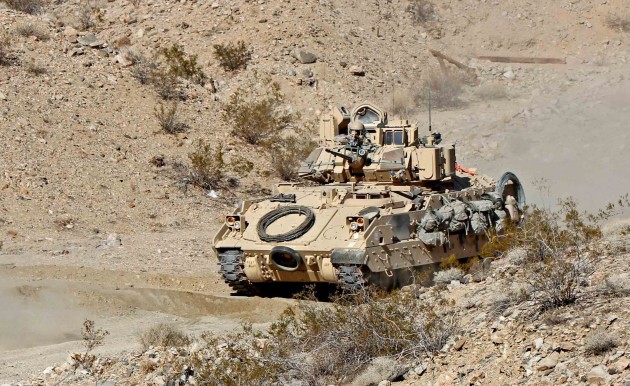
An Army M2 Bradley, like Dillard Johnson’s “Carnivore,” on a training exercise in January.
Even so, there were so many targets coming on so fast that Johnson decided he had to stick himself out the hatch and open fire with his M4 carbine and 9-milimeter pistol, getting shot in the process but being saved by his body armor. (“I was really sore from where the AK round had hit me,” he told Army historians, with remarkable mildness). The Army’s official history, On Point (pages 128-130), says that 488 to 493 bodies were found at the scene.
That’s another well-attested figure, but Johnson didn’t kill all of them. He has to share the credit with the crewmen on his Bradley, Sgt. Broadhead’s tank crew, an American mortar team, and an Iraqi mortar team that appears to have been firing indiscriminately into the melee, wounding Johnson with shrapnel.
So where did the other 2,000 or so “confirmed kills” come from? A lot of them, apparently, from an ad hoc accounting Johnson performed on his superiors’ orders: In the words of a New York Post profile, “he counted the dead by tallying rifles — and human heads — among the mangled or charred wreckage left behind by the Carnivore.”
That’s vastly superior to the “body count” methodology employed in Vietnam, which outright encouraged US commanders to rack up the corpses, whether they were Viet Cong combatants, collaborators, or entirely innocent civilians. But abandoned rifles do not equate to casualties.


Why propulsion could be the critical piece in Golden Dome’s architecture
Throttleable systems, boost-phase interception, and new manufacturing capacity expand missile defense options.
In fact, fairly early in the war, smart Iraqi fighters realized that if an American armored vehicle like an M2 Bradley starts coming for you (particularly one commanded by this guy), you don’t stand and fight, you drop your weapons and run. If you’re unarmed and heading the other direction, even if you’re in uniform, the modern American military usually won’t shoot you. In fact, Johnson himself kept trying to take prisoners throughout the As Samawah firefight, even though most of that particular bunch of Iraqis insisted on trying to shoot him instead – and in that one case actually hit him.
As brave as Johnson undoubtedly is, his training and technology contributed mightily to his lethality. After all, his Iraqi adversaries were often equally brave, but they died because they were unskilled and ill-equipped. Wave after wave of men on foot are precisely the target which machineguns were invented to destroy. Wave after wave of men on foot firing rifles were precisely the threat which armored vehicles like the Bradley were invented to survive.
In the modern era, at least since World War I, the impact of technology has not been to render human skill and courage obsolete. Instead, technology has multiplied the combat power of skillful and courageous men like Dillard Johnson.
“If you’re at Lexington or Concord, and you stand and fire your musket while everyone else runs away, you don’t have much impact, because you only fire one musket and it’ll probably miss,” military historian Bruce Gudmundsson once told me. “In World War I, you’ve got a machinegun, and now you can stop a regiment. Technology and the empty battlefield greatly increased the value of individual valor. [We’re] going back to the Middle Ages, David and Goliath, the duels of the Iliad, where a single hero is worth a hundred ordinary soldiers.”
Sing, O muse, of the rage of Achilles….Many a brave soul it sent hurrying to Hades; many a hero did it leave prey to dogs and vultures … (The Iliad)