
WASHINGTON: “It’s hard to get to simple,” Bell VP Keith Flail told me. “It does not mean you’re not high-tech.”
To meet the Army’s ambitious requirements for a new frontline scout, the Future Attack Reconnaissance Aircraft competition, “you have to design in that high performance and, at the same time, ensure that you’re sustainable and affordable in the long term,” Flail told me. “The Army’s going to have this aircraft in the fleet for decades, and it’s got to be able to be maintained in the dirt.”
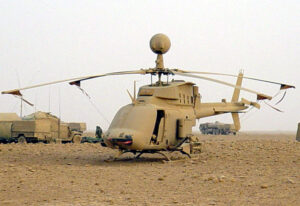
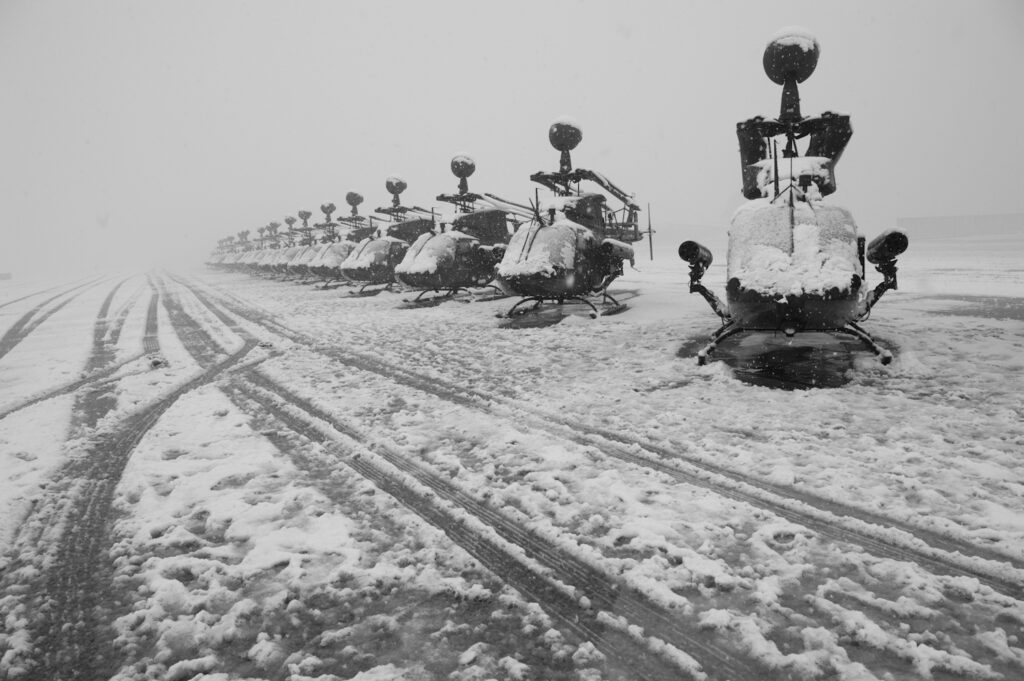
In fact, as the Bell team brainstormed what became the Bell 360 Invictus design last year, they took inspiration from two photos of the Army’s last long-serving scout helicopter, the Bell OH-58 Kiowa: one of a Kiowa covered in ice and snow, another in the aftermath of an Iraqi sandstorm.
Despite the social distancing and sanitation measures implemented at Bell facilities for the coronavirus pandemic, the 250-strong workforce for FARA has stayed on schedule, the company says. Detailed design work has begun, and some prototype components are already built and in testing, such as engine ducts and rotor spars.
The company is committed to spending a dollar of its own money on FARA for every two it gets from the government, Flail said. But that’s an average figure over the life of the multi-year Other Transaction Authority (OTA) contract: Bell and rival Sikorsky have almost certainly outspent the government so far, though neither will release figures.

Answering the demand signal to move faster, field sooner, iterate continuously
As threats rapidly evolve, digital engineering, manufacturing capacity and robust supply chains are critical to meeting challenges.
“Bell has invested very heavily in advance of the downselect, because the government has been very clear saying schedule is king,” Flail told me. “We have to have an aircraft on the ramp ready to fly in fall of ’22.”
The Army will choose between the Bell 360 and the rival Sikorsky Raider-X – that’s the “downselect” – in 2023.
Unconquerable or Underdog?
Although its name is Latin for “unconquerable,” the Bell 360 Invictus is arguably the underdog in the FARA competition. Why? The Bell 360 is essentially a conventional helicopter, borrowing many components from the civilian Bell 525, with the addition of small wings for improved high-speed performance. Sikorsky’s Raider-X, by contrast, is a radically new kind of aircraft called a compound helicopter, capable of higher speeds – a claim that Bell does not contest – and tested out in earlier prototypes, including the smaller but otherwise largely identical S-97.

No compound helicopter, however, has yet entered mass production. In the chaos of real combat when sleep-deprived mechanics have to maintain your aircraft in the mud, Bell argues it’s safer to go with proven and relatively simple tech. What’s more, Flail told me, Bell’s designers have labored mightily to get the most out of that mature technology to meet the Army’s requirements with minimum complexity and risk.
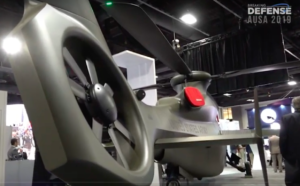
The most visually obvious example is the helicopter’s streamlining. Using both detailed computer models and physical wind-tunnel tests, Bell engineers have gone over the aircraft from the nose – with its narrow tandem cockpit – to the tail – with its ducted, deliberately asymmetrical tail rotor – to remove anything that might cause avoidable drag.
Now, streamlining the fuselage doesn’t solve the fundamental problem that conventional helicopters encounter at high speed, which is a phenomenon affecting the main rotor known as retreating blade stall. (When a helicopter is moving forward as fast as its rotors are spinning around, the aerodynamics get ugly, fast). But a streamlined fuselage still helps performance.
“There’s incredible elegance in simplicity,” Flail said. “That doesn’t mean we are not next-generation, that we’re not high-tech, but [we’ve done] all the things we can do … to meet the requirements… in the lowest risk, most sustainable, less complex way.”
But, I objected, there’s at least one area where Bell’s solution seems less elegant and more cumbersome than Sikorsky’s. The Raider-X design includes a single government-provided GE T901 Improved Turbine Engine, which Sikorsky says should provide all the power required to meet and indeed exceed the Army’s speed requirements. The Bell 360 Invictus will have a single GE T901 as well, but to reach the required speeds, it will have to engage an Auxiliary Power Unit (APU) to supplement the main engine.
Surely, I asked, if you need more power to achieve the same speeds, that means your design is less aerodynamically efficient than a compound rotor? And surely, needing a main engine and an APU is less elegant and more mechanically complex than just having the engine?

Actually, Bell says, you need an Auxiliary Power Unit on the aircraft anyway. If you don’t have an APU, you have to turn on the main engine to power up any system on the aircraft, even for basic maintenance checks by ground crews, which is a big waste of fuel and unnecessary wear on the turbine. But while APUs are a godsend for ground crews – and note, again, Bell’s concern for easier and more affordable maintenance – they usually don’t fulfill any useful function in flight. On the Bell 360, however, the APU does kick in during flight, to augment the main engine at high speed.
“One of the questions we got a lot at AUSA [last fall] was the ability to performance maintenance functions, pre-checks, in the field, to include buddy start capability,” said Frank Lazarra, Bell’s director of sales and strategy for advanced vertical lift. “I don’t see a way to do things without an APU.”
“So…we’re using an APU that is going to be required on the aircraft [already],” Flail said, “[but now] it’s not sitting there as dead weight in flight.”
Now, this only answers half the question. Yes, it’s definitely clever to use the same APU for two different purposes, one on the ground and one in flight. Nevertheless, the fact that the Bell 360 needs a source of extra power in flight to achieve high speed – when the Raider-X does not – still suggests the design is less aerodynamically efficient at those speeds.
That said, speed isn’t everything. Agility, survivability, affordability, maintainability: These factors are all equally essential for a front-line combat aircraft. And, for many of them, Bell believes its less revolutionary design gives it a practical advantage.