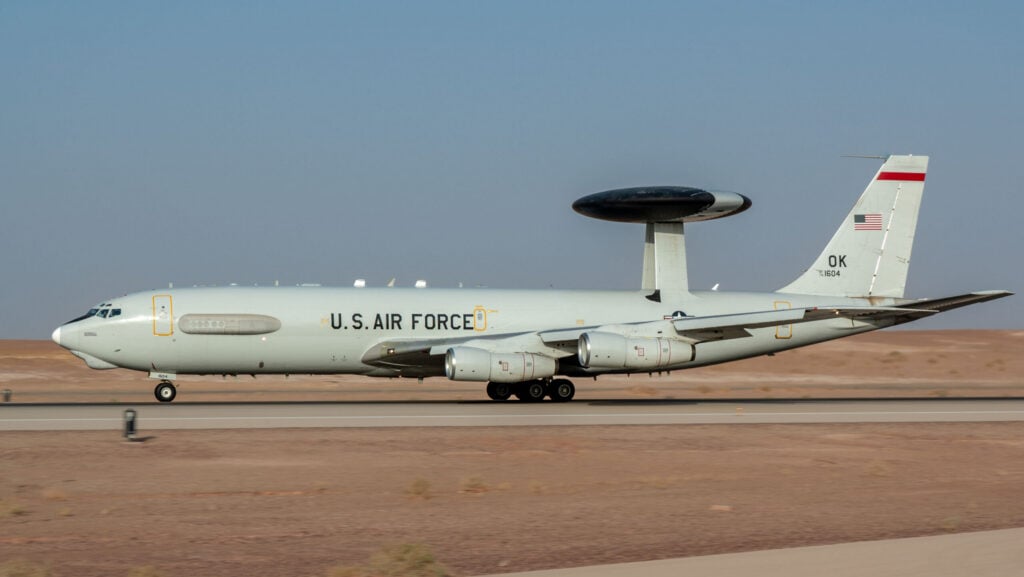
WASHINGTON — The US military “maxed out” its defensive posture in the lead-up to the war in Iran, US Defense Secretary Pete Hegseth said Tuesday, in the wake of an Iranian strike in Saudi Arabia that reportedly destroyed an American E-3 Sentry radar plane and damaged several air refuelers.
“The first thing we did was set up a defense and make sure our defensive capabilities were maxed out before any of this even started. That included fortifications as much as possible, but it also included dispersement [sic],” Hegseth said in a Pentagon press briefing, responding to a question about protecting US forces and strategic aircraft like the E-3. “If all of our people are in one place, you can imagine why that’s a big problem.”
“Alongside that dispersement is more and more bunkers … rapidly fielding that and improving those positions is a theater priority, no doubt. As are the air defenses, and the layered air defenses,” Hegseth continued. “So the defense of our troops and our assets is maxed.”
Despite those efforts, on Friday Iranian missiles and drones rained down on Prince Sultan Air Base in Saudi Arabia and destroyed the E-3 and damaged KC-135 Stratotanker refuelers, according to Air and Space Forces Magazine. The strike also purportedly wounded a dozen US troops. (NPR reported Monday that a second E-3 was also damaged in the attack.)
It’s the kind of potentially crippling attack US military leaders in recent years have stressed they’re tailoring formations to avoid.
Before the Iran conflict, a looming threat of conflict with China had spurred Air Force officials in particular to adopt a new approach to disperse deployed forces, a strategy dubbed Agile Combat Employment (ACE) in the service’s doctrine. Pentagon officials have emphasized the war in Ukraine has also provided valuable insight, such as the perils aircraft face on the ground following Ukraine’s successful “Spider Web” operation last year.
RELATED: Air Force needs ‘more robust, active base defense’ amid new threats: Allvin

Power at the sprocket: it’s the transmission that gives tracked vehicles their control
Army vehicles like Bradley need greater power at the sprocket for speed, braking, and manueverability.
Beyond Hegseth’s comments about “dispersement” it’s unclear if the Air Force specifically has been employing ACE concepts during the conflict in Iran. The war has seen some US aircraft operate from relatively distant bases, such as bombers that fly from the United Kingdom. The US is operating from from as many as 15 to 20 bases in the region, the Wall Street Journal reported Tuesday. Air Forces Central did not respond to a request for comment on its ACE posture or on the reported loss of the E–3.
In the wake of the Friday Iranian strike, experts told Breaking Defense that while dispersing forces is certainly a prudent strategic measure, the attack underscores that ACE maneuvers alone would not be enough — which must be paired with a mix of passive and active defenses — and could be blunted by logistical realities on the ground as well as constantly advancing adversary capabilities like near-real time satellite imagery.
The ACE concept “should significantly reduce the number of aircraft damaged in airbase attacks” by ensuring jets aren’t clustered together, Stacie Pettyjohn, director of the defense program at the Center for a New American Security, told Breaking Defense. She said ACE’s core concept of swiftly moving forces “frequently” should be doable given Tehran’s “relatively modest” daily drone and missile salvos.
But she said the US needs “more hardened shelters for aircraft and a more creative approach to both posture and operations, which should include camouflage and things like decoys to deceive Tehran.”
ACE ‘Could Certainly Apply’
ACE was laid out in Air Force doctrine in 2022, which the service devised in response to shrinking numbers of air bases and “adversarial technological advances in pervasive intelligence, surveillance, and reconnaissance and all-domain long-range fires.” The ACE approach, according to an Air Force document [PDF], “shifts operations from centralized physical infrastructures to a network of smaller, dispersed locations that can complicate adversary planning and provide more options for joint force commanders.”
In practice, that would look like spreading forces out and quickly moving them between locations to keep adversaries guessing.
“Historically, the [US Air Force] in the Gulf has concentrated large mixed wings at single bases — fighters alongside mobility and ISR [intelligence, surveillance and reconnaissance] aircraft — which is essentially the opposite of what ACE calls for,” Pettyjohn said.
“ACE could certainly apply to Epic Fury, even if the threat scale is modest compared to what the USAF would face in the Indo-Pacific,” she said, referring to the Pentagon’s name for Iran operations.
Tim Walton, a senior fellow at the Hudson Institute, noted that ACE is relevant even for large refueling aircraft like the KC-135, but that infrastructure limits bases from which those aircraft can operate. Refuelers, Walton observed, need access to bulk fuel stores not available at every location and require long runways for takeoff when carrying heavy loads of gas. Smaller aircraft like fighters, on the other hand, could access a greater number of airfields.
“Sustaining air operations under attack requires a mix of passive defenses (such as distribution, dispersion, early warning, camouflage, concealment, and deception, and infrastructure and logistics) and active defenses (such as ground-based air defenses and airborne air defenses),” he told Breaking Defense.
Beyond the constraints of infrastructure, there’s also the question of the utility of the inherent subterfuge of the ACE strategy in an era of persistent, near-real time satellite imagery, according to Clayton Swope, deputy director of the Aerospace Security Project at the Center for Strategic and International Studies.
ACE “loses some of its edge in an era of ubiquitous satellite imagery paired with AI tools that can identify targets in near real time. If it is sitting on the ground, it can be found. Any ground infrastructure for airpower has to be paired with layered air defenses — dispersal is not enough because there is really no place to hide,” he said in an email to Breaking Defense.
Iran’s Friday strike on Prince Sultan Air Base could be a “coincidence,” Swope continued, or Iran’s proficiency using satellite images for targeting has increased. That raises the question of whether Tehran could be receiving satellite targeting data from elsewhere. “A safe guess would be either Russia or China,” he said.
Speaking to reporters at the Pentagon, Hegseth acknowledged Iran’s strikes are benefiting from foreign assistance — perhaps similar to how the US provides Ukraine targeting data on Russian forces — and did not raise any consequences for doing so.
“There’s some things adversaries are doing to provide info and intel that they shouldn’t. We’re aware of it,” Hegseth said. “One of the biggest principles you learn in the military is to not set patterns, predictable patterns. So commanders are working hard to adjust in real time with those systems and make sure they’re in the right places and not easily targetable.”
Beyond ACE Shuffling
Maneuvers are only part of the equation when it comes to protecting US assets on the ground, as ACE also calls for a mix of passive and active defenses, from hardened facilities to integrated air defenses. As Hegseth suggested, hardening facilities can play a role, and analysts like Walton have maintained it’s an important factor.
Recent solicitations for hardened shelters by US Central Command indicate that officials are heeding calls for more passive defenses, the War Zone previously reported.
However, these shelters are not intended to protect aircraft, and some high-level officials have doubted their usefulness overall.
“I’m not a big fan of hardening infrastructure,” incumbent Air Force Chief of Staff Gen. Kenneth Wilsbach, then the commander of US Air Forces in the Pacific, told reporters in 2023. Wilsbach reasoned that the advent of precision-guided weapons, used effectively by the US against the Iraqi Air Force in 2003 to destroy aircraft in hardened shelters, limits their effectiveness.
On Tuesday, Hegseth also stressed the need for layered air defenses, consisting of a mix of different systems that are each tailored to specific threats.
“It’s not just Patriots and THAADs. It’s fighters in defensive CAPs [combat air patrols], it’s other kinetic defeat systems. It’s electronic warfare,” he said.
Either way, the Pentagon will likely be racing to protect the rest of its aerial assets from further strikes. The loss of the E-3 in particular was a significant blow to US air power and the military’s ability to defend itself, analysts said.
The plane carries its own large and powerful radar able to spot low-flying threats like cruise missiles, and comes with a crew of battle managers that help direct forces in the field. Prior to the strike, the Air Force had just 16 E-3s in its inventory, whose aging airframe already suffers from poor availability rates. The Air Force originally planned to replace the E-3 with the new Boeing E-7 Wedgetail, but the program is still in flux as the Pentagon attempts to shift sensing capabilities to space.
Damage to an unclear number of refueling aircraft — where five others have reportedly been previously struck on the ground at Prince Sultan Air Base — could also exacerbate the strain on the Air Force’s airborne tanker fleet, which has already been labeled by some Air Force officers as a “big gap” in current operations.
As it is, “We were mildly shocked to see an E-3 AWACS destroyed by an Iranian missile strike,” Byron Callan, an analyst at Capital Alpha Partners, said in a note to investors Tuesday. “We thought security would have been better, given the vulnerability the Russo-Ukrainian War has shown when high-value scarce aircraft are parked on tarmacs with no protection.”
Breaking Defense Video