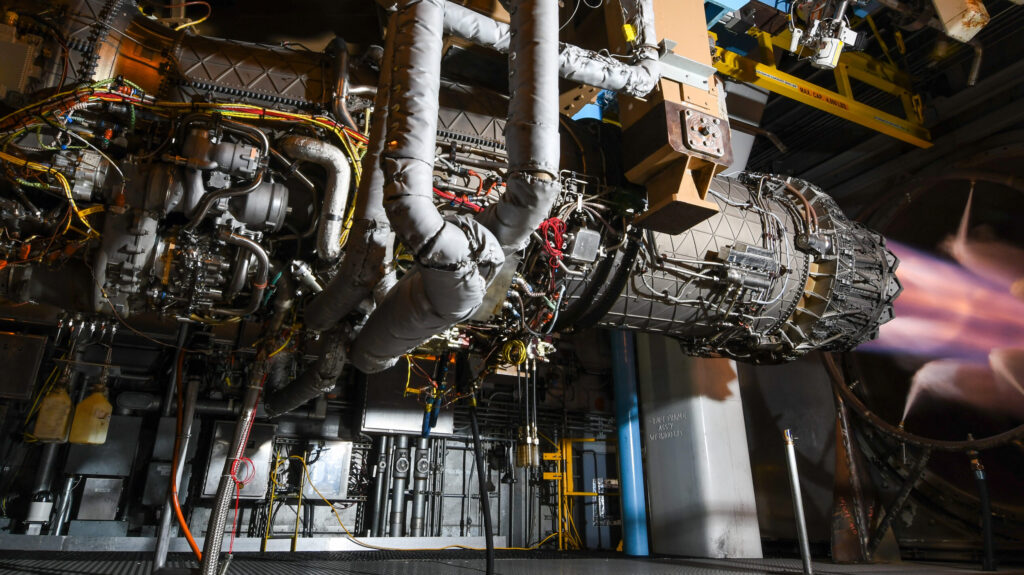
WASHINGTON — The Pentagon has finalized a deal with Pratt & Whitney for the next batch of F-35 engines and future powerplants for roughly $6.6 billion, according to a Defense Department contract announcement.
Pratt’s F135 engine powers the F-35 stealth fighter, and the Tuesday award officially sews up negotiations for the F135 to power an upcoming production batch of aircraft dubbed Lot 18, set to begin deliveries this fall. The contract also covers Lot 19 engines, whose deliveries are expected to start next year.
“The F135 is the most advanced military engine in the world, delivering unmatched thrust, reliability and mission readiness for the United States and its allies,” Jill Albertelli, Pratt’s president of military engines, said in a press release announcing the award. “Pratt & Whitney is investing heavily across our global production base and supply chain to increase production and accelerate engine delivery and sustainment to meet growing global demand for the F-35 program.”
The Pentagon initially issued the Lot 18 engine contract as an undefinitized deal worth nearly $2.9 billion for 141 powerplants in August, allowing production to proceed as dollar figures and quantities were hashed out. The contract modification issued Tuesday formally “definitizes” the agreement, and included the additional award for Lot 19 engines. The Tuesday award covers work through March 2028, the DoD announcement says.
A spokesperson for the F-35 Joint Program Office told Breaking Defense today that Lot 18 funds “approximately 140 production engines,” along with spare engine modules and other equipment for a total of $3 billion. Lot 19 features “approximately 150 production engines” and similarly includes spares and equipment at a price of $3.6 billion.
In all, F-35 manufacturer Lockheed Martin expects to deliver 296 F-35s across Lots 18 and 19.
The Pentagon plans to upgrade the F135 to head off power and cooling demands, which are set to rise as the F-35 fields new capabilities. A recent government watchdog report said that the engine program, known as the Engine Core Upgrade, won’t begin production until at least 2031. (Pratt has said the ECU can be retrofitted into existing aircraft.) A parallel effort is also overhauling the jet’s power and cooling system.


A leap in drone range and payloads come from a battery with different chemistry
Lithium-metal batteries are one way to break the weight and endurance limits of today’s unmanned systems.
US military Lot 18 F-35s will be sporting the current, standard F135 engine but they’ll be delivered with another unusual feature: weight ballasts where a radar would normally go. As Breaking Defense previously reported, Lot 18 planes have a modified bulkhead made to work with the new APG-85 radar, but the radar isn’t yet ready and so the planes will, for a while, fly without. While the APG-85 could be ready as soon as next year, jets delivered in the meantime will have a ballast in place of the radar to ensure aircraft remain airworthy and available for limited training.
Beyond the radar issue, since July 2024 and following a year-long freeze first reported by Breaking Defense, new F-35s delivered by Lockheed have been already reserved for training due to delays with a modernized software suite known as Technology Refresh 3. It’s not clear when the Pentagon intends to certify that software as combat capable.
Breaking Defense Video