
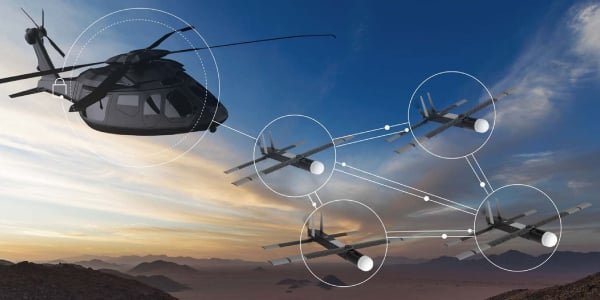
In this Q&A with Collins Aerospace’s Harold Tiedeman, Sr,. technical fellow and Future Vertical Lift chief engineer, and Chet Treloar, director, Future Vertical Lift Strategic Pursuit, we discuss the broader Future Vertical Lift (FVL) ecosystem, modeling and simulation that runs faster than real-time, and how the Army’s Modular Open System Approach (MOSA) comes to fruition and is key to building out FVL.
Breaking Defense: The Army’s FVL program is one of the most interesting in the DoD due to the diverse ecosystem that is building around FLRAA and FARA with Air Launched Effects (ALE), multi-domain connectivity, and MOSA. Describe the critical connections across the FVL ecosystem and what they entail?

Treloar: All of the connected elements of FVL, including the ALE team or your uncrewed platform connected to your FLRAA or FARA platform, which is connected to ground soldiers, and is maybe relayed through the manned platform back to command and control, are helping define what a better, faster, resilient network looks like across platforms and domains.
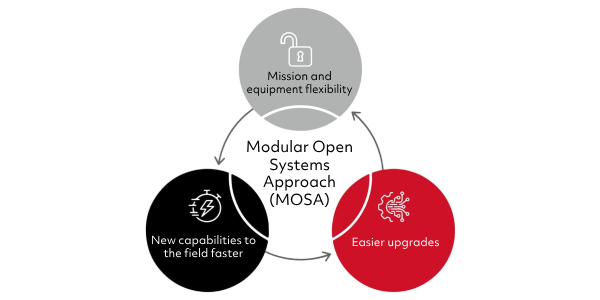
The work the Army and industry are doing on MOSA is another piece of the FVL ecosystem that, for example, permits quick changes to ALE payloads and the spiraling in of new capabilities at a faster, more affordable rate than ever before. While we may not have it all figured out, we’re making tremendous strides through participation in large-scale demonstrations and collaborations that benefit not only in the FVL program, but also current and next-generation programs across the armed services.
Tiedeman: That’s right. Ecosystem connectivity is about shortening the time to complete a mission and enabling sensor to shooter connectivity. It’s about the selection and active management of assets that are used to achieve that mission objective. The ALE team is part of that. FLRAA and FARA is part of that. Long range precision fires are part of that.
To add to what Chet just described, the ecosystem will be connected so that when FARA launches an ALE, it loiters until it detects a threat and then sends that information back to maybe a Gray Eagle or another FARA platform, which then gets relayed back to long-range precision fires that takes out the threat. It’s all cooperative, collaborative and must be able to communicate seamlessly.
That thread is also dependent on resilient communications. What it comes down to is not one network or one datalink. It’s the collection and combination of things that enable a highly reliable and available connection throughout that ecosystem. Collins has been very active with the Army helping define and demonstrate capabilities needed for resilient communications, as well as CONOPS for how components of the FVL ecosystem, such as ALEs, can become force multipliers.
Breaking Defense: You discussed the ALE team and one of the key programs in the FVL ecosystem is Future Unmanned Aircraft System (FUAS). Collins Aerospace was selected as a mission system solutions provider for the next phase of what’s known as the ALE ‘small program’ for both FVL and the enduring fleet. Tell us about that.
Tiedeman: We’re doing this through the Collins RapidEdge™ enabled Mission System that provides central functionality through radios for communications, solutions for handling multiple levels of classified data, and mission computing. It also enables multiple, autonomous ALEs to work together by leveraging individual payloads to make a greater impact on dynamic and complex operational environments. Right now, we’re defining the architecture under a rapid development timeline that will lead to a program to start rapidly fielding some ALE capabilities.
Treloar: The concept behind those effects is that they can do many different things because of their modularity. What we’re providing is the MOSA framework for integrating capabilities and payloads, small-form-factor computing, and cross-domain solutions.
We’re working in the digital environment to run those capabilities and autonomy behaviors in a simulation, get feedback from the user, and then make changes to the capabilities, regardless of whether it has to do with its autonomy or other functionality. New software can be quickly inserted and run again to see if that iteration is what they want.
We can make changes, integrate, test and deploy new software in a matter of hours. And because our system is agnostic to the platform we can apply what we learned not only to the small-platform program but also to bigger ALE and FUAS formats.
Breaking Defense: What examples can you discuss about how you’re assisting the Army in FVL testing and simulation?
Tiedeman: Under what we call a ‘faster than real-time environment’ for rapid integration that we’ve developed, you can execute a mission, develop the CONOPS, and validate your architecture. You don’t have to fly, expend lots of lab resources, and take tons of time to prove that capability. By running in an environment that’ll go, say, a thousand times faster than a physical system, you can work through those scenarios very rapidly.
We’ve offered this faster than real-time environment to the Army as a way for them to develop CONOPS and conduct mission rehearsals with a team of ALEs. They can simulate scenarios and different populations of vehicles across the entire FVL ecosystem. The Army has quickly realized the benefit of this because it’s something that hadn’t been conceived when the concept of ALEs was developed.
We are also working to forward a concept that will provide a virtual digital backbone. With that, you can virtually and rapidly integrate new capabilities. You can validate system architecture and configurations in a very realistic environment, and prove new capabilities integrated into that framework — all done virtually. You don’t have to bring in hardware or wait for a full capability to be provided. You can use models, software, and other ways to represent that capability and integrate it into a very realistic system.
We’re excited about what that’s going to bring to the Army and also to ourselves because it’s a powerful tool when you’re looking at safety critical networks that you must prove are going to be reliable and certifiable.
Breaking Defense: How do you see a successful open systems framework coming together for the US Army?
Treloar: The Army and industry, including Collins, has been working on open systems solutions for many years and progress has certainly been made. That said, with the FLRAA platform now selected it’s imperative that we nail down key questions around a viable open systems framework. Things like data rights and end customer use cases need to be aligned so that the program can move forward and streamline development and execution of critical systems in a way that also ensures the goals of open systems can be met.
Tiedeman: There are a million details to work through for FLRAA, and we will support that. With MOSA, there’s still a lot of focus on maturing and evolving the definition. There’s been a ton of progress there, especially around defining multi-domain operations and the interoperability between different capabilities within the ecosystem. Obviously, there’s a line in the sand with FLRAA that’s established with Bell and their approach.
At the same time, you see Army’s initiatives, including the inaugural MOSA Summit in September, to extend all the MOSA definition concepts for collaboration across the services. There’s focus on the Army’s enterprise product architecture and how that gets utilized and scaled across their aviation enterprise, especially when it comes to the benefits they expect to get from cost efficiency and capability enhancements going forward.
One of the hardest things to do is defining a MOSA backbone that is expandable, scalable, and upgradeable, and also something that’s not going to cause you to go back and rework everything when you try to expand it and add capabilities. There is a lot of forward momentum, though, and the details are starting to get written down and captured in the models and frameworks that the Army is defining.
The key is the collaboration — having all of these parallel paths coming together so we can collaboratively tackle tough questions and bring the best solution forward that will not only set the precedent for successful open-systems frameworks, but ultimately give allied forces what they need to consistently stay ahead of rapidly evolving threats.
Breaking Defense: Final thoughts?
Treloar: We’re excited to be part of the Future Vertical Lift ecosystem and are committed to the concepts that the Army has put forward, for MOSA in particular. We are listening, learning and collaborating across the industry to help bring the best solutions forward. These programs are critical to our nation, and we’re excited to see them advance.
Tiedeman: Chet used the word ‘listen’ and we definitely are listening, but we’re also actively leading the Army through their concepts. We all know that the Army’s trying their hardest not to dictate to industry while at the same time promoting a cycle of innovation.
There are a number of things we’re doing along with the rest of industry to go further on understanding MOSA and further on the concepts needed to support the Army enterprise. At the same time, we’re also implementing and collaborating through a CRADA with the Army on modular certification, which is a big deal when we’re talking about safety critical systems. Our focus is defining how you appropriately apply MOSA to enable rapid, incremental certification.
We’re very active in that and are doing that not only for the Army and DoD but for all of our customers, including commercial aerospace customers that are demanding the same thing. We’re taking a holistic product-line view across military and commercial ecosystems to accelerate implementation across the board.