AUSA 2023 — For Brandon Tseng, the rapid proliferation of drone warfare in Ukraine, as well as the numerous ways to counter it, did not come as much of a surprise.
That’s because Tseng, co-founder and president of Shield AI, has been developing an artificial intelligence pilot since 2015, which he claims can perform under the stresses of electronic warfare that have taken out countless drones from both Ukraine and Russia.
“When I talk to customers now, US or allied forces, they’re saying we need to operate in electronic warfare environments, like ‘just so you know, there’s no GPS or communications,'” Tseng said Wednesday on the sidelines of the Association of the United States Army annual convention in Washington. “And I’m like, ‘yeah I know, we’ve been working on this for eight years now.'”
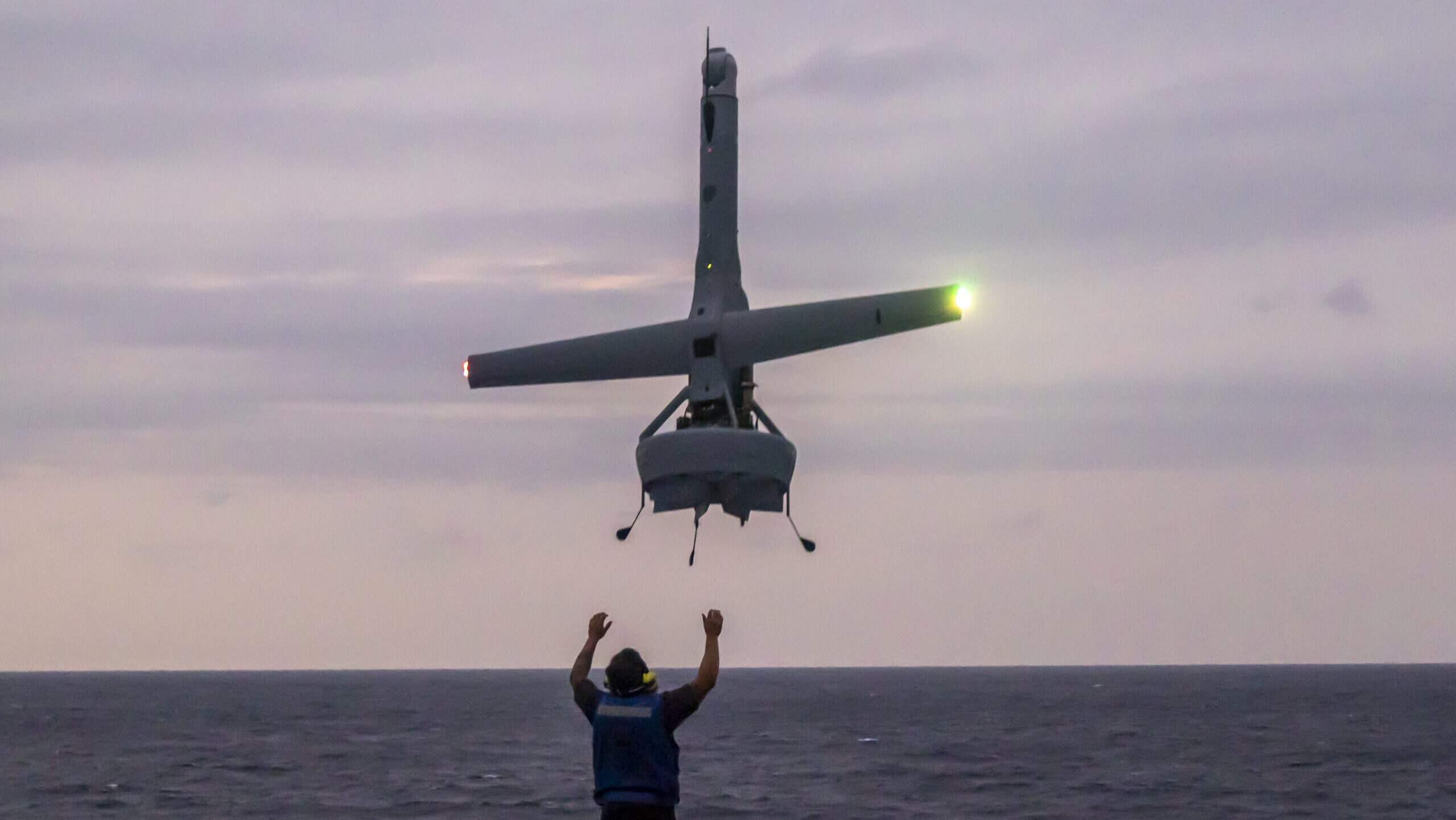
Shield AI says its Hivemind artificial intelligence pilot can operate in comms-denied environments, and can work alone or in guiding swarm attacks. Tseng envisions that when paired with the company’s V-BAT drone, which the startup acquired by buying a company called Martin UAV in 2021, Hivemind can provide the affordable mass the Pentagon yearns to field as its Replicator initiative gets underway.
According to Tseng, taking out a drone of V-BAT’s size and flight envelope would require kinetic warfare like a missile, positioning the robots to absorb expensive munitions that would otherwise target pricier platforms like fighter jets, where a pilot’s life would also be at risk.
“That’s why I talk about intelligent, affordable mass and why I think it’s so exciting. You flip that cost asymmetry,” he said.
As part of its presence at the AUSA conference, Shield AI held a product launch for its V-BAT teaming concept, which the company says can simultaneously fly four of the V-BATs. Shield AI plans to double that number annually, according to Tseng. (Tseng said logistical constraints, not the capability of Hivemind, are the limiting factors in scaling up the swarm.)
A vertical takeoff and landing mid-sized drone — known as a class 3 in Pentagon parlance — Tseng said the V-BAT can be launched by a few people in any 12 foot by 12 foot patch of land. Though the V-BAT might not fit with some drone efforts like the Air Force’s Collaborative Combat Aircraft program, the Hivemind, on the other hand, could vie to fly other drones than the V-BAT and has already piloted an F-16.
Hivemind is “the Android operating system with the aircraft manufacturer,” Tseng said. “So the same way Android works with Nokia, Samsung … we want to work with every OEM [original equipment manufacturer], every aircraft.”
Hivemind’s applications don’t stop at the DoD. Tseng has previously pointed to commercial benefits for the AI pilot, telling Breaking Defense last year that autonomy is key for the nascent electric vertical takeoff and landing market, which could soon regularly transport people and cargo as developmental efforts take flight.
V-BATs could also serve other purposes beyond the teaming concept promoted by the company, with Tseng pointing to a recent solicitation by the Defense Innovation Unit asking industry for an enterprise test vehicle. The drone is able to host a range of payloads like sensors and munitions, Tseng said, and its “architecture … makes it well-suited for windy, choppy seas.”
The company builds the V-BAT in Dallas, Texas, and has the capacity to churn out between 800 to 1,000 a year, according to Tseng. “I think yes, in time, we will need to expand past that 1,000 aircraft per year capacity,” he added.
Shield AI is reportedly valued at $2.5 billion, according to Bloomberg. Tseng wouldn’t comment on the Bloomberg report, though he noted that “you’ll see something in like two weeks” and that “we’ll have the full and accurate picture because it’ll be from us.
“What I will say is, there’s a lot of interest from the venture community around defense technology,” he added. “I started this company in 2015. We went up to Silicon Valley … and 30 investors said no, we don’t do defense. That’s obviously changed.”
PHOTOS: AUSA 2023
 Gallery