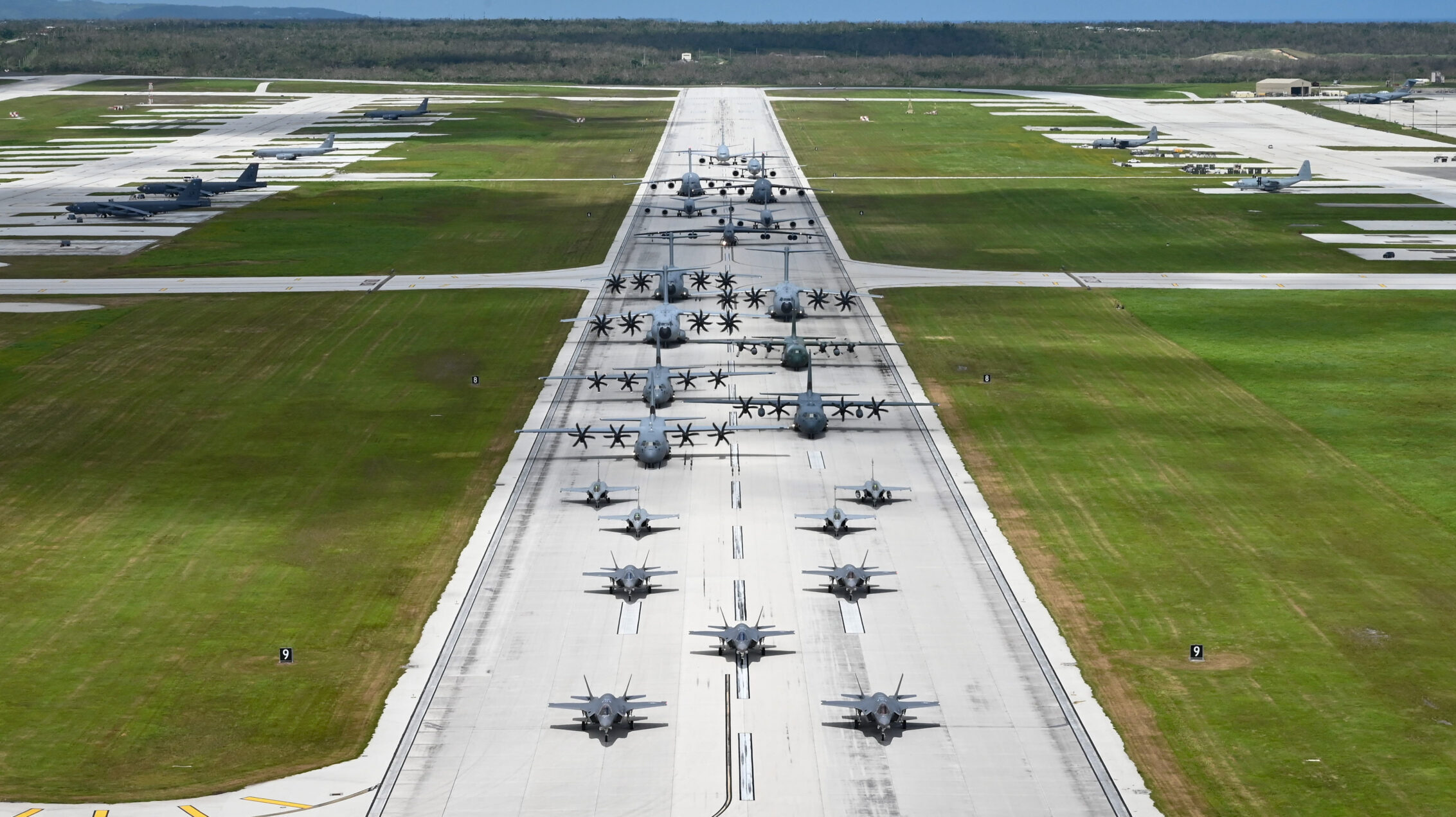
WASHINGTON — After sketching out a rough map of the world, Lt. Gen. David Harris, the Air Force officer charged with crafting his service’s future concepts and strategies, started to illustrate the “threat intensity” around the globe as he sees it — in this case, depicted as a line graph above the map.
The line stayed low as it passed over the Western Hemisphere, but rose steadily as it moved east to reflect the military prowess of America’s adversaries, beginning its climb near Eastern Europe and the Middle East and peaking above China’s east coast — where officials worry US troops might be called up to defend Taiwan and repel a Chinese invasion.
“And then all of a sudden you get into where China is and Taiwan, and we see a spike, and it goes up,” Harris said in a recent interview at the Pentagon.
In the past, the Air Force would design forces to “find whatever the highest threat was” in order to “cover every contingency known to man,” he said. But the range of threats today — especially the growing military power of China — requires new thinking. Ultimately, however, to make plans viable requires one thing above all else.
“Candidly,” Harris said, “the Air Force is underfunded to do the things that we need to do.”
Harris is not alone in raising concerns about resources the service requires to do its job, but his comments underline a challenge facing Air Force leaders. After helping to craft a new “Force Design,” Harris has handed officials a framework for thinking differently about the service’s operations in light of new threats — one that must eventually map onto physical realities, like what kinds of aircraft could be employed and in what number. And that’s where the money comes in.

Multi-channel data link reshapes Navy’s communications capabilities
The Network Tactical Common Data Link system enables secure comms and ISR for carrier strike groups and their air and naval assets.
Luckily for Harris and his colleagues, they may find congressional support, particularly under a new GOP majority. Sen. Roger Wicker, a Mississippi Republican and incoming chair of the Senate Armed Services Committee, for example, recently championed “a full-scale rebuilding of the shrinking US Air Force” including by “supercharg[ing] production” of the B-21 Raider.
It all means that the Trump administration’s first budget request could end up being the defining factor for how the Air Force’s new Force Design is employed, including what capabilities can be brought to bear within it.
‘Mission Areas’
A largely conceptual framework — the document itself has not been publicly declassified, though some of its key attributes have been shared in an unclassified summary [PDF] — the new Force Design sets out three different “mission areas,” whose attributes differ based on the threat environment.
Filling out those mission areas then requires devising a force structure, building out specifics like the number of fighter jets needed for a scenario. The mission area construct was created, in part, to be a better steward of taxpayer dollars, Harris said, while emphasizing that the Force Design largely eschews specific platforms.
“This is a design. I’m not talking about force structure. I’m not talking about like, ‘B-21s are the only thing that can survive in here.’ It could be something completely different,” he said. “You can have multiple force structures being able to meet [mission areas] at different price points in time. There’s no one force structure.”
The first mission area, called Mission Area 1, features capabilities that can “live within and generate combat power from the dense threat area which will be under constant attack,” according to the Air Force’s summary. Here, pointing to a scenario like a battle in the Taiwan Strait, Harris said that extremely exquisite or highly attritable platforms — think stealth fighters and drones, respectively — will tend to play a leading role.
“The Mission Area 1 forces and what can go into there, it’s highly dependent on the attributes of it. And I would say survivability is the biggest piece of that,” he explained. “You can see how dense of a threat that is. Obviously, we put things in there that are survivable. Or the opposite end of the spectrum, attritable. Don’t care if they’re lost.”

Mission Area 2 features capabilities with sufficient ranges to “operate from the defendable area of relative sanctuary beyond the umbrella of most adversary ballistic and cruise missiles or attack UAVs and project fires into highly contested environments,” according to the summary. In Harris’s rough map of the world, a Mission Area 2 tasking could be required somewhere like the Middle East, or out past Taiwan’s coast into the Pacific.
The third mission area covers the relatively lower threat environment that defines much of the globe, “with position resilient to limited adversary attack,” according to the Force Design overview. This mission area “covers your homeland defense piece of it. It covers a little bit of strategic deterrence from all the bombers and tankers and things that come out of CONUS [Continental United States] to be able to power project,” Harris said.
Mission areas can also be adjusted based on emerging threats, according to Harris, like a flare-up in the Middle East or Europe, which each may present different “force packaging options.” They’re also interrelated: Mission Area 1 taskings won’t win a war outright, but they will help halt the spread of a threat and roll it back, especially by staying connected to the broader joint force. That approach can then open up battlespace opportunities in the process, like creating a more permissive environment conducive to something like a Mission Area 2 tasking.
“So it’s a phasing, it’s an approach, but it’s also a way of thinking about the core missions of our Air Force, and how they connect together through this mission area 1, 2 and 3 construct,” he said.
Force Structure
But when it comes to actually building a force structure to fill in a mission area, that may require risk or more money.
Harris is not alone in raising concerns about resources the service needs to do its job. Air Force Secretary Frank Kendall, for example, has repeatedly warned about spending limitations, recently musing that a planned next-gen tanker may not be affordable. Chief of Staff Gen. David Allvin too has been vocal on the issue, saying in November, “The force is stressed, and we’re still doing our very damn best.”
Air Force officials have talked for years about growing the force to meet modern threats, noted Doug Birkey, the executive director of the Mitchell Institute. Highlighting raging conflicts like Ukraine and a potential clash with China in the Indo-Pacific, “the fundamental challenge is that you need air power and space power for everything. And the Department of the Air Force has been severely underfunded since the Cold War,” he said.
Service leaders’ hands are tied by competing prioritizing like simultaneously recapitalizing the air- and -land-based legs of the nuclear triad. Funding constraints combined with technological considerations also appear to be driving a pause for the service’s Next Generation Air Dominance (NGAD) fighter, a platform viewed by many as critical for an Indo-Pacific fight — raising questions about what a force structure could look like in that scenario.
“I think what it does is it challenges the way that we would actually execute in a Mission Area 1, or a Mission Area 2 or a Mission Area 3. I’m not just going to put it in one bin,” Harris said during a recent forum hosted by the Mitchell Institute, when asked about the impact if NGAD doesn’t come to fruition. “There’s probably multiple force structures, some of them may not include NGAD. But I’ll tell you, it’s less about the platform and more about the systems and how they’re coming together, and how you actually replicate the effect of what that system would have.”
The funding issue looms for the fiscal 2026 budget, now in the hands of the forthcoming Trump administration. Pentagon toplines the past two years have been held down by the Fiscal Responsibility Act, and some in Washington are weary that spending cuts could be in the cards if Elon Musk’s and Vivek Ramaswamy’s “Department of Government Efficiency” gets its way.
“The DoD quiver is pretty thin, and it’s time to reset in core areas,” Birkey said. Programs like the Sentinel ICBM, Columbia-class submarines and B-21 Raider stealth bomber “are the real answer, and they’re not cheap.”
Speaking during a virtual event hosted by the Center for Strategic and International Studies Dec. 10, Air Force acquisition chief Andrew Hunter made a blunt assessment of the current fiscal environment, warning of the consequences if it continues.
“[I]f the Fiscal Responsibility Act shapes the resource posture of the nation, we will not be able to fulfill the National Defense Strategy,” he said.
Asked about funding considerations, Harris emphasized the Air Force needs more resources specifically for a high-intensity scenario like a Taiwan Strait fight. Fielding new forces and maintaining existing ones also requires sustainment dollars, with Harris pointing to upkeep of Mission Area 3.
The “primary driver” of Air Force funding constraints, Harris said, is “the new capabilities that we need to get. But there’s also funding that’s needed to sustain the current capabilities within Mission Area 3.”
More broadly, Harris framed the funding needs as driven by modernization, as well as ensuring capabilities are properly supported.
“If I had to categorize it, modernization costs are something that we still need,” Harris said. “And there’s even some readiness pieces in here that allow me to have the right supply and support. All of that still needs to come together.”