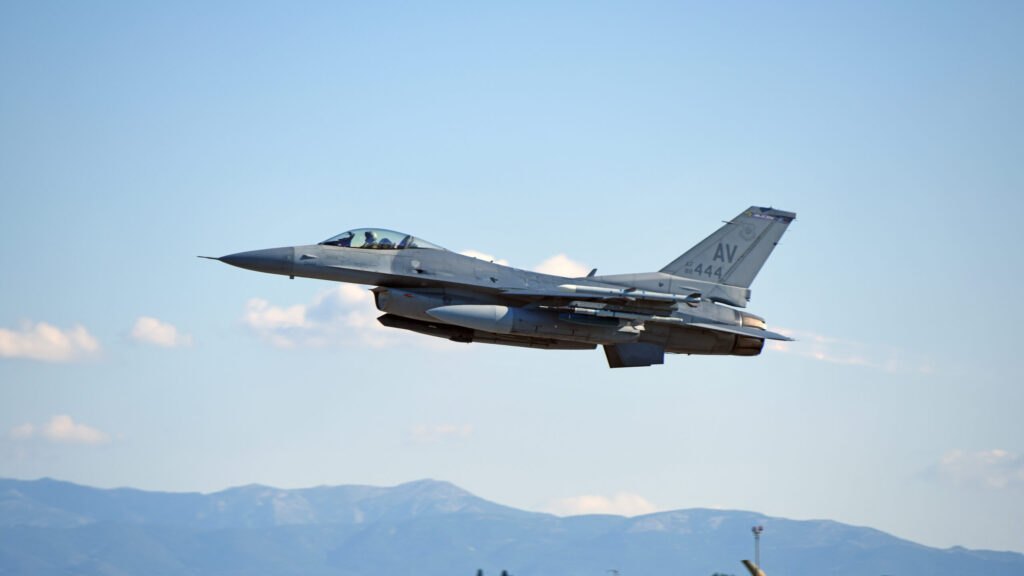
ROLLING MEADOWS, Ill. — The Air Force’s F-16-based electronic warfare suite is being rushed to the field to support an urgent requirement in the Middle East, according to industry officials.
Northrop Grumman officials explained to reporters there is an urgent operational need for its AN/ALQ-257 Integrated Viper Electronic Warfare Suite (IVEWS) that was validated over the summer from Air Forces Central for 72 systems to be fielded as soon as possible.
“The performance of the system led to a desire by the Air Force to accelerate the fielding of the system, which had stalled for a little bit in earlier budget planning documents,” Phil Louden, director of international IVEWS capture at Northrop Grumman, told reporters during a visit to Northrop’s Rolling Meadows, Ill., plant. (Like other outlets, Breaking Defense accepted travel and accommodation from Northrop for this trip).
The Air Force declined to comment on the urgent operational need and funding priorities for IVEWS.
IVEWS is the program of record for F-16 self protection. It is the only electronic warfare system on the F-16 providing digital radar warning receiver performance and active jamming capability that can detect, identify, locate and counter potential threats.
Congressional language in the reconciliation package that passed over the summer added $187 million to accelerate the installation of “F-16 electronic warfare capability,” without naming IVEWS specifically, in order to mitigate the risk against “Houthi-like adversaries.”
The system had been in somewhat of a limbo, according to company officials, with budget documents indicating less funding over time. Other officials noted that the Air Force’s previous priorities lay with more future platforms, leading to stalled funding efforts for IVEWS.

Why Bigger Fences Aren’t Enough in the Age of Drones
Traditional thinking about how to protect facilities must adapt to new threats such as drones or downstream attacks.
“I think that the previous leadership was really focusing on their next generation platforms,” Jim Conroy, vice president of electronic warfare and targeting at Northrop Grumman, said. “If you really need to fight tonight, you got to fight with what you have. F-16s are the platforms that are out there. … They had never lost any focus on F-16. But we didn’t get all the funding. It was really, ‘what can we do with the amount that we had?’ Now, it’s ‘how do we take and get it out there as quick as possible?’”
For its part, the Air Force said it will continue to prioritize electronic warfare capabilities.
“The Air Force has identified multiple scenarios where enhanced electronic warfare systems can help meet the Air Force’s operational needs across different AORs. IVEWS was flown in several Air Force exercises this year and has been tested on F-16s against multiple threat platforms. The Air Force will continue to prioritize electronic warfare systems to meet national security objectives,” according to a service spokesperson.
Northrop officials said the $187 million in the reconciliation package will help to complete the qualification of the system, the hardware, the software design verification test, and the trial kit proof, all for rapidly fielding of the system.
They said that IVEWS has not flown operationally yet, but has participated in several exercises and logged over 300 flight hours.
Company officials also noted how capable the IVEWS system is at thwarting modern threats in the electromagnetic spectrum. Self-protection systems such as IVEWS have grown in importance in recent years due to the change in the threat environment and the sophistication adversaries are demonstrating within the electromagnetic spectrum to jam GPS navigation, communications and even munitions.
Enemy radars and jammers typically were at fixed locations, but now, US forces don’t know where they all are as the enemy will turn them on and off sporadically.
Systems like IVEWS are designed to help aging airframes such as F-16s stay current against modern threats while also reducing the need for true electronic attack platforms — which are low in number but provide high-powered jamming to allow other aircraft to penetrate air defenses that don’t have self protection — meaning they can be more self-sufficient against a raft of threats.
This means most, if not all, aircraft now have to be EW platforms as well.
In touting the power of IVEWS, Northrop officials cited anecdotal evidence from users that the system is essentially a mini EA-18G Growler on F-16s. Growlers are the Navy’s premier stand-off jamming fighter aircraft, providing powerful electronic attack capabilities to blind enemy radars and allow other platforms to conduct missions in enemy airspace.
With this jamming power resident on F-16s, which are in much higher numbers than the more exquisite dedicated jamming platforms such as the Growler or EA-37B Compass Call, mission planning becomes easier.
However, the focus thus far for Northrop has been on the F-16 and other services have not approached them to mount IVEWS, despite it being designed for modularity.
Breaking Defense Video