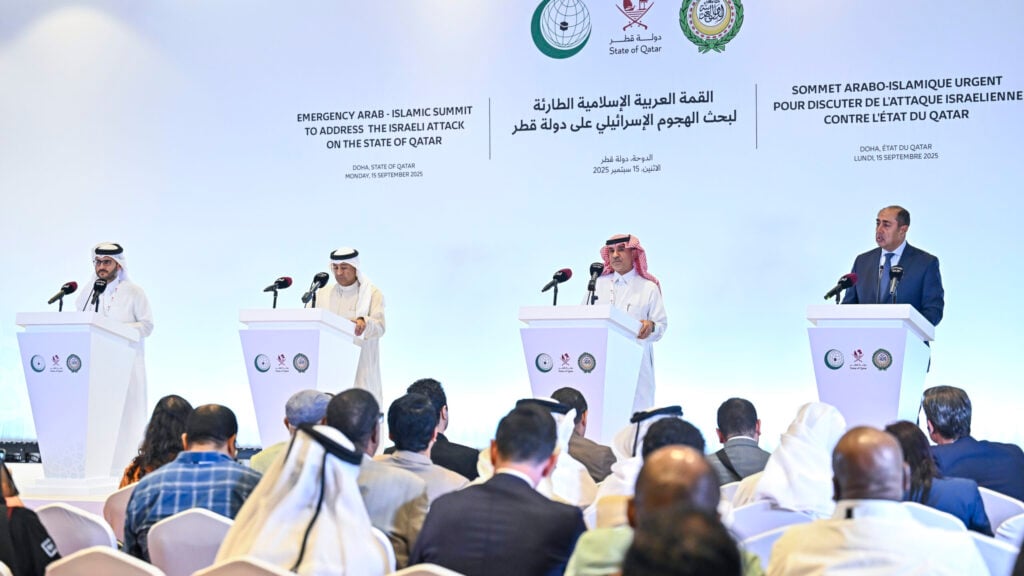
BEIRUT — The Gulf Cooperation Council convened today in Doha, announcing its intent to boost defense ties between member states in response to the Israeli strike on Hamas targets in Qatar earlier this month.
Stating that an attack on one GCC member is an attack on all, a special session of the GCC’s Joint Defense Council made made five pledges, which include increasing intelligence sharing, increasing image sharing, accelerating work on early warning systems, updating defense plans, and conducting joint exercises, according to a translated statement. The GCC is made up of six states: the Kingdom of Saudi Arabia, the United Arab Emirates, Kuwait, Bahrain, Qatar and Oman.
“The security of the GCC states is indivisible, in accordance with the provisions of the Joint Defense Agreement,” the statement reads.
Today’s defense council meeting comes just days after an emergency meeting was convened on Monday in Doha to discuss next steps after the Israeli strike, which the council “condemned in the strongest terms.”
The meeting also comes amid regional reports that Arab nations could be considering even closer defense ties in formal a NATO-like structure — though analysts told Breaking Defense that step would be unlikely.
“The recent attacks have intensified debates on collective Gulf security, exposing critical air and missile defense gaps,” retired Kuwaiti air force Col. Zafer Al Ajami told Breaking Defense, adding, however, that “political divisions may hinder a formal Arab-NATO.”
The GCC has a “collective security commitment at heart,” but any joint military constructs “remained for the most part theoretical,” Hasan Alhasan, IISS senior fellow for Middle East policy, told Breaking Defense. Today’s announcement, however, could be a step towards getting them up and running.

Interoperability becomes the price of entry for next-gen warfighting tech
AI, autonomous systems, cyber, and EW converge as industry targets faster battlefield effects.
While the GCC has historically worked with the US, with US Central Command based in Bahrain, some defense analysts expressed concern to Breaking Defense about the US’s “reliability” as a partner to the Gulf when it comes to Israel.
“I think there are concerns about the reliability of the United States as a defense and security partner,” IISS senior fellow for Middle East policy Hasan Alhasan said. “Obviously the US has the capability. The question is, does it have the political will to use that capability and its broader political and economic and diplomatic leverage over Israel to restrain Israel and drain it in from further attacks. I think this is where the US is quite unreliable.”
Ajami agreed, saying that the Israeli strikes have “amplified Gulf doubts” about the US. He further added that US protection is “viewed as conditional and politically volatile.”
In addition, Rashid Al Mohannadi, a non-resident fellow at the Middle East Council on Global Affairs, noted that Israel’s strike has caused Gulf nations to question their allyship with the US.
“The assumption that if we were American allies we wouldn’t be attacked by American allies, the assumption turned out to be false.”