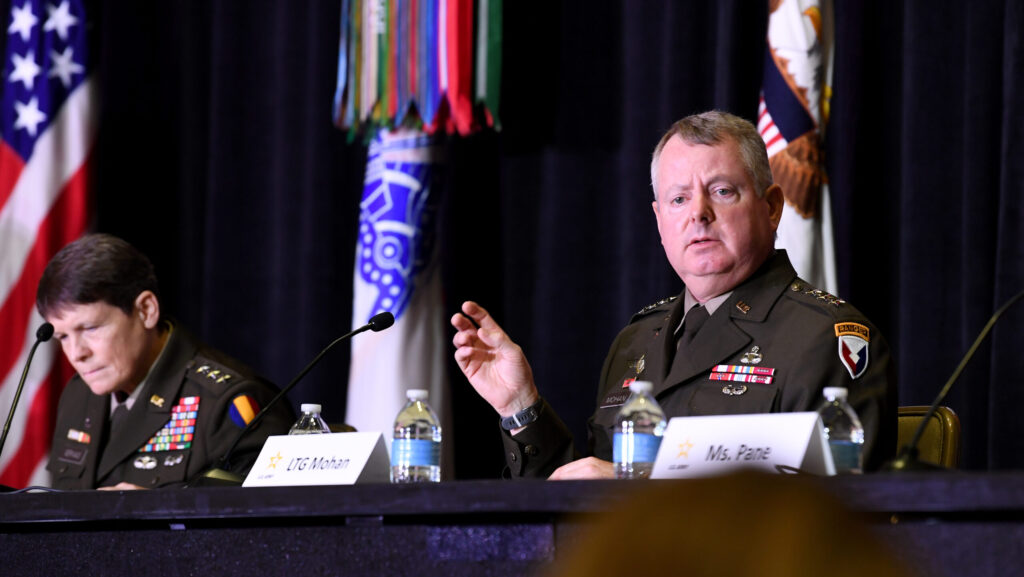
WASHINGTON — The Army does not own the intellectual property for many of the parts that go into its weapons and platforms, making it difficult to easily or affordably reverse engineer and 3D print such parts when they need replacing, the acting lead of Army Materiel Command told Breaking Defense.
As a result, Lt. Gen. Christopher Mohan, who serves as the deputy commanding general and acting commander of AMC, said industry should not “be surprised” if the service starts moving forward in trying to manufacture more of its own parts through 3D printing not derived from the vendor’s IP, so it can get more of its tanks, helicopters and other platforms up and running more quickly. He acknowledged that this makes industry “apprehensive and weary,” but added that he’s been transparent with vendors about the service’s struggles.
“We’ve been very upfront with them, and I told one of our industry partners yesterday, don’t be surprised if you just see us doing things because we can’t wait. We can’t wait,” Mohan said in an interview at last week’s annual AUSA conference.
“I acknowledge that their intellectual property is their intellectual property,” Mohan said of the vendors. “It is a shame on us for not buying it up front, which is foolish, a fool’s errand.”
As an example, Mohan said a few months ago one of the service’s vehicles wasn’t working due to an issue coming from a small valve in the tire, so he asked the prime vendor for the tech data to reverse engineer the valve. However, the vendor didn’t own the tech data as it belonged to whomever manufactured the valve about two or three tiers below the prime, so it took even longer to get the part fixed.
“We can’t live like that, right? So again, I said don’t be surprised if we just start doing things,” Mohan said, adding, “there’s got to be some kind of model that says, ‘Hey, we can buy the rights for just the part we need to print. We don’t have to buy the entire vehicle system or whatever.’”
Though not owning suppliers’ intellectual property remains a problem for the service, Mohan said the Army has made strides in using additive manufacturing at scale. As part of one of the Army’s 3D printing “sprints” the service is on track to create 60 parts in 60 days, though Mohan didn’t specify what the parts would be for. Typically it would take weeks to make a single part.
The future of Zero Trust
Zero Trust is the Pentagon’s foundation for its modern cybersecurity strategy.
Further, the service stood up a digital repository that has “simplistic” parts that are easy for soldiers on the battlefield to print such as fan grates, door handles and more.
“It’s a containerized shop. [Soldiers] were able to go through tactical networks all the way, tunnel up to the digital repository, download the part and print it out in the field, so we know it works,” Mohan said. “It’s not as smooth as we wanted it to be, but we know we have the capability to do that.”
Army Secretary Dan Driscoll echoed Mohan’s sentiment, showing a crowd at AUSA a fin for a Black Hawk’s external fuel tank that the service created without the company’s IP.
“This may sound trivial, but simply being able to make or repair our own parts can save millions of dollars and save lives,” Driscoll said during his keynote address at AUSA last week.
“They are built cheap, so they break often. The vendor charges over $14,000 for a replacement. Our team can do it better. They 3D scanned it, reverse engineered it, printed prototypes and conducted structural validation in only 43 days,” he added while holding up the part.
He said the Army was able to manufacture the part for just over $3,000, adding that the Army’s manufactured piece was “300 percent stronger and 78 percent cheaper.”
Further, in September Driscoll gave soldiers the authority to fix what needs fixing on the battlefield within a certain guidelines that the Army created.
For example, if there is a small risk to fixing something, soldiers don’t have to go through a higher bureaucratic process to get it approved, but if there is a “medium” or “high” risk, soldiers will have to go through a lengthy approval process. This new system is beneficial, Mohan said, because previously there was a “one size fits all” approach to getting approval to fix something in the field, so soldiers were unable to fix anything, even if it was “low” risk.
“I’ve been around the Army for a long time. I’ve never seen anybody get in trouble for fixing something, right? Mohan said. “We’ve got to change the way we think.”