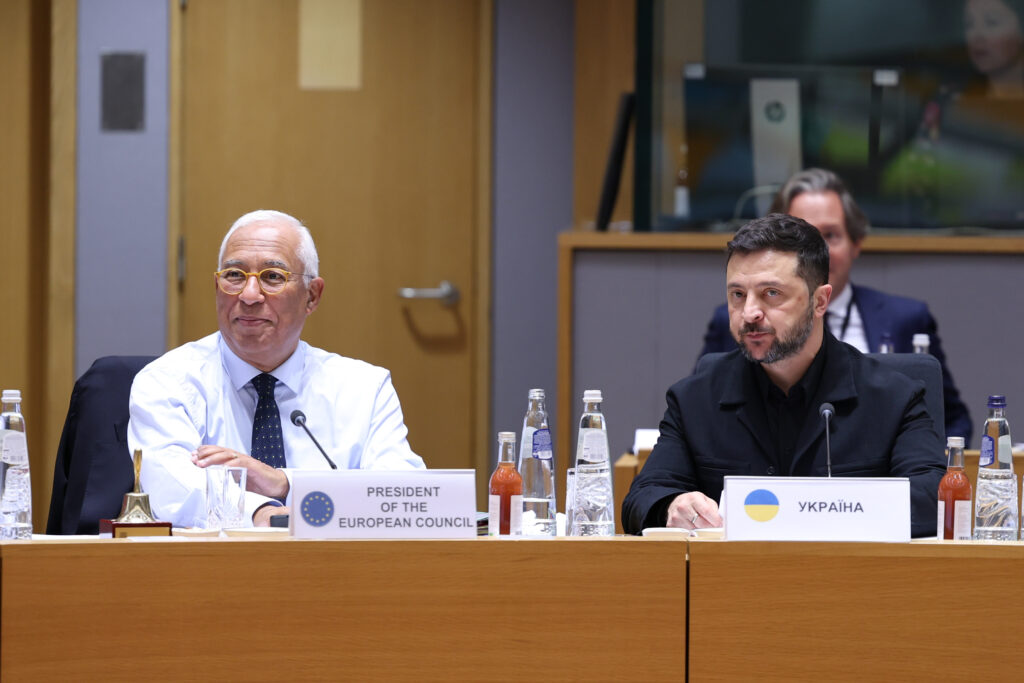
BELFAST — The European Council today threw its weight behind a new plan to grow Europe’s defense by 2030, as the continent continues its push to rearm amidst Russian threats and concerns over America’s reliability as a long-term security partner.
After convening a meeting in Brussels today and formally receiving the readiness roadmap [PDF] from the European Commission, the council shared a statement pledging to “deliver at pace and scale on this [readiness] objective, so that Europe is better equipped to act and deal autonomously, in a coordinated way, and with a 360° approach, with immediate and future challenges and threats.”
Unveiled last week, the readiness roadmap makes clear that by the end of the decade the continent “needs a sufficiently strong European defence posture to credibly deter its adversaries and respond to any aggression.”
The document also declares that Russia “poses a persistent threat to European security for the foreseeable future,” and notes member states will “contribute to a framework of long-term security guarantees to Ukraine that rests on: enduring legal arrangements; predictable multi-year finance and military supplies.”
The rush to bolster readiness comes on the heels of the European Union pushing forward with a €800 billion ($843 billion) Rearm package.
Core to the roadmap is a series of milestones that include the establishment of “capability coalitions in all priority areas” complete with lead or co-lead nations selected, alongside supporting implementation plans through to 2030, to be approved by the first quarter of 2026, with the coalitions launching by midyear 2026. Reflecting on those plans specifically, the European Council said in its statement that they would put the continent “in a position to better supply equipment in the quantities and at the pace needed.”
The long term defense readiness project also calls for 40 percent, at minimum, of European Union defense acquisitions to be carried out on a joint procurement basis by the close of 2027.
Other areas of focus include a proposal to develop four readiness “flagships” based on the European Drone Defense Initiative, the
Eastern Flank Watch, the European Air Shield and the European Space Shield. German defense minister Boris Pistorius has said Berlin wants to lead the Air Shield effort.
Member states will be able to add additional flagships at a later date, “agreeing as they see fit on the concrete objectives, task distribution, national budgets funds’ allocation, and the most appropriate framework to achieve them,” notes the document.
Both the European Drone Defense Initiative and Eastern Flank Watch are set to reach “initial capacity” by the close of 2026, with more mature functionality set for the end of 2027 and end of 2028 respectively.
The pair of flagships are considered the “most urgent” but the document also stresses that “work should accelerate to develop a European Air Shield to achieve an integrated, multilayered air and missile defence protection for Member States, fully interoperable with NATO’s Command and Control system.”
Regarding “immediate needs” EU members should prioritize anti-drone and air defense capabilities, outlined the European Council statement.
More broadly and tying the flagships together, the European Space Shield is expected to “ensure the protection and resilience of space assets and services.”
Both the Air Shield and Space Shield are slated to be launched in Q2 2026.
“The European Council calls for accelerated joint development of space assets and services that serve security and defence purposes, as well as for the protection of existing assets, including dual-use assets, given their importance for Europe’s strategic autonomy,” added its statement.
As part of the European Union’s next multiyear budget (2028-2034), the bloc plans on spending €131 billion on defense and space capabilities, through the European Competitiveness Fund. The sum is a five fold increase over the current budget cycle, according to a European Commission factsheet.