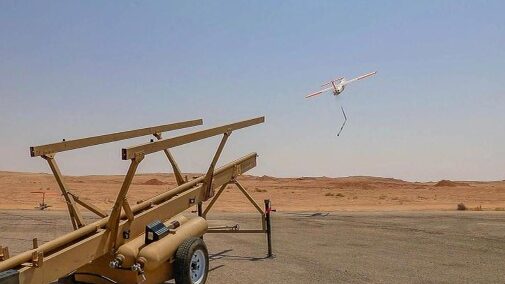
WASHINGTON — The Army is asking industry for counter-unmanned system components that it can use to support a potential small drone interceptor program in the future, according to a recent request for information.
As part of the solicitation, the Aviation and Missile Center within the Army Combat Capabilities Development Command is probing industry for components such as seekers, control actuation systems, batteries, mission computers and more, with the “primary objective” of providing the government with a database of “readily available component technologies that may be leveraged in support of a future C-sUAS Interceptor program,” the RFI reads.
“The evolution and proliferation of Small Unmanned Aircraft Systems (sUAS) in mass attack scenarios is currently being demonstrated in global warfare engagements. These types of engagements can quickly overwhelm current defense architectures and drive the need for deep magazines with versatile deployment options at low cost per kill,” the solicitation continues.
The RFI comes as the service makes strides to ramp up its c-UAS efforts in line with the expansion of global drone warfare, specifically in Ukraine’s ongoing war with Russia. Small drones, especially those in Groups 1 and 2 weighing up to 55 lbs., have demonstrated increasing levels of lethality as they’ve been able to take out multi-million dollar armored vehicles.
Already the Army has two ongoing counter-drone interceptor programs, the eXtended Range Counter-sUAS (XRC) Missile program and the Next-Generation Counter-UAS Missile (NGCM) program, which are designed to take down drones in the Group 2-3 range. (Group 3 drones can weigh up to 1,320 lbs.)
The XRC Missile program is still in the early stages as the Army released an RFI last fall searching for a missile that would work with the Stinger missile launcher, and eventually replace the Stinger missile, but no further update has been provided to date. The NGCM program is further along with Aeronvironment winning the contract for the program last month for its Freedom Eagle missile.
This leaves the Army still searching for an interceptor program that can defeat Group 1 drones, which can be more difficult to shoot down given their small size and the fact they emit less heat, making them harder to detect. But last week’s solicitation indicates that the Army may be gearing up to begin a new interceptor program for the smaller family of drones.


Winning the information war is as much about ideas and perception as it is about data
"Being able to tell the commander you don't need to do something is actually a pretty powerful message, as well."
According to the solicitation, the Army is looking for mature commercial off-the-shelf and government off-the-shelf missile components that are at a Technology Readiness Level 5 or above and have the “immediate availability” to be demonstrated in a lab environment. The service also said its looking for components that can be packaged within 40 millimeter to 70 millimeter diameter missiles, are “tolerant” to military environments and “launch accelerations of 30 G” and can be produced at high volumes with a low cost per unit.
Responses to the RFI are due no later than noon on Dec. 19.
Breaking Defense Video