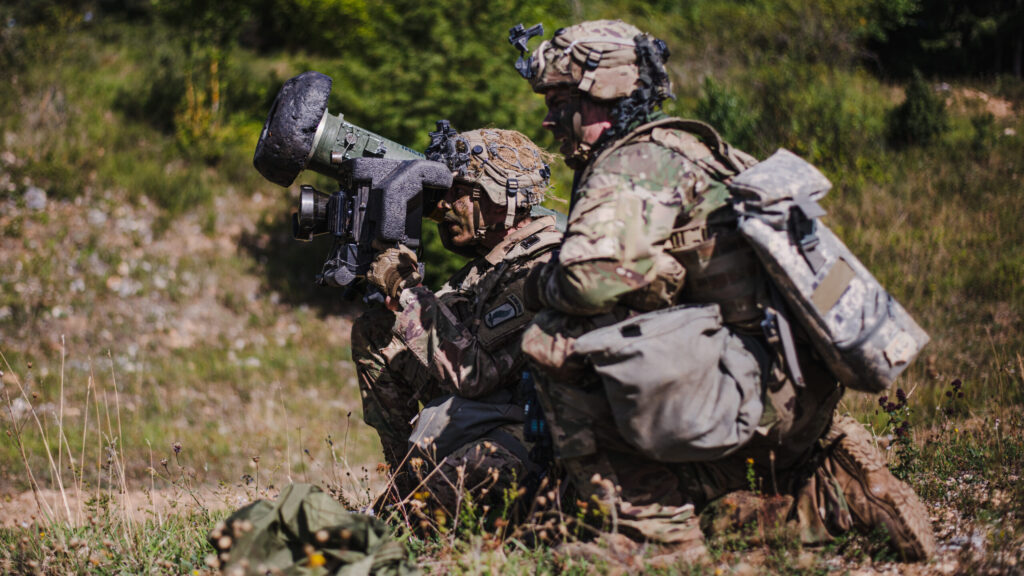
WASHINGTON — Raytheon and Lockheed Martin have delivered the first next-generation Javelin launcher units to the Army, the companies said in a joint release today.
Through the Javelin Joint Venture (JJV) partnership, the companies have been working for several years on the Lightweight Command Launch Units (LWCLU), which is set to replace the Javelin’s legacy launcher.
“Delivering the first LWCLUs to the U.S. Army reflects the Javelin Joint Venture’s commitment to continuously advancing technology for service members,” Jenna Hunt Frazier, president of the JJV and director of the Javelin program at Raytheon, said in the release today. “Our investments in modernization and production capacity ensures soldiers receive this cutting-edge capability faster.”
The new launcher incorporates modern infrared camera technology that allows for easier and faster target detection, and is smaller and lighter than the original CLU, according to a report on 2025 weapons testing from the Pentagon’s office of the director of operational test and evaluation. The new launcher is also “backward” compatible with old and new Javelin missiles, the report added.
In the joint release today, the companies said the LWCLU gives soldiers “twice the target detection and recognition” range while also reducing the size of the launcher by 30 percent and weight by 25 percent.
“The production and delivery of the LWCLU marks a pivotal step in modernizing the Javelin system for today’s warfighter,” Rich Liccion, JJV vice president and Lockheed Martin Javelin program director, said in the release today. “Its innovative design enhances mobility and survivability while preserving the precision firepower that users rely on.”
Today’s announcement comes after the Pentagon’s 2025 weapons testing report stated that “urgent fielding” of the LWCLU is expected to begin in the second quarter of fiscal 2026. However, as Breaking Defense previously reported, Army leaders said in 2024 that they wanted to begin fielding the first launchers in mid-fiscal 2025.

From directed energy to AI and hardening, JIATF-401 is widening counter-UAS options
There is no single answer to the drone threat, pushing the Pentagon toward a broader mix of defenses.
Even earlier, the Pentagon stated in its 2023 weapons testing report that the LWCLU did not meet its reliability requirement during the follow-on operational test and evaluation phase due to a “new software fault.” After the 2023 report was published, an Army spokesperson told Breaking Defense that the software issue was solved in 2024. The Pentagon’s 2025 weapons testing report also confirmed that the software issue had been fixed.
Neither Raytheon nor Lockheed Martin responded to requests for comment regarding the number of units the Army received, how much the units cost nor what Army units received the launchers. The Army likewise did not respond to a request for comment confirming the delivery of the LWCLUs or what units received the new launchers.
Breaking Defense Video