WASHINGTON and BERLIN — Germany’s first-ever national security space strategy envisions a plethora of new military capabilities to boost Berlin’s capacity to act independently to protect and defend its space assets — as well as play a stronger role in influencing European and global security policymaking.
“This Space Safety and Security Strategy forms an important part of Germany’s efforts to safeguard its interests and consolidate its position as a responsible actor in space,” German Foreign Minister Johann Wadephul and Defense Minister Boris Pistorius said in a foreword to the document.
The long-awaited “Space Safety and Security Strategy,” released today by the German Foreign and Defense Ministries, lays out in surprising detail the government’s priorities across sectors, including defense, and how they will be implemented over the next several years.
While stressing Berlin’s continued strong support for international law and space norms of behavior, the strategy exemplifies Germany’s pivot in recent years from its traditional position against the weaponization of space to a more robust military stance that includes the pursuit of offensive counterspace weapons.
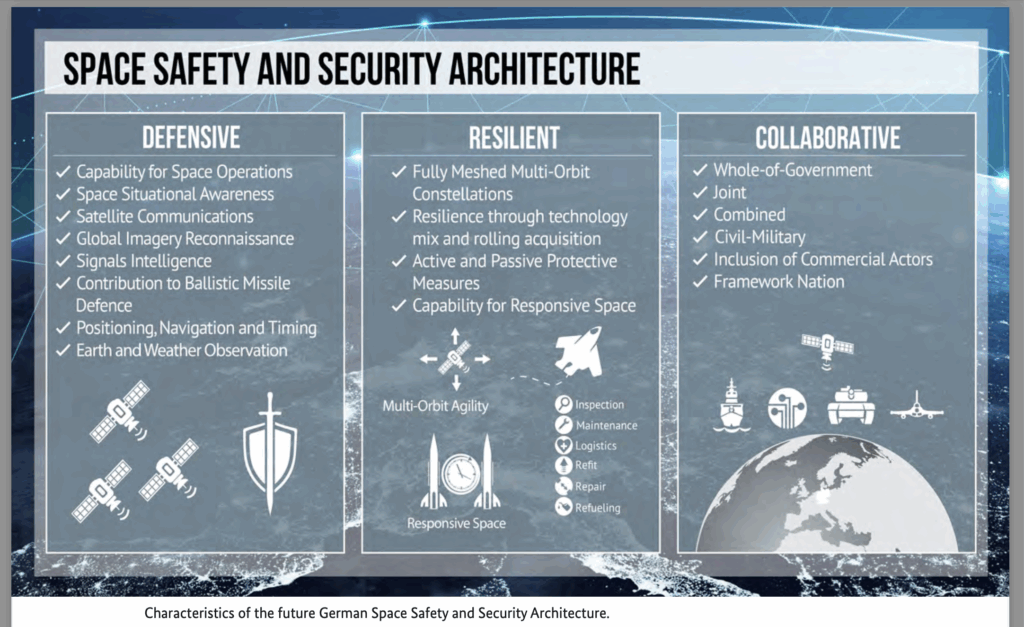
The strategy “sets out how Germany will decisively and rapidly expand its defence capabilities in space. It promotes the systematic integration of the space domain into defence planning within the context of national and collective defence, thereby contributing to Germany’s deterrence and defence capabilities as well as those of its NATO Allies and European partners,” the document explains.
German Space Command chief Maj. Gen. Michael Traut told the Berlin Security Conference today that under the new strategy the military is moving to improve its capacity across a wide range of mission areas.


European-made Black Hawk gets an armed upgrade
New kits turn Black Hawks into attack Hawks in just three hours.
“There will be some large programs to enhance and replace our existing SATCOM [satellite communications] capabilities. Secondly, we will broadly enhance our space reconnaissance and intelligence capabilities by adding some new capabilities, not only replacing and reinforcing our radar satellites or perhaps optical satellites, but getting new capabilities in terms of signals from space,” he said.
Further, Traut said, MoD will develop new capabilities for “satellite-based missile detection, because as you know Europe is not only under threat in space, but under threat by ballistic missiles and hypersonic vehicles. So this is on top of the list of our national defense executives and chiefs to provide a very capable, credible integrated air and missile defense.”
Finally, he added, German Space Command is working on creating more robust command and control systems and “space effectors, which do not necessarily need to be destructive.”
Far from being a wish list, MoD’s ambitious plans now have the resources to enable them following the Sept. 25 announcement by Pistorius that Berlin will invest €35 billion ($41 billion) over the next five years on space security.
The new strategy sets out 10 interagency priorities designed to create a stronger German space infrastructure across the civil, commercial and military sectors. These are:
- Maintaining, developing and strengthening the ability to operate, protect and defend our own national and European space infrastructure;
- Supporting a responsive, resilient and innovative space industry, including through the regular awarding of contracts by sovereign customers;
- Supporting an active, innovative research sector; Achieving the capability for military space operations;
- Achieving the capability for cyber operations and electromagnetic spectrum operations in the space domain;
- Closing capability gaps as quickly as possible, for example by pooling and sharing;
- Ensuring the national ability to take action with core strategic and military capabilities by reducing dependence on non-European actors through the maintenance, development and strengthening of our own space reconnaissance capabilities;
- Potential inclusion of German space systems into European and international alliances and partnerships such as NATO, space projects and organisations;
- Potential incorporation of European space infrastructure into national use;
- Developing the capability to establish space situational awareness as a civil-military task, including by building a sensor network with global coverage;
- Developing norms, rules and principles for responsible state behaviour within the United Nations framework.
Those priorities are to be implemented through three “strategic actions,” with each supported by a long list of specific subtasks: the first is, “Identify risks and threats, develop options for action;” then, “Promote international cooperation and sustainable order;” and finally “Build deterrence, strengthen defence capabilities and resilience.”
For example, under the first basket, MoD is charged with fielding a global sensor network for space situational awareness. In addition, the military is to pursue a new satellite constellation for tracking launches of adversary “rockets, satellites, HAPS [High Altitude Platform Systems] and hypersonic flight systems.”
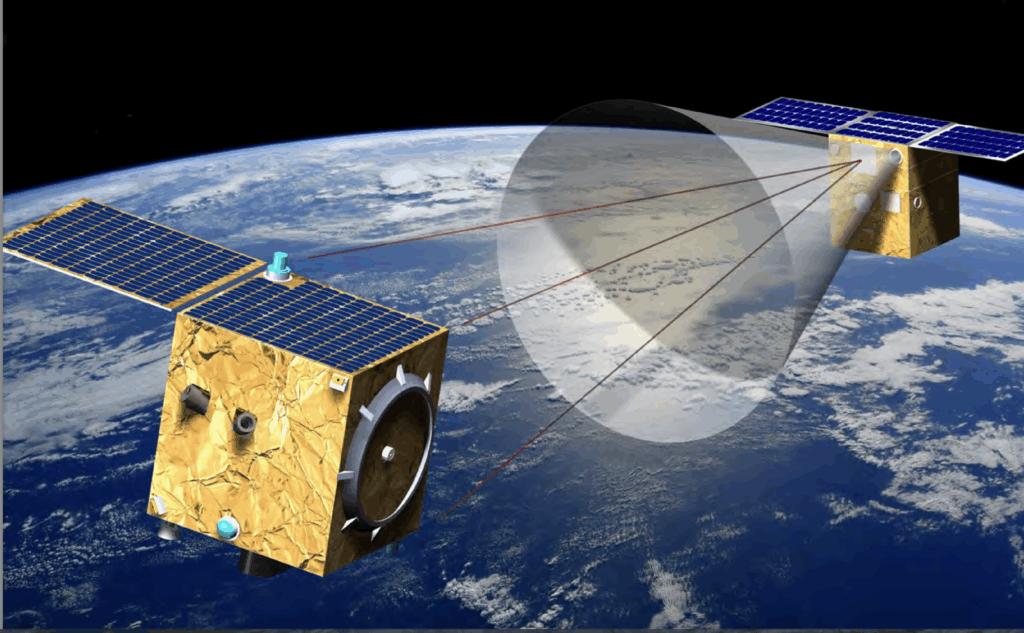
Under the third basket, the strategy calls for the development of “technical and operational capabilities to restrict/prevent military use of space by an adversary at national level and/or in cooperation with partners, including deep precision strike and hypersonic capabilities.” It also instructs MoD to field “highly agile low-signal surveillance and bodyguard satellites and reusable spaceplanes to inspect and effect an adversary’s systems.”
On a macro-level, the strategy is subtle, but clear, on Berlin’s ambitions to up its space game on the international stage.
“We are deepening our European and international cooperation as part of our own capability building and are increasing our whole-of-government resilience in space. We will expand Germany’s defence capabilities in space decisively and rapidly. We are also promoting the application and further development of space law,” the strategy states.
Further, the document pledges Germany to take a stronger role in guiding European space defense policy and investments.
“Germany is assuming more responsibility for the protection and defence of EU space systems and is working towards incorporating security and defence aspects in civilian programmes,” the strategy document says.
At the same time, Berlin also is pushing for Europe to establish strategic autonomy and reduce its dependence on “non-European actors” (with a beady eye on the US government and industry) for everything from ISR capabilities to space launch to future exploration/exploitation of resources beyond Earth’s orbit.
Breaking Defense Video