Congress is poised to pass sweeping acquisition reform, following similarly oriented acquisition reforms by the Pentagon. While observers disagree on how transformative these changes will be, the shared goal is clear: pull more commercial innovation into the US Joint Force.
Far less attention has gone to Congress’s and the administration’s attempts to help America’s most innovative tech startups overcome the second Valley of Death: the US defense export system. Both branches made meaningful headway this year, but much more is required to fully harness emerging technologies for allies and partners and strengthen their ability to deter conflict on their own.
Emerging and commercial technologies — decentralized communications networks, 3D printers, unmanned surface vessels with AI-enabled RF sensors, commercial drones, and advanced operational planning tools, and advanced operational planning tools — offer partners a chance to narrow the military power gap they face against larger adversaries when deployed effectively.
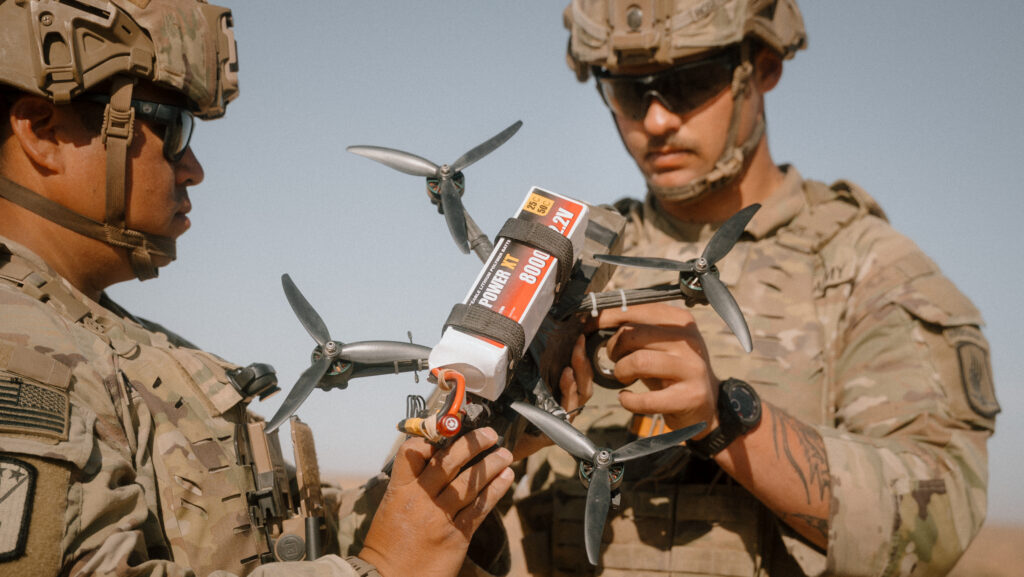
Take, for example, Ukraine’s swift adaptation of inexpensive, imported, commercially available quadcopters and hobbyist racing drones into lethal strike systems early in the war (which it now produces domestically), which shifted the tactical balance against a larger Russian force.
As new technologies reshape warfare and empower smaller militaries innovating with them operationally, the US must deliberately harness emerging and commercial tools to enable allies and partners to be more effective in deterrence and on the battlefield – particularly as the US asks allies and partners to bear more of the burden of managing conflict in their own backyards.
Despite this potential, the US Foreign Military Sales (FMS) and security cooperation systems were not designed to routinely transfer emerging technologies, or non-programs of record (NPOR). Instead, FMS was designed around major US weapons systems – or programs of record – where the Department of War (DoW) had already invested in development, testing, sustainment, and a cadre of acquisition personnel that bring deep expertise to building an acquisition plan and negotiating contracts on behalf of foreign partners. As a result, the US government has lacked clear guidance and repeatable processes to evaluate, validate, and contract for NPOR on behalf of foreign partners.
Similarly, for innovative companies seeking to export their system through Direct Commercial Sales (DCS), despite significant reforms in 2013 the US export licensing and technology transfer system have not kept date with the state of technology. Lack of transparency, and dated criteria for what counts as a controlled defense article versus a dual-use item continue to discourage innovators from entering foreign markets.


Turning R&D into reality to meet the challenges of the modern battlefield
Knowing when to build on commercial systems and when to develop something new can be the difference between parity and information dominance.
Given that national security potential – and the fact that the $318B US defense export market now surpasses annual US defense procurement spending – it is vital for US national security and economic competitiveness to modernize how these technologies are sold and licensed.
A growing number of leaders in Congress and the administration recognize the problem. The conferenced FY26 National Defense Authorization Act directs the Secretary of War to establish the first office for supporting NPOR acquisitions for foreign partners—which could become an important hub for identifying promising systems, highlighting them with allies, and coordinating interagency review.
The Defense Security Cooperation Agency (DSCA) also issued its first formal guidance for NPOR cases in August and November, giving the security cooperation community clearer rules and establishing NPOR as a normalized category within FMS.
Meanwhile, the Executive and Legislative Branches streamlined and committed to regularly reviewing the government-to-government transfer list (formerly the “FMS-only list”). And the Department of State launched a unified, public portal where export license applicants can track the status of their applications, improving transparency long sought by industry.
These steps matter—but they fall well short of the structural changes needed to ensure emerging technologies can move through the US export system at the speed competitors and partners now require. To build on 2025’s progress, Congress and the administration should tackle the deeper barriers in 2026, including:
- Institutionalize excellent yet ad-hoc processes and culture that bring emerging and commercial technologies into senior diplomatic, military, and operational capability discussions with key allies and partners;
- Establish programs and funding to give the Departments of War and State the personnel and expertise required to identify, test, evaluate, advise allies and partners, and negotiate contracts for NPOR for allies and partners;
- Require and resource a technology-driven process for more regular, time-bound updates to the US Munitions List (USML) and Commerce Control List (CCL), allowing items to move from USML to CCL in step with technological maturity;
- Allocate resources for the Department of War to conduct Operational Test & Evaluation (OT&E) for emerging technology solutions that could enable foreign partners to better manage their own security needs but may not be relevant for US joint force requirements, and establish mechanisms for allies and partners to contribute to those OT&E costs and infrastructure requirements;
- Run a systematic review of where POR and NPOR overlap, enabling the export and acquisition communities to leverage existing US expertise where possible in testing and developing contracting pathways for NPOR; and
- Ensure ongoing FMS review and oversight conversations include emerging technologies, and consider the impact of recent reforms – from the Department of War’s commercial-first policy, to the FY26 NDAA’s provision allowing only defense primes to enter into early manufacturing agreements for foreign military sale cases, to moving DSCA under the Under Secretary of War for Acquisition and Sustainment, to establishing an Assistant Secretary of War for International Armaments Cooperation – on the quality, combat relevance, and cost of technologies available to US allies and partners.
Ultimately, the question is not whether emerging technologies matter for allied deterrence, but whether the US defense export system is equipped to move them at the pace today’s security and commercial realities demand. Congress and the administration have begun to adjust the system but sustaining US national security and economic advantage will require fully integrating commercial and non-program-of-record technologies into deterrence strategies and the authorities and funding that support them. Without that shift, Washington risks limiting both partner capability and US influence in an increasingly competitive global environment.
Jamie Morgan is a Non-Resident Fellow at the Carnegie Mellon Institute for Strategy and Technology. She has worked for nearly 20 years on US defense, technology, and security cooperation issues, including as a Navy combat veteran, in the US Congress (2015 – 2021) and at the Department of War (2021 – 2025).