
The newly released US National Security Strategy prioritizes homeland defense and deterring China over Europe. Meanwhile, comments from the White House indicate a desire to draw down America’s posture on the continent.
So how can Europe keep America engaged? One answer may lie in the rapidly expanding European munitions base,
The Ukraine/Russia conflict shined a spotlight on the global supply crisis for artillery shells and missiles. Two decades of the War on Terror, with no peer competitor, led to limited munitions purchases, focusing on just-in-time efficiency rather than mass production. Lacking a crisis, delivery backlogs were accepted, foreign military sales deliveries were pushed back, and budgets were cut in favor of more pressing needs. Ukraine’s expenditure continues to outpace the industry’s ability to restock inventories, while Xi Jinping’s mandate for China to be prepared for a Taiwan invasion by 2027 draws closer.
More than any other commodity, munitions are ripe for international collaboration and cooperation, and over the last two years, Europe has launched an industrial upswing. The EU’s Act in Support of Ammunition Production (ASAP) is pumping hundreds of millions of euros into chokepoints across the 155mm and propellant supply chain, targeting a capacity of roughly 2 million shells per year by the end of 2025. Major primes, Rheinmetall foremost, are adding new lines to reach 1.1–1.5 million 155mm shells annually by 2027.
Parallel efforts prove that Europe can source and move rounds at scale: A Czech-led initiative aggregated shells worldwide when transatlantic aid stalled, demonstrating the value of agile procurement and alliance-wide financing in the face of complex geopolitical challenges. Examining critical source materials in the supply chain, Romania is leading efforts to capture some of China’s rare earth market share, enabling EU production of critical items, which currently accounts for less than 3 percent of global production. Success will ensure European access to the most crucial of materials.
The underlying lesson is one of industrial integration: Deliveries accelerate when allies coordinate financing, standards, and logistics.
For Washington, a strong transatlantic munitions base is not just Europe’s victory — it’s a vital strategic asset. If Europe can reliably supply NATO with reloads, the US can focus advanced production and stockpiles on Indo-Pacific and homeland defense, confident that European security won’t be compromised.

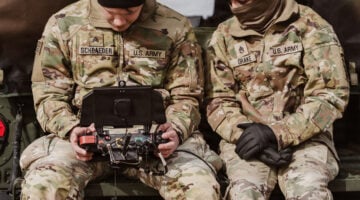
Interoperability becomes the price of entry for next-gen warfighting tech
AI, autonomous systems, cyber, and EW converge as industry targets faster battlefield effects.
Bilateral relationships can provide the US with critical capabilities for an increasingly strained relationship with China. Further joint capability and industrial coordination permit leveraged production of both simple and exquisite munitions and effects. More importantly, it frames business transactions that each side’s leaders can point to as commercial and readiness success.
Simply put, when Europe fills NATO’s magazines, America gains the flexibility it needs. In turn, Europe becomes a key part of the US defense industrial supply chain, ensuring there are reasons to maintain defense ties — and, potentially, giving an incentive for why the US should keep forces in the region.
To prepare for any shift in US posture, Europe must act now to codify a combined munitions and fires posture. Within the next 12 months, several items will set the stage for a smooth transition from legacy posture to shared mission responsibility. Specifically:
Formalize a policy to align US and European production planning, licensing, and surge mechanisms. Given the fragility of a limited domestic production base, such a compact would permit the US to rely on European capacity during global contingencies. Providing European firms with predictable US orders and technology further develops a friend-shored base for assured munitions access. This arrangement would signal that Europe’s output directly enhances American readiness, not competition.
Designate certain European plants as “surge ready” under NATO oversight, with audited stockpiles of critical inputs such as propellant, primers, and metals. If activated, these plants would fill alliance orders under common procedures and security protocols. Having visible surge nodes lowers US risk and justifies investments in protection and shared logistics. By framing output as an enabler of US global flexibility to deter China, Europe could communicate value as a partner worth defending.
And finally, launch co-funded programs in energetics, smart munitions, and advanced propellants that explicitly allocate workshare across the Atlantic. Shared intellectual property and production capacity would make US protection of Europe’s defense base a matter of self-interest. Hardening plant infrastructure against cyber and kinetic disruptions, while creating a diverse and dispersed production base, further cements the relationship.
These measures set the stage for a more accountable alliance posture that sustains US engagement and European autonomy.
Load-sharing on munitions converts allied will into actual capability. It responds to the core question, “who is doing what, and can they sustain it?” by providing hard metrics such as numbers, rotations, and deliveries, rather than communiqués. Congress can verify that production expansion covering routine European missions is beginning to fill allied magazines and therefore recognize that Europe’s factories both contribute to overall US security while also being worthy of protection.
Through this, NATO addresses America’s most formidable problem: how to deter in two arenas simultaneously — meaning imminent US “homeland-and-China-first” strategy is not a threat to NATO. Rather, it’s a to-do list to gain an opportune transatlantic advantage and preserve American interests.
Capt. Michael Kidd is an instructor at the Dwight D. Eisenhower School for National Security and Resource Strategy, National Defense University, and a former Operations Branch Head at the NATO Joint Logistics Support Group, Naples, Italy.
Giana Farry is with the University of North Carolina at Chapel Hill, Peace, War, and Defense Program.