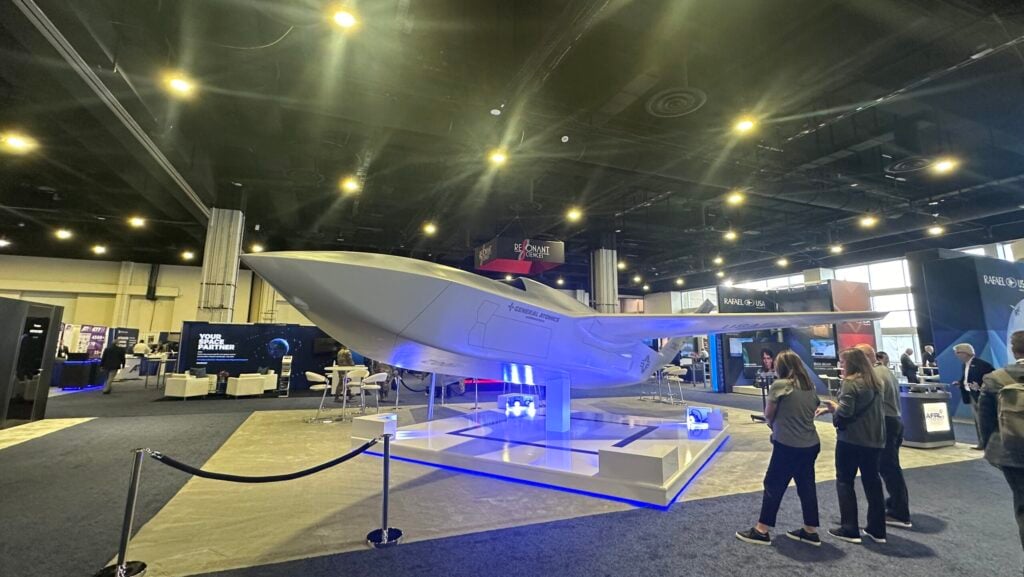
For the past several years, the Pentagon has made broad commitments to integrating AI into our defense systems as a strategic necessity. The United States Air Force has even said it wants thousands of AI-driven “loyal wingman” type aircraft designed to support human pilots rather than fully replace them.
Defense companies across the spectrum have rolled out solutions, demonstrating that we have the technology to fly fully autonomously. But the question that has mostly percolated around this topic over the last decade remains the same: whether the Pentagon should be focused on augmenting human pilots with this technology, or replacing them entirely.
Debating this topic with my aerospace engineers, we believe both sides are thinking about it in the wrong way, still too bound by what has come before to be able to think about what may be coming next.
Human pilot advocates think about what’s missing in the unmanned aircraft: the immediate presence and human judgement of a pilot who cannot be jammed or hacked. As we all know from observing AI platforms, even the most sophisticated generative deep neural net is only as good as its training data set and supervised learning. Situations or objects very far from what the system was explicitly trainedon can be a challenge. And discriminative AI algorithms are prone to simply ignoring something they don’t recognize as if it doesn’t exist at all — not a great behavior in a close combat support role.
Advocates for pilotless aircraft also focus on what’s missing in an unmanned aircraft. Every pilot is expensive to train. An AI pilot is trained once. The airplane is made more expensive and somewhat less capable by the need to accommodate a human being. A pilot who is not in the cockpit cannot be killed and thus can take on more dangerous missions.
Both arguments are valid, and the Pentagon is likely right — the best outcome is a layered approach of manned and unmanned aircraft. But that’s not what’s interesting in this debate.
There is a greater argument to be made about what we consider the role of aircraft to be during a conflict. Instead of applying AI to replace what we have traditionally used aircraft for, why not consider new possibilities for the support AI aircraft could lend to our warfighters?
The interesting thing about a pilotless aircraft is NOT the absence of a pilot. What’s truly exciting is what an aircraft can be designed to do when there is no pilot at all.
Let’s think about the possibilities. A fighter pilot in an F-18 can handle a 7.5g maneuver. How about an autonomous plane designed for 20Gs? What does a mission profile look like with that option in play?
Runways take space, time to build, and can’t be moved. How about a 10G vertical launch canister using a cheap solid rocket motor and returning to a capture net? (My old colleague Dieter barely survived a similar idea that lacked AI, as a Ba349 Natter pilot). You could establish an AI air base anywhere in about a day!
A fighter uses 20 percent of its fuel load taking off and landing. But a plane designed from the ground up without a human pilot could use a solid rocket motor to perform a high G vertical takeoff that a pilot couldn’t handle — and suddenly, it doesn’t need that fuel load for takeoff. And what about transiting a fighter to the mission area hypersonically in five minutes on that solid rocket motor?
The newest aircraft carrier has a complement of 90 aircraft. What if we could expand that arsenal to 900? 2,000? Smaller pilotless, vertical takeoff planes do not need space for a runway. This would increase the speed in which we could deploy across regions without the need for more, expensive aircraft carriers to do so.
If we work these theories to their logical conclusion, the ultimate answer for the Defense Department may not necessarily be the “loyal wingman” model currently favored by the Pentagon, but rather separate roles throughout an air campaign for manned and unmanned aircraft.
Greatly simplifying, an air campaign has three jobs:
- Establish Air Dominance at the very beginning, destroying the enemy’s air force and owning the skies.
- Strategic Strike that can reach deep into the enemy’s territory and disrupt their ability to support the front and the means for war.
- Support Ground Troops with close combat air support, search and rescue, etc.
Initial air dominance and strategic strike are both obvious applications for AI aircraft. The mission would be simple; kill everything flying, communicating or shooting in the air, and take out enemy assets on the ground.
This airspace is defended and dangerous. The high speed, maneuverable, and heavily armed AI planes could take off unexpectedly from their covert launch sites, aggressively attack, and quickly dominate without the loss of any US personnel.
Maintaining ownership of the skies would shift to piloted aircraft, as would close combat support of ground troops. The flexibility, judgement and reliability of human pilots excel in this role.
I hope that by this 80,000-foot discussion (pun intended), you can see the broad implications of a truly disruptive combination of technologies and how they could be used to quickly end conflicts, reduce the loss of life, and ultimately deter conflict from beginning in the first place.
Tory Bruno is the CEO of United Launch Alliance giving him direct insight into the intersection of automation, AI, and human-machine testing within high-reliability systems. Tory is a Member of the National Academies, Honorary Fellow of the American Institute of Aeronautics and Astronautics, and Academician of the International Academy of Astronautics. Tory writes frequently on aerospace innovation and national security.