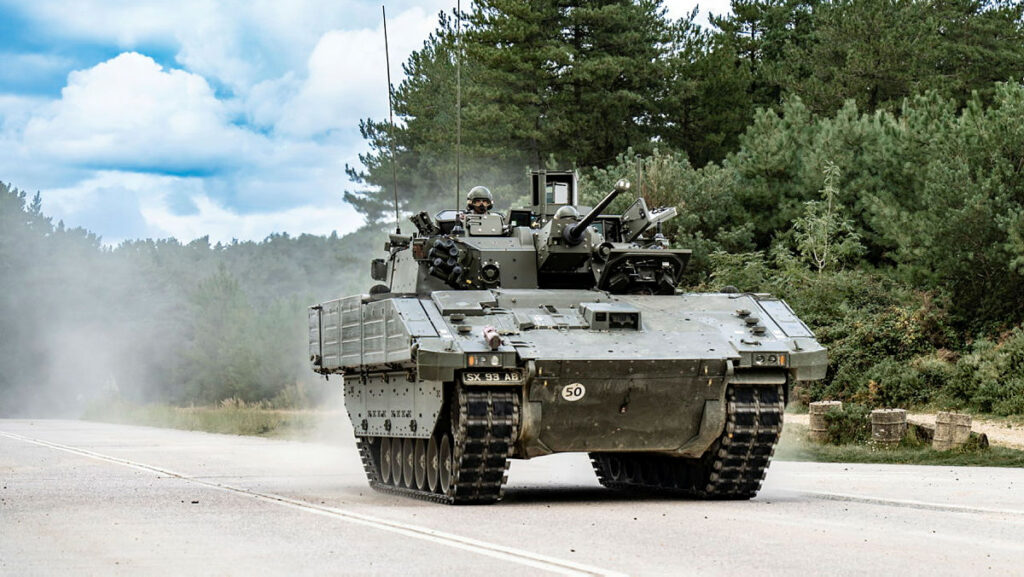
BELFAST — UK Minister for Defence Readiness and Industry Luke Pollard said today he would order a review into advice he received from top military officials that the Ajax armored vehicle was “demonstrably safe to operate” just weeks before so many soldiers grew sick from riding in the vehicle that the program had to be paused.
“Until I see the findings of the preliminary report into what happened, I don’t want to make a judgment as to the process that led up to it, because I want to see what happened in the first instance,” Pollard told UK lawmakers today.
The latest Ajax setback involved “around” 30 Ajax personnel reporting noise and vibration “symptoms” during a training exercise on Nov. 22, after which Pollard called for a two week “pause” on use of the platform for training and operations, pending a safety investigation.
He said in a Nov. 26 parliamentary statement that “those affected [in the initial] training exercise received full medical care and attention, and continue to be monitored.”
The Ajax’s suspension comesafter the UK declared that the fighting vehicle had reached an initial operational capability (IOC) milestone on Nov. 6, eight years later than planned and after the vehicle had to undergo a new round of tests due to excessive vibrations that left some service personnel reportedly suffering from hearing loss.
Pollard told lawmakers that before IOC was met he received “assurances in writing by senior Ministry of Defence … personnel that the [Ajax] system was safe,” without naming names. Today, however, he named British Army chief Gen. Roly Walker and the “national armaments director who was in place at the time,” presumably a reference to Andy Start who recently left the post, as those who had given the advice.
Labour MP Derek Twigg told Pollard, “Clearly somebody didn’t understand what happened [was happening] because he advised you that everything was okay.”
In response Pollard said, “I want to see what the results are, but I share the general concern I think you’re raising.”


How integrated modeling and simulation accelerates Europe’s defensive edge
Lockheed Martin’s ACES platform delivers a shared virtual battlespace that strengthens readiness, interoperability, and faster decision-making through advanced, integrated modeling and simulation capabilities designed for evolving global threats.
Pollard said he expects the preliminary findings from a British Army investigation to be in hand, “very shortly.”
A MoD spokesperson told Breaking Defense in a Monday statement, “Safety investigations during Ajax’s extensive trials — covering more than 42,000km [26,000 miles] — found no systemic issues with the vehicle, and that information formed part of the advice to declare IOC.”
The MoD declined to comment on why vibration issues have re-emerged, the potential impact Ajax’s suspension could have on meeting Final Operational Capability (FOC) and why the UK plans to delay a deployment of the vehicles, in support of its Forward Land Forces, to Estonia. (The Estonian Ministry of Defense had circulated a Nov. 26 statement in which Defense Minister Hanno Pevkur said he expected the vehicles to arrive in Estonia “as early as next year,” but that statement was later replaced with another one online that just said they should come “within the next few years.”)
Besides operational setbacks, the latest technical problems could also damage Ajax export sale prospects. Last month, the UK MoD said in its IOC announcement that the vehicle has “significant export potential, with active conversations with multiple potential customers already underway.”
General Dynamics UK produces Ajax out of its Merthyr Tydfil, Wales facility, with a last of 589 vehicles, in six variants, planned for delivery to the British Army in 2029. But after that, the line would presumably rely on export orders. In response to the initial wave of technical problems relating to vibration and noise issues, the UK withheld payments to the manufacturer, restarting them in 2023.
The company did not respond to a request for comment on Tuesday, but in 2021 pushed back on a internal military report that described major Ajax issues, including crews reporting joint pains and loss of hearing. “Recent media accounts have disparaged the performance of Ajax. These accounts are without foundation in fact, and the actual performance data refute them,” said the manufacturer at the time, as previously reported by Breaking Defense.
The MoD says Ajax vehicles are “armed with a range of weapons and state of the art sensors, delivering reconnaissance capabilities to identify enemy targets on the battlefield, and giving the British Army the fighting edge on the frontline.”
The vehicle is set to be a core part of the service’s armoured and deep reconnaissance strike brigades. More than 160 Ajax platforms have so far been delivered to the British Army, according to General Dynamics.