WASHINGTON — House and Senate appropriators have agreed on an $838.7 billion defense topline for fiscal 2026 in a bipartisan deal that would boost defense funds by $8.4 billion over the Pentagon’s request. But they declined to include tens of billions of dollars for additional requests made by the department in recent months.
Since the Defense Department released its budget request last June, it identified more than $50 billion in what it said were additional funding needs.
That includes $26.5 billion in funding discrepancies between its FY26 request and the reconciliation bill — essentially a laundry list of accounting errors that resulted in shortfalls to key programs like the Virginia-class submarine. It also included an additional $2.3 billion in “emergent requirements” and a whopping $28.8 billion sum for multiyear munitions procurement contracts.
While the Appropriations Committees remain open to working with the Pentagon to solve those shortfalls, “the agreement was unable to fully fund most of these unfunded requirements and priorities,” appropriators wrote in a joint explanatory statement accompanying the bill.
“The agreement welcomes the Department’s focus on strengthening our military, modernizing its capabilities, expanding industrial capacity, and replenishing munitions stockpiles. However, the agreement observes that solving these real challenges will be difficult without sustained funding through a predictable, annual appropriations process,” it states.
The bill effectively dampens the Pentagon’s last-minute push to add more than $28 billion in multiyear funding for 13 critical munitions.
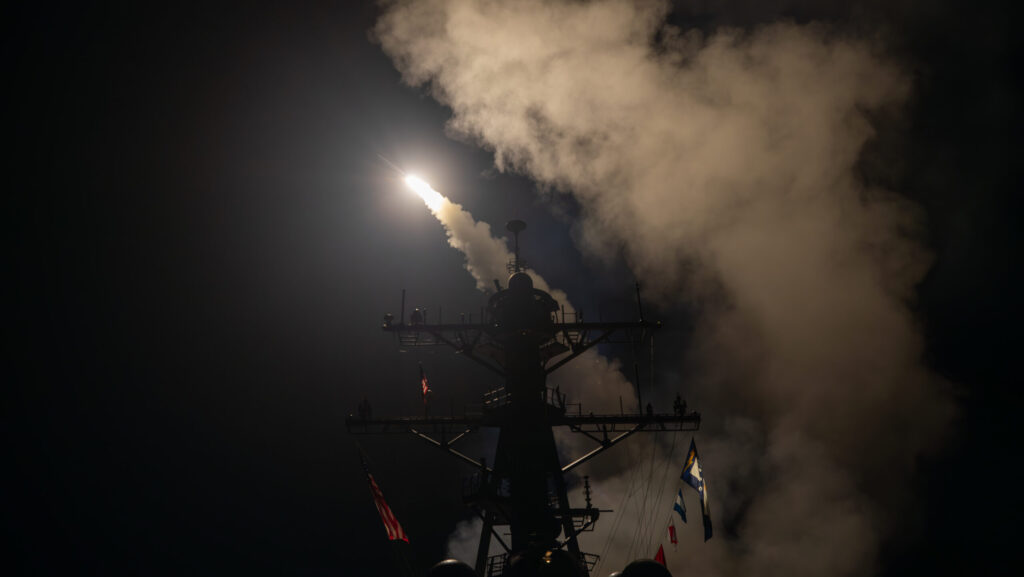
Instead, appropriators boosted funds for those weapons by $1.8 billion and approved eight munitions for multiyear procurement: PAC-3 missiles, Standard Missile 6 (SM-6), Terminal High Altitude Area Defense (THAAD), Advanced Medium Range Air to Air Missiles (AMRAAM); Tomahawk cruise missiles; Long Range Anti-Ship Missile (LRASM), Joint Air-to-Surface Standoff Missile Extended Range (JASSM-ER) and Standard Missile 3 Block IB (SM-3 IB).


Meeting Zero Trust goals while maintaining information dominance
Balancing security and access to data are critical to providing users with trustworthy, reliable data for real-time decisions.
The previous, broader request had been criticized by key lawmakers, including Sens. Mitch McConnell and Chris Coons, the top Republican and Democrat on the Senate Appropriations defense subcommittee. The justification document puts some complaints in writing, saying that the Pentagon “has not demonstrated with necessary documentation” that the munitions meet the requirements for multiyear procurement authority as spelt out in law.
“The proposal was presented absent an official budget request, and without adequate funding offsets or additional topline. Concurrently, the House and Senate Defense Appropriations Subcommittees had to address substantial reconciliation funding incongruencies and other Department priorities with limited discretionary resources,” appropriators stated. “This resource limitation constrained Congress’ ability to provide the necessary funding to fully support the MYP [multi-year procurement] initiatives as presented.”
In addition to the relatively small boost in funding for munitions, lawmakers attempted to make headway on a key supply chain challenge for weapons: solid rocket motors. The omnibus bill provides $500 million for solid rocket motor makers to modernize or expand their facilities, with $150 million of that sum going specifically to qualify second sources of supply.
RELATED: With the boom for solid rocket motors for missiles, a perilous crunch in the supply chain
“The Secretary of Defense is directed to prioritize actions that enhance competition within the solid rocket motor industrial base, including the introduction of new entrants, expansion of qualified suppliers, reduction of barriers to entry, and mitigation of single-point-of-failure risks,” the justification document states.
Appropriators have demanded several reports on munitions: one that would document all expended munitions, another that would compare requested munitions quantities with the maximum amount that could be manufactured by the industrial base, and a third on potential sources of new, low-cost munitions.
Lawmakers also direct the department to begin submitting semi-annual reports on the status of all multiyear munitions contracts until all of the weapons covered under the awards have been delivered.
Poking The Pentagon Over Golden Dome
For Golden Dome — another key defense priority of the Trump administration — lawmakers complained that the Pentagon has failed to provide budgetary details and justification for the $23 billion allotted to the program as part of last year’s reconciliation bill.
“Due to insufficient budgetary information, the House and Senate Defense Appropriations Subcommittees were unable to effectively assess resources available to specific program elements and to conduct oversight of planned programs and projects for fiscal year 2026 Golden Dome efforts in consideration of the final agreement,” appropriators write in the justification details.
As a result, the bill directs the Pentagon to submit a comprehensive spending plan for Golden Dome within 60 days after the enactment of the legislation, with detailed information on planned spending obligations from FY25 to FY27. The department must also compile a separate budget justification book for Golden Dome starting in FY28.
The budget agreement also diverges from the Trump administration’s budget request on Ukraine, adding $400 million to the Ukraine Security Assistance Initiative account.
Beyond that, here’s a breakdown on how each of the services fared in the FY26 defense spending bill:
Army’s Agile Funding Falters
After the Army spent several months pleading the case for agile funding, appropriators ultimately turned down the service’s request, stating that there are already “sufficient authorities to restructure its internal programming and budgeting processes” within the Defense Department. Lawmakers added that enacting such agile funding practices is “unlikely to improve program execution.”
The decision comes after the Army requested earlier this year that its budget lines for electronic warfare, drones and counter drone capabilities all be consolidated into one line, with the culmination of these lines equaling about 1 percent of the service’s budget, according to Army Secretary Dan Driscoll.
As it is now, and will remain per the appropriators’ decision, the Army, for example, cannot take money from one drone program line item and redirect it for a separate drone program. Driscoll previously complained that makes it impossible to adjust priorities based on need.
We are in, like, a holy war over whether we’re going to have the authority for 1 percent of our budget to have the flexibility to buy different makes and models,” Driscoll told reporters during a roundtable in September.
The bill also slashes funding for the service’s Armored Multi Purpose-Vehicle (AMPV) from a requested $554 million down to $415 million, with appropriators justifying the decrease due to “support ahead of need” and “funding aligned with the ATI [Army Transformation Initiative]”.
The service also requested over $135 million for upgrades to its Stryker vehicle, but the bill allocates just $28 million, with appropriators justifying the decrease due to a handful of the vehicle’s systems being “early to need.” The bill also decreased funding for the ground mobility vehicles from $308 million to $246 million because the Infantry Squad Vehicle’s funding was similarly “ahead of need.”
Further, in a surprising switch up, the bill gives $345 million for the Joint Light Tactical Vehicle (JLTV) program, though the Army only requested a little over $45 million for the vehicles after the service effectively cancelled the program in line with the ATI.
In terms of Army missile procurement, the bill provides an additional $500 million for PAC-3 funds and over $100 million for the Precision Strike Missile (PRSM) program.
Regarding Army aviation, appropriators provided $240 million for MQ-1C Gray Eagle 25M aircraft for the Army National Guard, which the service did not request any funds for previously this year, and provided an additional $360 million from $1.6 million for the service’s remanufacturing AH-64 Apache helicopter program.
In other cuts, appropriators decreased funding for the Army’s tactical network communications from $866 million to $665 million saying the request was “early to need.” Appropriators also slashed funds for the service’s communications and electronics line item from over $110 million to nearly $47 million, citing a “classified adjustment.”
Navy’s F/A-XX Gets Nearly $900 Million
The Navy’s sixth-generation F/A-XX fighter got a lifeline in the FY26 spending bill, with appropriators adding $897 million above the president’s request to continue development of the aircraft.
Appropriators appear to be forcing the department’s hand on awarding an F/A-XX contract despite questions within the Pentagon about whether to proceed with the program. The bill states that funding granted in FY26 should be used “for the purposes of awarding the EMD contract limited to one performer in accordance with the acquisition strategy to achieve an accelerated Initial Operational Capability (IOC).”
The bill also directs the Navy to submit a report with a revised schedule for F/A-XX and information on “any programmatic, budgetary, or policy barriers that have delayed execution” of the program, noting that the department “expended nearly all fiscal year 2025 funding on contract extensions with minimal demonstrated value to the program.”
Beyond the huge plus-up for F/A-XX, the bill includes $27.2 billion for 17 ships, including include one Columbia-class ballistic missile submarine, two Virginia-class fast attack submarines, three Medium Landing Ships, and one TAGOS SURTASS ship for anti-submarine warfare.
It also adds $242 million for long lead items for FF(X) frigate program, $800 million to procure three additional Medium Landing Ships, and $320 million for two additional ship to shore connectors.
As for aircraft, the bill includes $1.9 billion for up to 14 CH-53K heavy transport helicopters for the Marine Corps, $1.1 billion for three E-2D Advanced Hawkeye aircraft for the Navy, and $387.7 million for three MQ-25 tanker drones. It also added about $500 million for four KC-130Js for the Navy Reserve.
The agreement also includes $1.5 billion for the maritime industrial base “to invest in critical areas including supplier capacity and capability, strategic outsourcing, workforce training, and technology and infrastructure,” a summary of the bill states.
Air Force Gets $1.1 Billion For Wedgetails, Part Of Procurement Boost
The Air Force also saw big shifts in its funding accounts, as appropriators moved to protect key programs, infuse cash into top priorities and trim funds where they saw fit. Perhaps the most notable change concerns the E-7 Wedgetail: despite the Pentagon’s attempts to kill the radar plane, appropriators would provide $1.1 billion to continue rapid prototyping and transition the effort into engineering and manufacturing development.
Procurement also saw a big boost, with appropriators landing at a top line of roughly $20 billion alongside billions of dollars from the One Big Beautiful Bill. To buy more new tails, appropriators would provide $976 million for six C-130Js for the Air National Guard, $474.4 million for two EA-37B Compass Call electronic warfare jets and $250 million for a C-40C VIP airlifter. Appropriators further added $115 million for one additional F-15EX fighter jet and $165 million for a polar airlifter LC-130J.
Curiously, $527 million was added for a classified adjustment. Procurement of the B-21 Raider was cut by $620 million to roughly $2 billion, but saw a $409 million boost in development funds.
The tri-variant F-35 also saw a plus-up, but the money doesn’t appear to increase the number of jets the Pentagon is seeking. Instead, appropriators would disburse an extra $401.6 million for “revised economic assumptions” for the Air Force’s share of the program — possibly suggesting a price jump for the aircraft. In an effort to shore up the F-35’s sustainment amid dismal availability rates, appropriators would also add $440 million to boost spare parts across Air Force, Navy and Marine Corps jets.
The service’s request for missile procurement remained largely intact with a trimmed topline of nearly $4 billion, the largest change being a classified $190 million reduction.
The service’s R&D account, meanwhile, took a roughly $1.4 billion hit for a final topline of $50.6 billion. The bulk of that change appears to come from a line item for classified programs, where appropriators cut $4.2 billion from a $22.3 billion request, citing only a “classified adjustment.” Meanwhile the in-development next-gen F-47 fighter jet got an extra $500 million due to “reconciliation funding incongruence.”
Space Force Budget Shuffle
The FY26 appropriations bill adds $642 million to the Space Force’s procurement budget, bringing the total to slightly over $4 billion. Lawmakers also chopped $569 million from the service’s $15.5 billion research, development, test and evaluation (RDT&E) budget, for a total of $14.9 billion.
In particular, appropriators shifted $156 million from the service’s RDT&E budget for Long Range Kill Chains aimed at tracking targets on the ground from space to the procurement of “auxiliary payloads” related to ground moving target indicator (GMTI) sensors being deployed under a joint effort with the National Reconnaissance Office (NRO).
The move was part of a larger and complicated shuffle of RDT&E funding requested by the Space Force for Long Range Kill Chains, GMTI, the classified MILNET space communications program and the Space Development Agency’s planned Transport Layer of data relay satellites.
Appropriators zeroed out the $1.9 billion RDT&E request for Long Range Kill Chains, including a cut of $82 million due to a lack of adequate justification as well as the aforementioned movement of funds. The GMTI budget was cut by $344 million to bring the total down to slightly more than $719 million from the request of $1.06 million — with $189,500 going to two new procurement lines for these sensors.
The service’s $277 million request for the secretive MILNET program, which is also being pursued under a joint effort with the NRO, was zeroed out. However, $41 million was transferred to the budget line that funds projects transitioning from prototypes to programs of record.
Finally, the appropriations bill adds $50 million to the SDA’s budget in order to “maintain warfighter centric capabilities” within the PWSA architecture.
Part of the rationale for the budget shuffling appears to be growing concern among lawmakers about recent moves by the Space Force to rely on collaboration with the NRO, via its classified program to put intelligence, surveillance and reconnaissance satellites in low Earth orbit based on what is reported to be a sole-source contract with SpaceX for use of its Starshield constellation, to obtain key capabilities. This issue has come to a head in the ongoing Pentagon debate about whether to kill SDA’s planned set of new Tranche 3 Transport Layer layer satellites in favor of using MILNET.
“The National Reconnaissance Office within the Geospatial Intelligence portfolio utilize non-competitive, sole-source procurements on contracts that are non-severable and hamper the oversight of appropriated funds by the congressional defense committees,” the bill says in explanatory language.
Lawmakers note that “in contrast,” SDA is using a competitive acquisition model and that the Transport Layer has been configured specifically to meet warfighter needs rather than a more generalized requirement for high speed, low latency communications.
In addition, commercial operators of intelligence, surveillance and reconnaissance satellites scored a big win in the appropriations package — with the bill slating almost $169 million for the Space Force to buy products and services from the private sector, up $132 million from the service’s almost $37 million request. Specifically, the bill includes $30 million to increase available services to combatant commands via the Tactical Surveillance, Reconnaissance, and Tracking Services (TacSRT) pilot program.
The pot also includes $50 million for a new program of record to fund “sustained” agreements with providers of electro-optical imagery, analytical products and data – a program that lawmakers instruct the Secretary of the Air Force to continue to fund in the 5-year defense budget starting in FY27.“