
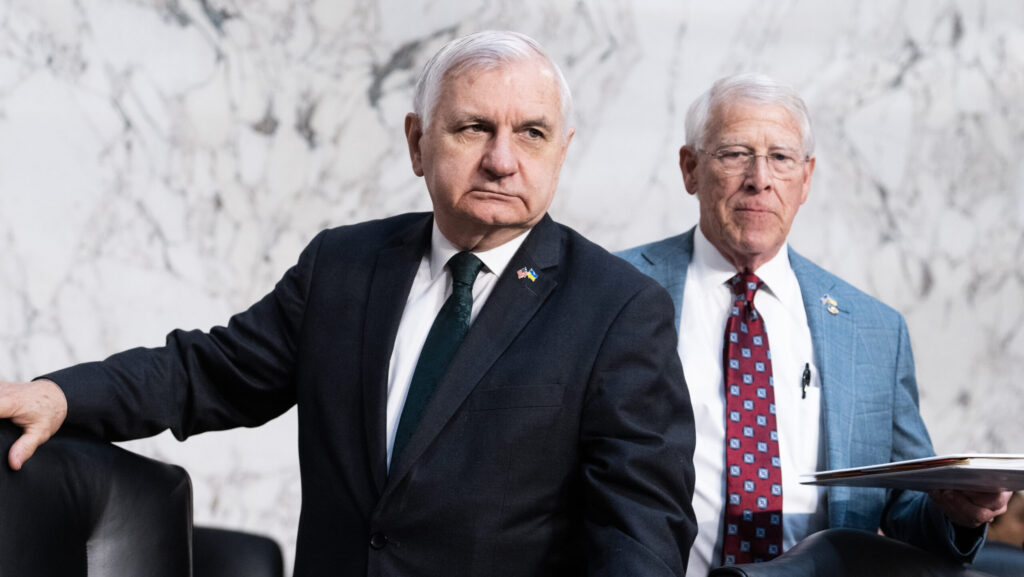
WASHINGTON — New restrictions on defense contractor share buybacks and dividends may need to be written by Congress into law in order to withstand legal challenges, the top Democrat on the Senate Armed Services Committee said today.
“Frankly, if Congress doesn’t codify it, they’ll go into court. My sense [is] it’s really difficult to justify tax changes because the president wanted to change them,” Sen. Jack Reed, D-R.I., told reporters.
“I think they [lawmakers] would have to because they [defense firms] have no shortage of lawyers, and they’ll go into court and say, ‘This is not within the tax code. You can’t do it,'” he said.
On Wednesday, President Donald Trump released a long-awaited executive order limiting defense companies’ ability to pay dividends to shareholders or buy back stock, telling CEOs in a Truth Social post, “This situation will no longer be allowed or tolerated!”
Specifically, the EO directs the Defense Department to review contractor performance, and that poor performers that are unsuccessful at resolving their issues with the Pentagon will be penalized. Future contracts will also be written in a way that limits stock buybacks, dividends and executive compensation if contractors fail to meet performance metrics, the EO states.
While Reed didn’t go so far as to say he supported the restrictions written into the executive order, he said it “represents a realization that these companies have done extraordinarily well, and yet we’re behind in so many different systems.
“And at the same time they’re not making their targets on budget and on time, they’re giving themselves significant benefits through stock buybacks,” he said.


Data overload threatens decisionmakers as autonomy expands
Reducing cognitive overload on warfighters while improving “time to trust” for autonomous systems is a matter of design.
A key Republican on the committee — South Dakota Sen. Mike Rounds, who leads SASC’s cybersecurity subcommittee — praised the EO for putting pressure on contractors to make larger capital investments.
“I think these defense contractors understand that it’s not very popular with the American public,” he said of stock buybacks and dividends. “We want to see this money go into real infrastructure and being able to respond to the country’s needs. We’re not producing our weapons quickly enough or more efficiently enough. And so if we put the resources, and if we’re going to contract with them, we want them to do a good job of actually getting the facilities in place long-term that will help our country.”
In the nearly 24 hours since the EO’s release, few defense companies have commented on the new restrictions, and none have publicly voiced concerns about the new policy or signaled that they will take legal action.
During a roundtable with reporters today, HII CEO Chris Kastner said the shipbuilder is still waiting for further details on how the order will be implemented, but he doesn’t expect it to change the company’s capital allocation plans, as it had already stopped stock buybacks.
“We’ve been investing more. I expect us to grow more, and I expect to be held accountable to meet the commitments I make in my contracts. So I don’t see that as different,” he said. “When I read the executive order, it felt like, okay, we’re doing the right stuff. We’re going down the right path.”
In an appearance on Bloomberg TV on Wednesday, Anduril founder Palmer Luckey defended the administration, saying that Trump isn’t “anti-defense company” and that companies funded by the government should be held to account.
“When you are working on the taxpayer dime, there is no level of oversight or intervention that I am against conceptually,” he said. “Now I think some of these might be bad moves. They might not necessarily help the defense base, but in concept, I think everything should be on the table.”
Defense firm Kratos, which today announced a contract win for a Marine Corps collaborative combat aircraft program, expressed “strong support” for the EO in a statement earlier today, noting that it “does not have a practice of conducting stock buybacks or paying dividends, choosing instead to reinvest capital directly into the development, production, and fielding of affordable, mission-ready technologies for the warfighter.”
In a statement that did not reference the EO directly, Lockheed Martin said it “shares President Trump’s and the Department of War’s focus on speed, accountability, and results, and will continue to invest and innovate at scale to ensure our warfighters maintain a decisive advantage and are never sent into a fair fight.”
But belying the public praise, some industry officials have expressed concern behind the scenes, especially when it comes to potential jitters on Wall Street.
“This administration is really focused on getting on these companies putting more money up front with no contracts on the horizon. And money is in search of money. If these investors sense that they’re not going to get the return they need from this investment, they’ll take it someplace else,” one industry official said on the condition of anonymity.
“You’re messing with the ability of companies to reward the investment of their investors, and so, are you chasing that investment away?”