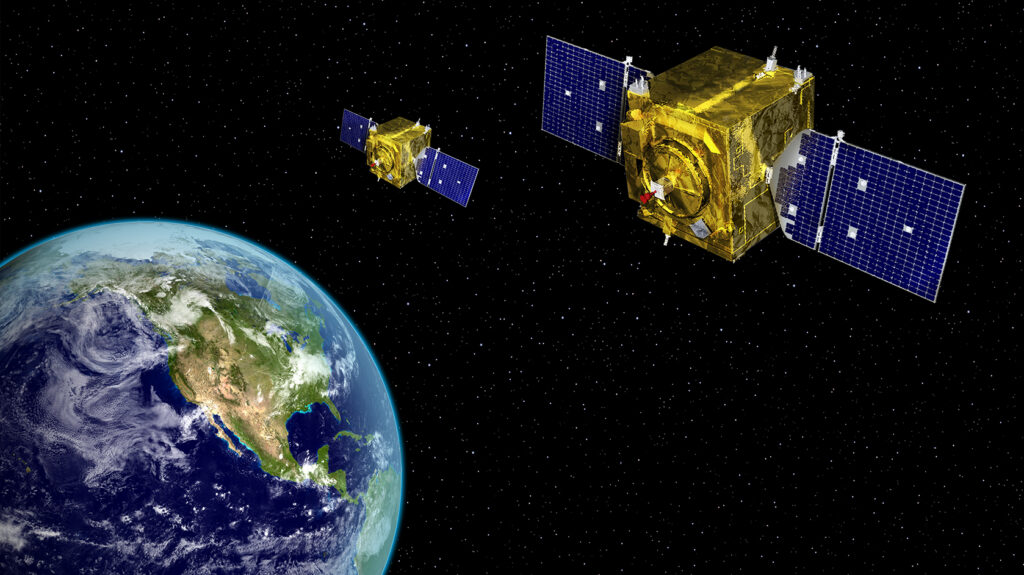
WASHINGTON — The Space Force is planning to buy its new RG-XX neighborhood watch satellites on a rolling basis over time, using a pool process under which multiple qualified vendors will be issued individual task orders based on service needs and budget, according to a senior service official.
“Our strategy is to set up an ID/IQ — indefinite delivery, indefinite quantity contract type — which allows us [to] multi-award vendors. This will allow us to every year procure what the service needs based off of the available funding,” Col. Byron McClain, program executive officer for Space Combat Power at Space Systems Command (SSC), told reporters on Friday.
SSC on Jan. 13 issued a request for proposals under the ID/IQ, which has been given the code name Andromeda, giving interested firms until Feb. 12 to respond.
RG-XX is being designed as the successor to the Space Force’s Geosynchronous Space Situational Awareness Program (GSSAP) constellation originally comprised of six satellites in geosynchronous Earth orbit (GEO) some 36,000 kilometers in altitude.
The flexibility of the new acquisitional approach is necessary because, for one, McClain said it’s unclear how many RG-XX satellites the Space Force will need.
“The quantity will be based off of a couple of factors,” he said, “the cost of the individual systems that we get, [but also] available funds and the mission need.”
And while RG-XX sats are expected to be more manueverable than GSSAP birds and will be the first Space Force satellites capable of refueling in orbit, McClain said it is not completely clear whether the RG-XX satellites alone will be all that is needed to replace the venerable GSSAP birds, the first of which launched in 2014.


How the “Doomsday Plane” contract highlights the rise of mid-tier primes
Midsized companies can offer flexibility and agility while keeping intellectual property in the hands of the government.
“It is possible that RG-XX can really take on most of the majority of that mission, but it’s not going to be the exact same thing, or do it the exact same way,” he said. “As we [and] the service work through this and learn, the service may say we need something else. Part of the reason of having our ID/IQ is that if we’re missing something, we can just roll that on the next year, and by leveraging the commercial defense industry, we believe we can go a lot faster so that we can make those pivots.
“So, the short answer is, terms of our plan, I do not have plan for follow on to GSSAP. I do have the RG-XX approach, and the service will continue to learn and make decisions every year.”
McClain further noted that while there isn’t a hard and fast timeline yet for when the first RG-XX satellites will be on orbit — in part because SSC has yet to see what various vendors can offer; in part because it will depend on funding in the fiscal years 2027 and 2028 defense budgets — he is “hoping to move as quickly as possible.”
As first reported by Defense Daily, SSC hopes to choose qualifying vendors for the pool under the ID/IQ by early March, and to issue the first RG-XX task orders shortly thereafter.
McClain said that as “onboarding” of vendors happens each year, it will provide an opportunity for the Space Force to “pull in” new capabilities
Paving The Way For Broader Refueling Decisions
The RG-XX program is the first time the Space Force has mandated the satellites in question be refuelable, in the hopes that being able to move more rapidly more often to keep tabs on potentially threatening space objects will give the service and edge in the growing high-stakes game of orbital hide and seek with Russia and China.
“We have included a requirement in the design for refueling because we think it maybe something we need, and we want to make sure that we’re laying the right groundworks for it. Depending on the economics of it, and depending on what capabilities are out there, I think this will really help us inform the service for long-term decisions,” McClain explained.
But while the first task orders under RG-XX will be aimed at working with industry partners to identify “the design trades that we need to make and some initial design capabilities,” he stressed that the Space Force has yet to make up its mind about the operational and cost viability of refueling.
“So, what is the long-term refueling plan and architecture? I don’t have an answer to that, as the service is still trying to work through what makes sense,” McClain said. “[W]e intend on using this very first period with our ID/IQ to really help us refine the requirement with industry as a partner in this, instead of us just doing an architecture and a design saying, ‘Go build this’.”
No Bespoke Ground Systems
One thing that is for certain is that the RG-XX satellites from different vendors will not each have their own ground systems, nor will the command ground system for the constellation duplicate other networks, according to McClain.
Instead, SSC is working with Mission Delta 9, Space Operations Command’s Orbital Warfare unit, to figure out “what the ground system needs to be so that it can be common,” he said.
McClain noted that there also are some possibilities for RG-XX to use existing ground systems, while the Space Force continues to wrestle more broadly at how it can streamline the plethora of ground systems already in use. For example, the Space Rapid Capabilities office’s Rapid Resilient Command and Control (R2C2) software for maneuvering satellites now being fielded.
In addition, he said, there are “some temporary capabilities in other mission areas and for other classified programs that I may be able to leverage, and that is what the team is evaluating right now. … My lack of clarity in the answer is because we are working through internally what is the right answer using things that already exist.”