
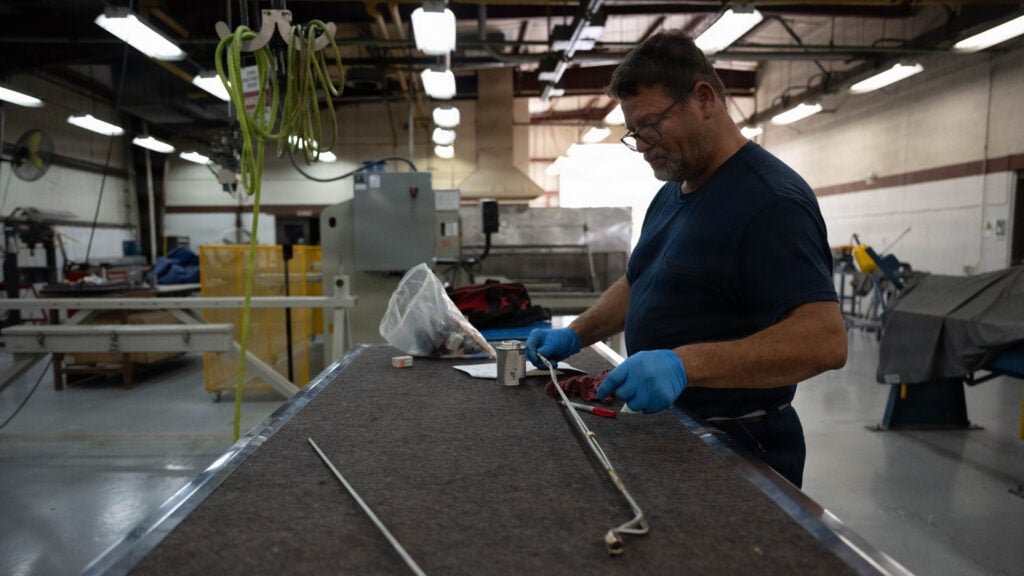
Today’s warfighters face the challenge of quickly getting essential supplies and parts where and when they are needed. Additive manufacturing, also known as 3D printing, in contested and battlefield environments offers a solution. But this solution comes with challenges related to securing intellectual property (IP) for critical technologies like weapon systems, and ensuring contractors are fairly compensated for the IP they own.
This issue was underscored recently when the House passed a version of the National Defense Authorization Act that deleted provisions giving the military its coveted “right to repair” capabilities. Basically, these capabilities would make it easier for end users in the military (or other third parties) to repair systems and devices without approval from the manufacturer.
This has often been portrayed as a zero-sum challenge pitting the Pentagon against the private contractors who serve them. However, that doesn’t have to be the case. In fact, there is a model from the commercial world that could help alleviate the vast majority of concerns around this topic.
First, let’s set the stage for why this has become an issue.
In contested areas of conflict, traditional supply chains are often not feasible. In addition, parts and systems are infinitely more complex now. When a piece of equipment breaks, users can’t simply “MacGyver” a solution like they could in the past.
Consequently, the military depends on contractors who create and manufacture the equipment needed for success on the battlefield. However, these contractors usually do not have facilities at forward operating bases, so they are in no position to respond immediately when a spare part is needed in the field.
Hence, the appeal of additive manufacturing is easy to see: It gives the warfighter the ability to manufacture the parts they need on the battlefield or at nearby locations. Some of the military services, as well as a lot of suppliers, are developing devices that contain full-blown additive manufacturing facilities that can be airdropped or moved forward closer to the point of need. In addition, additive manufacturing is advancing to include, for example, “drone manufacturing in a box” at a forward operating base, in which disposable drones are built, flown, disposed of, and then new ones are built.

Building the stand-off and stand-in weapons needed for the fight
Threats have changed the range, seeking and attack capabilities necessary to ensure effectiveness.
But many contractors are understandably concerned about handing over their IP for equipment and parts to the military to support manufacturing in contested environments. These companies prioritize supporting the warfighters’ mission, but they also must protect their commercial interests to remain viable businesses. So, they raise legitimate concerns when, for example, military service people in the field reverse engineer parts at depots and use additive manufacturing without the contractors’ involvement. Contractors have also raised security concerns protecting their digital IP as it is transmitted to contested environments, as well as concerns about ensuring their IP is deleted from third-party machines after they are used.
Thankfully, these competing concerns on the parts of the military and its contractors are not irreconcilable. In fact, a good model comes from an unexpected place: streaming video.
With streaming, consumers can download a movie and retain viewing rights for a specified number of days or a specific number of times. Applying that same concept, which I’m dubbing “remuneration,” would lead to a situation where the military can be authorized to manufacture critical items in the field for a limited time, but prohibited after an established period. The process of remuneration can give warfighters the ability to print parts in contested environments while compensating contractors per part.
The military has already begun experimenting with a platform to support this breakthrough IP protection process. The platform incorporates IP security not only through end-to-end encryption, but also through a concept known as “drip IP,” in which manufacturers stream individual lines of code to manufacturing devices then automatically delete each line after it is used.
Aside from addressing contractors’ concern about additive manufacturing in the field, remuneration can also help address the military’s issues with increasingly old and obsolete equipment, a billion-dollar problem for the Pentagon. For example, the B-52 is projected to remain in service until it’s 115 years old, creating a challenge in getting parts for it. When a manufacturer of aircraft or weapon systems no longer has that product line in place and the US government is still using that product, that’s a huge problem. Remuneration provides a way for contractors to get paid for legacy parts they no longer make by allowing the government to print parts in exchange for a licensing or royalty fee.
Remuneration ultimately translates into the ability to turn digital IP into a physical object that’s real. It’s an ideal solution, providing the warfighter what they need, when they need it, where they need it, while securing the IP and ensuring that private manufacturers get paid.
These developments have the potential to render the “right to repair” debate moot.
John Ustica is the President & CEO of Siemens Government Technologies (SGT), Inc., the separate but affiliated U.S. government arm of technology powerhouse Siemens.