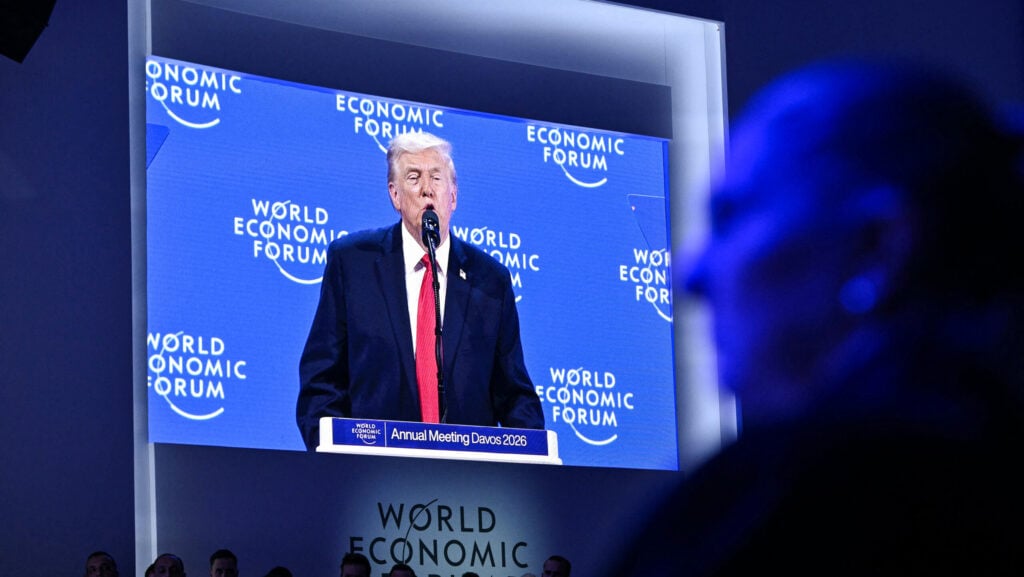
WASHINGTON and BELFAST — Calling Greenland a “strategic national security” imperative and tying it to the US air defense Golden Dome initiative, US President Donald Trump called for negotiations to start immediately to acquire the Arctic island.
“It’s the United States alone that can protect this giant mass of land, this giant piece of ice, develop it and improve it and make it so that it’s good for Europe and safe for Europe and good for us,” Trump told the audience today at the World Economic Forum in Davos, Switzerland.
“That’s the reason I’m seeking immediate negotiations to once again discuss the acquisition of Greenland by the United States.”
When later pressed during a fireside chat about what negotiations with Denmark could consist of, Trump said, let’s “see what happens.”
Trump also threw out a variety of reasons for his growing push to acquire the Arctic island, at one point seemingly tying in the Golden Dome architecture — a sprawling development effort to protect the US from incoming aerial threats.
“All we want from Denmark, for national and international security, [is] to keep our very energetic and dangerous potential enemies at bay [with] this land on which we’re going to build the greatest Golden Dome ever built,” he added.
In recent weeks Trump has ramped up his public calls for acquiring Greenland from Denmark to include weekend messages to Norway’s Prime Minister Jonas Gahr Store saying that since he did not win the Nobel Peace Prize, he no longer felt obliged to “think purely of Peace.”

Meeting Zero Trust goals while maintaining information dominance
Balancing security and access to data are critical to providing users with trustworthy, reliable data for real-time decisions.
During his speech today — which included comments blasting NATO, discussions of European migration policies and windmills, while also praising the early January US military operation capturing Venezuelan President Nicolas Maduro — Trump said he is not prepared to use force to occupy Greenland right now.
“We probably won’t get anything unless I decide to use excessive strength and force where we would be, frankly unstoppable, but I won’t do that,” he told the international audience.
“I don’t have to use force. I don’t want to use force. I won’t use force,” Trump later added. “All the United States is asking for is a place called Greenland.”
But with that sentiment, the US president also questioned the strength of NATO’s Article 5, the key collective defense clause, saying that the proposed Greenland acquisition was a “very small ask” compared to what the US has given NATO.
“The problem with NATO is that we’ll be there for them 100 percent but I’m not sure that they [would] be there for us, if we gave them the call: ‘Gentlemen, we are being attacked. We’re under attack by such-and-such a nation.’ … I’m not sure that they’d be there,” Trump added.
World leaders gathered in the Swiss ski town had been anticipating a fiery showing by Trump, with much attention being placed on Greenland.
Speaking ahead of Trump at Davos, NATO Secretary General Mark Rutte refused to comment on the Greenland standoff, arguing his predecessors in the post had taken a similar approach when “tension” between allies, including a past dispute between Greece and Turkey, emerged.
Going against such a stance would mean he could no longer be in a position to help other allies “de-escalate” matters.
“That’s why you will not hear me comment,” Rutte explained. “You can be assured that I’m working on this issue behind the scenes, but I cannot do that in public.”
Joining Rutte on stage, Polish President Karol Nawrocki said he hoped the Greenland issue “will be solved thanks to all partners [in a] diplomatic way.”
He added, “It’s our partner, Denmark, but I’m looking at Greenland … [from a] strategic point and geopolitical issue, between free world democracies … and with Russia.”
Focusing on the importance of the US to NATO however, he said that in light of Washington contributing “65 percent” of alliance spending, “we have to consider what Donald Trump would like to say about security, because he is responsible for [the] security of the world.”
Nawrocki also said that US defense equipment “is the best in the world” and stressed that Poland hosts 10,000 US troops. Warsaw has ordered or operates a wide range of American-made weapon systems ranging from Lockheed Martin F-35 fifth-generation fighters to Northrop Grumman’s Integrated Battle Command System and Boeing AH-64E Apache attack helicopters.
Alongside Rutte and Nawrocki, Finnish President Alexander Stubb was asked who or what could “defuse” the Greenland problem. He said that “we’ll find an off-ramp on this,” preferably a process that addresses “working on a real problem, which is Arctic security.”
Transatlantic relations with Trump and his wider administration are “good and solid,” added Stubb, but he noted that on occasion, “there are curve balls flying in different types of directions. We try to catch them and we try to solve them.”
In his view, there are “two schools of thought” on Greenland’s future. One position involves de-escalation, the other is “escalate to de-escalate.”
Praising Trump, Rutte said that the US leader and “other [NATO] leaders are right. We have to do more … we have to protect the Arctic against Russian and Chinese influence.”
Similarly, Stubb appeared to pay tribute to Trump for putting pressure on allies to increase NATO defense spending.
“If someone would have told me in Washington, DC, for the 75th anniversary of the alliance, that we’re going to increase our defense expenditure next year to 5 percent I would have said, ‘You have no clue about international relations or [you should] seek help with a doctor.’”
More broadly, discussing whether Europe potentially needs to defend itself against an attack from the US, Stubb said, “Let’s not push the hypotheticals here, let’s get back to the reality of the situation, and let’s put it back into perspective, especially the war in Ukraine.”