WASHINGTON — When the United States military launched an operation to fly directly into downtown Caracas and snatch Venezuelan leader Nicolás Maduro, top US officials noted that the invading force was met with limited ground-to-air fire — but they made no mention of any aerial resistance.
And while some details about the dramatic Absolute Resolve raid in the early hours of Jan. 3 have yet to be revealed, two experts told Breaking Defense it’s likely Venezuela’s fleet of fighter jets remained for the most part grounded for two reasons: Tactically, they were taken by complete surprise, and strategically, the force had been hollowed out for years by the regime itself.
On the night of the raid, “Caracas realized that any scramble would be quickly neutralized,” Andrei Serbin Pont, president of the Argentina-based CRIES think tank, hypothesized, leading Venezuela to “prioritize the withdrawal and dispersion” of its aerial assets.
RELATED: After US raid on Venezuela, analysts weigh lessons about Russian air defenses
More broadly, retired Colombian Air Force Col. Iván González said that “the status of the Venezuelan air force is worse than in the year 2000” when he was in Caracas. The Colombian officer stressed the current “low level of capabilities of [Venezuela’s fleet of combat] aircraft, limited quick-reaction capabilities.”
A Varied Fleet, Fewer Pilots
The Venezuelan air force, officially the Aviación Militar Bolivariana, is made up of a mix of aircraft from Moscow to Beijing to the US. The service still operates F-16A/B Fighting Falcons, acquired from the US in the early 1980s during the Reagan administration. At the time Venezuela was led by President Luis Herrera Campins, viewed by the US as democratic and moderate.


Voyager is accelerating access to space
After manifesting 1,400 payloads aboard the ISS, Voyager is applying its mission management expertise to the next generation of space stations, ensuring uninterrupted mission readiness and success from the ground to space.
It was some of the F-16s that conducted a fly-by of US ships in the Caribbean in the wake of the earliest strike on suspected drug boats in September.
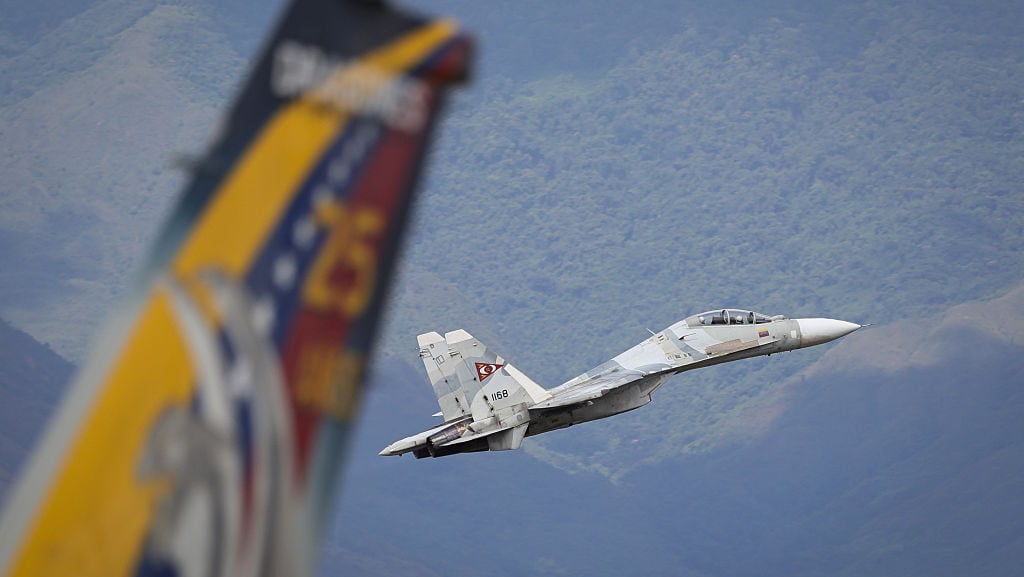
During the administrations of Hugo Chávez (1999-2013) and then Nicolás Maduro (2013-2025), Caracas acquired Sukhoi Su-30s from Russia and Hongdu K-8 light attack aircraft from China. The fleet also includes Embraer 312 Tucano aircraft, acquired back in the 1980s.
According to the Military Balance 2025, published by the International Institute for Strategic Studies, the air force’s fighter and ground attack fleet is divided into two squadrons of F-16s, four squadrons of Sukhois, one squadron of Tucanos, and two squadrons of K-8s.
How many of these assets can fly currently is unclear, given Caracas’s lack of transparency, decades of sanctions, and an economic crisis that prevented the acquisition of spare parts. Cannibalizing some systems to keep others operational is a likely strategy. But some are airworthy. In addition to the F-16s’ September flight, the Venezuelan military released a video showing the launch of a Sukhoi belonging to combat group No. 11 “Diablos” just days before Absolute Resolve commenced.
Serbin Pont suspects that, based on open-source intelligence, the Venezuelan air force can fly as many as six single-seat warplanes “with limits in the available weaponry,” and around 12 airworthy Sukhois.
But then there’s the human factor. The crackdowns on suspected coup-plotters, desertion of personnel, and limited air training availability means there are fewer qualified pilots who can fly combat aircraft. Serbin Pont noted that the air force likely has “few pilots of advanced age.”
Those who are available to fly, González said, have “low levels of pilot training,” and “a low morale and will to fight.”
The Night Of The Raid
According to Chairman of the Joint Chiefs of Staff Gen. Dan Caine, US forces launched the raid the night of Jan. 2 into the early hours of Jan. 3, sending helicopters over the water flying at just 100 feet as they approached Venezuela.
“As they approached Venezuelan shores, the United States began layering different effects provided by SPACECOM, CYBERCOM, and other members of the interagency to create a pathway,” he said. By the time the helos had to fly up and over Venezuelan terrain, “we assessed that we had maintained totally the element of surprise.”
US Southern Command did not provide information to Breaking Defense about any aerial engagements as of press time.
That was due in part to non-kinetic effects, presumably electronic and cyber attacks, but also due to a series of airstrikes on Venezuelan targets. In the early hours of Jan. 3, the Venezuelan Ministry of Defense issued a statement noting attacks in Caracas as well as in the states of Miranda, Aragua, and La Guaira. In Aragua, the air base El Libertador (located in Macay) saw strikes, while targets in Caracas included the air base Generalísimo Francisco de Miranda — the location of the Russian-supplied Buk-M2E air defense system, which appeared to have been destroyed during the operation, according to several videos released online.
But it’s unclear how many, if any, Venezuelan fighter jets were struck. So far, Caracas has not confirmed any aircraft destruction or damage.
Videos uploaded to social media on the afternoon of Jan. 3 reportedly show F-16s and Sukhois flying in Aragua and Puerto Ordaz; however, Breaking Defense cannot independently confirm their veracity.
To González, even if they weren’t damaged, Venezuela’s fighter jets just may simply have not had enough time to respond, as they “did not receive early warning notifications or real-time intelligence.” According to Caine’s timeline, after arriving over Maduro’s residence at 1:01 am ET, the attack force was back over the water by 3:29 am.
In the wake of the raid, observers will be watching closely for any changes in Venezuela’s military stance, even if President Donald Trump said today he’s “canceled” a second military operation since it’s unnecessary.
On Wednesday, interim President Delcy Rodríguez named Gen. Gustavo González López as the new commander of the counter-intelligence general directorate (DGCIM) and the presidential honor guard. Despite the catastrophic failure by the Venezuelan military during the operation, Minister of Defense Gen. Vladimir Padrino López and Major General Lenín Ramírez Villas, commander of the air force, remain in place.