FORT WAINWRIGHT, Alaska — During the 11th Airborne Division’s most recent exercise, Gen. John Cogbill, commanding general of the 11th, told reporters that his division discovered what kind of ground vehicles it needs more of, and it’s not anything heavily armored.
“Armor and the Arctic don’t necessarily match,” Cogbill said. “They’re heavy. They would fall off the roads. They tumble down the side of a mountain. So we have to be light, highly mobile. It’s a matter of [having] just over the snow mobility.”
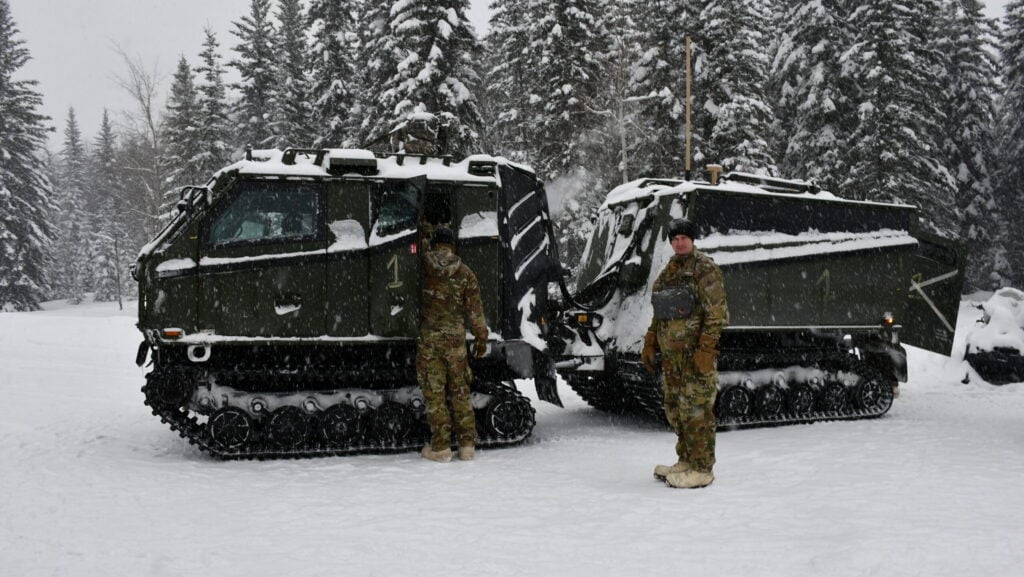
Instead of armored vehicles, the 11th wants more Cold-Weather All-Terrain Vehicles (CATVs) and a solution that is “like” an Infantry Squad Vehicle (ISV), Cogbill said. The CATV, made by BAE Systems and called the Beowulf, is meant to carry up to nine soldiers, withstand extremely cold temperatures and essentially “float” on top of snow, Cogbill said. It’s an amphibious tracked vehicle that replaces the decades-old Small Unit Support Vehicle.
Right now, the division has 33 CATVs and is slated to receive 76 more to make a total of 109 by November. Eventually the division is slated to have a total of 184 vehicles, an Army spokesperson confirmed to Breaking Defense. Of course, Cogbill said, company commanders would ideally like more, but they have to factor in other costs as the price of each CATV is around $1 million.
“There are finite resources, so we have to kind of compare, do you want more CATVs, or do you want more small UAS, or do you want better gear? Or do you want new [Arctic-10 person tents]?” Cogbill asked.
Cogbill clarified that the CATVs and ISV-adjacent solution would be used mainly for logistics operations in a conflict, as he foresees the 11th potentially fighting with howitzers, small drones, individual riflemen and machine gunners.
Nonetheless, he said, the CATVs are “worth their weight in gold” as they’ve made sustainment and logistics operations much easier; allowing soldiers to get from point A to point B faster than they could in the old vehicles while also allowing for increased mobility.

Not just selling into the kingdom, but building partnership with Saudi Arabia’s defense industry
Partnerships with outside industry are a cornerstone of the kingdom’s ambitious growth strategy.
The topic of mobility is an important one, Cogbill said, as the 11th is transitioning its infantry brigade combat teams into mobile brigade combat teams in line with directions from the Transformation in Contact initiative to transition 25 of the service’s IBCTs into MBCTs.
To help turn IBCTs into MBCTs, units have increasingly relied on ISVs as they allow for soldiers to zip around the battlefield more quickly. Because of their open windows, Cogbill said, an ISV isn’t a perfect fit for Arctic winters.
“So think more like the ISV. Great, great vehicle. We love it. We’re probably going to get some because all we’re converting to mobile brigade combat teams,” Cogbill said. “They don’t work in the Arctic, though, at least not in the winter months, because they’re not winterized. It’s like driving a jeep with the top down when it’s 20 below.”