WASHINGTON — In the latest in a strategic shift, the Army has issued a call to industry, broadly soliciting solutions for the electromagnetic spectrum rather than outlining specific needs as usual.
Documents posted alongside a the request for information note that currently the Army “lacks the ability to sense, locate, attack, and protect in and through the EMS across competition and geographic continuums in order to generate necessary effects against targets of interest at range.” But rather than think up a singular solution and request specifically that thing, the service’s requests aims to see a range of solutions from across industry — the more ideas, the better.
“Our modern approach of sharing upfront, broad problem statements through a CoN [Characteristics of Need document] — as recently demonstrated in the Next Generation Command and Control effort — will be critical in obtaining meaningful industry feedback to shape procurement approaches for new equipment,” Joseph Welch, Program Acquisition Executive for Command and Control (C2)/Counter C2, said in an Army release today. “This process enables collaboration between the Army and a diverse range of commercial industry partners, including small businesses, large firms, and non-traditional vendors, to ensure best-of-breed capabilities are rapidly delivered into the hands of Soldiers.”
The CoN identifies four general areas for which the Army is seeking solutions:
- Attack: systems for jamming and denying the use of the spectrum to the enemy for communications, sensing and navigation;
- Support: systems used for sensing, identifying and locating signals and emitters;
- Protect: systems capable of blocking enemy jamming and ensuring emissions control, reprogramming and obfuscation of signals, and;
- Common services: a standard baseline that all EMSO [electromagnetic spectrum operations] systems, which are primarily software based, can be built into and share data exchanges.
Military officials have long complained that in the dynamic environment of the electromagnetic spectrum, the current acquisition of capabilities is too slow. As evidenced in Ukraine, the cat and mouse game of electronic warfare is waged not in weeks or months like the Cold War of yesteryear, but rather days and hours.
The RFI also states that the current acquisition and fielding model presents challenges in meeting the needs of tactical commanders with systems varied across several formations.

Streamcaster Nexus: Empowering the connected soldier at the tactical edge
On today’s battlefield, mobility isn’t optional - it’s mission-critical.
Moreover, the CoN acknowledges that “EMSO capabilities are spread across different warfighting functions and not fully designed as cohesive technologies that are modular, scalable, and adaptable enough to mitigate modern threats. … This prevents the Army from truly leveraging Artificial Intelligence and Machine Learning (AI/ML) for quick decision making to exploit opportunities across the competition continuum.”
Col. Scott Shaffer, PM for EW&C, emphasized the RFI itself is geared toward proposals that embrace artificial intelligence and edge computing, with speed in mind.
“Unlocking the potential for spectrum operations at machine speed will be key to winning the EMS fight,” he said in the Army release.
The Army has been on a multi-year journey to rebuild and modernize not only its capabilities in the spectrum, but its prowess. After the Cold War, the service divested much of the relevant systems and expertise. Now, adversaries have become more adept at operating within this invisible domain, learning that blocking signals, navigation, munitions and communication would be key to defeating US forces.
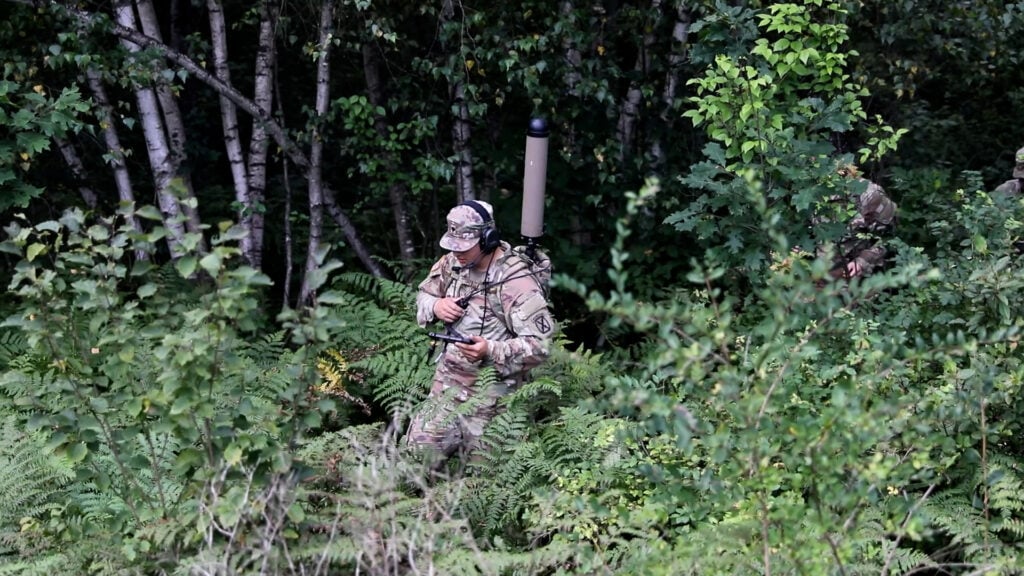
The Army has through fits and starts begun to modernize its electronic warfare enterprise, spending years developing some systems only to cancel or change direction. To date, it has fielded one program of record jammer for offensive use, which is a dismounted backpack.
Speaking to Breaking Defense last month, Welch said generally the service is aiming to use CoNs more broadly to allow more flexibility. Using what he called a “product centric inventory,” he wants program managers to have the ability to look at technologies available today and assess them for what they are, instead of through the lens of a requirement document with the advent of problem statements outlined through characteristics of need.
“When I look at the electronic warfare portion of our portfolio or I look at what we deliver from a SIGINT perspective, those are two different functions, they operate under different legal authorities. From the product perspective, these products, the ones that perform those tasks, there’s not always a whole lot of difference between them,” he said in an interview on the sidelines of the Army Technical Exchange Meeting. “Looking at what a vendor has that’s high maturity or able to go into a prototype and saying we’re not going to identify in advance, this is the only requirement this thing can solve, we’re going to see what it’s capable of and if we need to update requirements.”
The new EMSO CoN outlines a series of “key characteristics” EMSO solutions should possess such as resilient, adaptable, modular, saleable, rapidly deployable and secure. Responses are due March 13.