

WASHINGTON — Northrop Grumman’s chief executive said today that the company has no plans to follow L3Harris’ lead to allow the Pentagon to take a financial stake in its solid rocket motors business, but hinted that some of its key suppliers may enter into similar investment agreements with the department.
“We certainly work in the supply chain to ensure that our suppliers also have the resources they need. And in some of those cases, there may be an interest for those companies to take investment directly from the government,” Northrop CEO Kathy Warden told investors during Citi’s Global Industrial Tech & Mobility Conference. “We’re facilitating those conversations with the [Pentagon’s] Office of Strategic Capital.”
In January, the Defense Department announced it would invest $1 billion into L3Harris’ missile solutions business, which the company would spin off as a separate publicly-held company. The deal enables the department to take an ownership stake in the new company, although it will not be on the board of directors or involved with managing the business.
For Northrop’s own solid rocket motor business, however, Warden stated that the company remains the “best party” to continue making the investments needed to scale up motor production, with no such spin off necessary.
“We have not entertained any discussion with the government to make that investment, and certainly no discussion about equity in our company or the model that has been utilized and communicated by L3Harris,” she said.
One key reason for that, she said, is the interplay between solid rocket motors and the company’s strategic missiles business — a separate division of Northrop that includes programs like the Sentinel intercontinental ballistic missile program, which use solid rocket motors.
“There’s just a lot of strategic synergy in those parts of our portfolio that we want to maintain ownership structure of,” she said. “But just because we as a large company see that strategic synergy across the portfolio and are choosing one model doesn’t mean that other companies won’t choose a different model.”

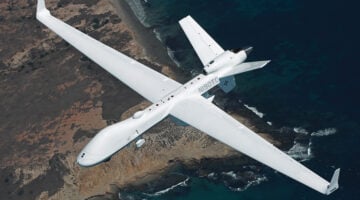
The uncrewed revolution: MQ-9B and Gambit Series forge a path to regional air dominance
The MQ-9B and Gambit Series represent parallel capabilities that address global challenges for security head-on.
Consolidation of the defense industrial base during the 1990s and 2000s left the Pentagon with only two domestic suppliers of solid rocket motors — L3Harris and Northrop — and despite a wave of up-and-coming providers like Anduril and Ursa Major, the sector still routinely struggles with long lead times and supply chain challenges.
When asked in January whether the Pentagon’s stake in the L3Harris missile solutions business could lead to a competitive disadvantage for other solid rocket motor providers, Michael Duffey, the Pentagon’s top acquisition and sustainment official, said the ability to provide a return to the taxpayer was the driving force in L3Harris deal.
“We’ve had a pattern within the defense industry of writing checks from the Department of War on behalf of the taxpayer to expand the industrial base with no promise of return,” he said. “This is a direct change to that.”
So far, L3Harris is the only defense prime that has agreed to spin off a portion of its business with the Pentagon taking an ownership stake. L3Harris, which will remain the majority shareholder of the new missile solutions company, plans to move forward with initial public offering (IPO) of that division in the second half of 2026.
During a later session at the Citi conference, Lockheed CEO Jim Taiclet had strong words when asked whether he had considered a financial arrangement similar to L3Harris’ spin-off agreement while brokering deals with the Pentagon to increase PAC-3 and THAAD interceptor production.
“We did not consider any kind of structure like L3Harris,” said Taiclet, adding that regulators had previously rebuffed Lockheed’s proposed purchase of solid rocket motor maker Aerojet Rocketdyne in 2022 before allowing L3Harris to acquire it.
“They [L3Harris] didn’t have, I guess, apparently, the resource to manage the scaling themselves. We do, and if we would have had [Aerojet Rocketdyne] inside of our company, we would just be doing it,” he said. “We have the scale and scope and the financial wherewithal to do exactly what we’re talking about, to deliver that growth path with internal investment and our own balance sheet, our own cash flow. And so we’re committing to do that without having to joint venture, spin off, sell off part of the company.”