BELFAST — Sensational comments this week from leading German labor union and local aerospace industry officials have once again put the fate of Europe’s multibillion dollar Future Combat Air System (FCAS) effort into question.
A provocative opinion piece, published on Monday in German business outlet Handelsblatt, poured fuel on the bitter industrial dispute — centering on ownership of program leadership and workshare arrangements — that’s been rumbling on for months between France’s Dassault and Germany’s Airbus.
Authors Marie-Christine von Hahn, the CEO of BDLI German Aerospace Industries Association, and Jürgen Kerner, deputy head of the IG Metall labor union, effectively called for tearing up the fighter cooperation effort, directly proposing a “two-aircraft” approach. BDLI represents “all industry segments” across German aerospace, according to its website, and IG Metall is the country’s largest industrial union. Their alignment on FCAS puts greater pressure on political decisionmakers to take concrete action or step in to solve outstanding issues.
“Combined with a robust federal budget, we are in a position to invest confidently and thus pursue bold industrial policy paths: We will no longer join multinational projects, but will instead establish our own [future fighter jet] program and then seek partners who wish to participate,” they wrote.
The two accused Dassault of “de facto claiming exclusive control of the [FCAS] project” for close to a year: “This uncompromising stance can no longer be considered a claim to leadership between equal partners. It is an invitation to relinquish our industrial independence.”
In a further, thinly veiled threat against the Rafale manufacturer, they wrote, “Anyone now demanding absolute control [of FCAS] shouldn’t be surprised if there are consequences.”
Based on widely reported comments reacting to the Handelsblatt column, French President Emmanuel Macron reportedly said “non” when questioned if the project was dead. He explained, “It’s a good project, and I haven’t heard anything from the German side to suggest that it isn’t… For my part, I believe that things must move forward.”
Asked how the company views developments in the aftermath of comments from Macron, von Hahn and Kerner, a spokesperson for Airbus told Breaking Defense in a statement today that the company “remains committed to the success of the FCAS programme and to all agreements made to date between the programme’s partners.”
Dassault and the German ministry of defense had not responded to a request for comment at press time.
The Handelsblatt comments come as Germany is set to host Macron and other European leaders at the Munich Security Conference — setting an opportunity to clear the air or, potentially, continue what has for several years felt like a slow breakdown of a marriage of convenience.
Analysts speaking to Breaking Defense previously questioned Berlin’s capacity to build a future fighter jet alone, largely because of concerns related to a lack of local engine manufacturing experience. France, they said at the time, might be better placed to take on development of a sixth-generation platform on its own, based on doing so with the Rafale aircraft and alongside the potential for it to fly out to 2060.
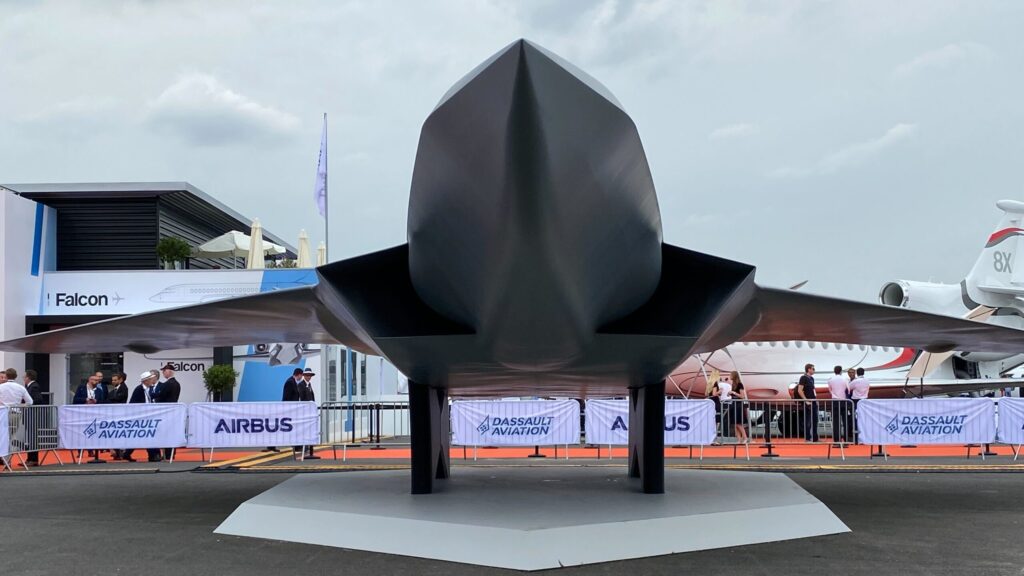
The trilateral FCAS program that also includes Spain was established to deliver a Eurofighter Typhoon and Rafale replacement aircraft from 2040, known as the New Generation Fighter — to be accompanied by swarms of drones and a “combat cloud” communications network.
The longer industry problems persist however, the greater the risk of delay, especially as this year is planned to initiate the launch of Phase 2 — though a contract has still to be negotiated. Under the milestone, industry is expected to develop technology demonstrators covering the NGF, its engine, drones, the combat cloud and sensors.