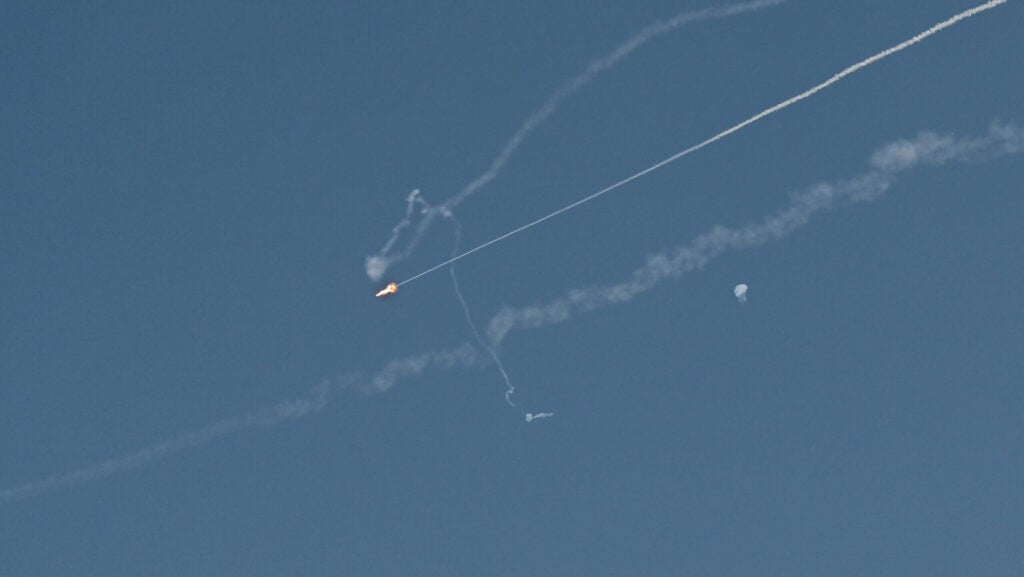
BEIRUT — In response to the joint attack by Israel and the US, Iran has launched hundreds of missiles and drones towards its neighbors — forcing countries to scramble their air defenses in order to protect civilians, with mixed results.
In the 36 hours since the war against Iran began, Tehran has launched weapons towards Bahrain, Jordan, Kuwait, Iraq, Qatar, Saudi Arabia, and the United Arab Emirates. While ostensibly against US bases in those countries, weapons have hit airports and civilian buildings across the region.
“For the first time in history, all the GCC states were targeted by the same actor within 24 hours. Their long-standing nightmare scenario has happened,” Sinem Cengiz, a researcher at Qatar University’s Gulf Studies Center and a non-resident fellow at Gulf International Forum, told Breaking Defense. “Although in case of a US attack to Iran, this was an expected action from Tehran, but the scope has shocked both the Gulf political elite and public.”
She added that by hitting civilian infrastructure, whether intentionally or not, in the Gulf Cooperation Council capitals, “Iran has crossed a dangerous line. The aim may have been to raise tensions in the Gulf to pressure the US, but this calculus may also backfire. It risks pushing the GCC states closer to the US camp in this war.”
Defending against the incoming fire has been an all-of-government situation, said Gulf-based security and defense analyst Kristian Alexander.
“States across the Gulf Cooperation Council, notably [the] United Arab Emirates, Qatar, Saudi Arabia, Kuwait, and Bahrain, have activated far more than missile-defense batteries,” he told Breaking Defense. “They have dispersed military aircraft, hardened critical infrastructure, activated alternate command-and-control nodes, and implemented widespread civil-defense measures such as shelter-in-place alerts, school closures, and controlled public movement.”
Getting an exact count of what has been launched by Tehran is difficult for many obvious reasons. However, open-source reporting and statements from the local governments have shown a sizeable barrage, as the numbers presented below largely represent interceptions and not the weapons that got through:

Military & government leaders: Share your perspective
Share your insight in a 10-minute survey—$10 donated to Homes For Our Troops for every response.
- The UAE Ministry of Defense announced at 8:30 am ET that its air force and air defense forces have “dealt with 165 ballistic missiles, two cruise missiles and 541 Iranian drones since the start of the Iranian attack.”
- The Kingdom of Saudi Arabia has not put out hard figures, but has confirmed it has taken incoming fire, with the government condemning the attacks.
- Qatar claims to have intercepted eighteen ballistic missiles, cruise missiles and drones, according to MOD announcement on its X- handle. Both jets and ground-based air defenses were involved.
- Kuwait air defense forces have intercepted 97 ballistic missiles and 283 drones in total, per the government.
- The Kingdom of Bahrain, which hosts the US Fifth Fleet, has also shot down forty five Iranian missiles and nine drones, including Shahed-136 kamikaze drones. Video has shown parts of Fifth Fleet’s headquarters were hit in the initial attack by Iran Saturday.
- In Iraq, the US-led coalition said it shot down several missiles and kamikaze drones.
- Reportedly and as of yesterday, Jordan said it has intercepted 13 ballistic missiles and 49 drones.
Early reports indicate that drones have had better luck penetrating the airspace. For instance, while the UAE intercepted 541 drones, another “35 fell within the country, causing material damage,” according to the UAE MOD statement.
“The conflict has shown structural vulnerabilities. Despite decades of heavy defense spending, Gulf states remain highly exposed to missile and drone warfare. Air defense systems can intercept, but not at scale or at low cost. Saturation attacks remain a serious concern. Collective coordination among Gulf states remains limited at best and operationally non-existent beyond the public statement,” Ali Bakir, defense analyst and professor at Qatar University.
While the farthest measure taken by Gulf states so far is interception, all statements from the Gulf powers have reserved the right to respond to Iranian aggression — which is something to watch for, according to Ryan Bohl, a senior Middle East and North Africa analyst at the RANE Network.
“If Iranian attacks continue throughout this week, I would expect the Gulf Arab states to eventually participate in counter-attacks on Iran,” Bohl told Breaking Defense. “The UAE in particular would be one to watch for this, but so too might Saudi Arabia. They need to restore some kind of deterrence against the Iranians and sitting passively by and using up their air defenses won’t accomplish that.”
These attacks come less than two months after the US Central Command (CENTCOM) opened a new air and missile defense coordination cell at Al Udeid Air Base in Qatar in January, to strengthen “regional defense cooperation,” according to a statement by CENTCOM Commander Adm. Brad Cooper.
“This cell will improve how regional forces coordinate and share air and missile defense responsibilities across the Middle East,” Cooper said at the time. It is unclear what role the cell played in coordinating interception across the region over the last 36 hours.