
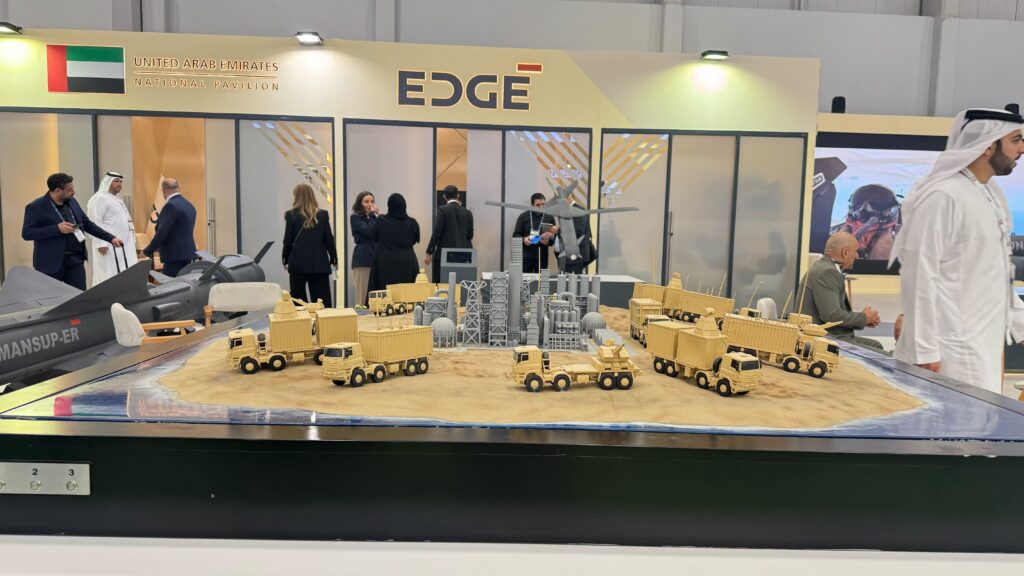
ISTANBUL — The United Arab Emirates used nationally built, soft-kill systems developed by EDGE Group to help counter Tehran’s unmanned aerial vehicles (UAVs) in the latest conflict between the US and Iran, according company CEO Hamad Al Marar.
The systems included the Sign4l SKYSHIELD drone, which is a counter-unmanned aerial system with high-power radio frequency and Global Navigation Satellite Systems (GNSS) jamming system and the NAVCONTROL GNSS system for jamming and spoofing.
During the SAHA expo in Istanbul, Hamad Al Marar, also EDGE’s managing director, sat down with Breaking Defense to discuss these technologies, as well as some future endeavors for the company. Below is a look at some of that conversation.
This interview was edited for length and clarity.
BREAKING DEFENSE: During the last conflict, the UAE has to have a high rate of interception. What systems from EDGE Group were used to defend the Emirati skies from Iran’s drones and missiles?
HAMAD AL MARAR: The UAE armed forces have been very strategic in providing the layered defense. And as we saw, it was done in a manner by which we don’t have one point of failure, and it is a multinational layer of solutions, going from east to west and national solutions.
We have been able to deploy, of course, everything around the soft kill, in terms of jammers and spoofers, and we worked with the MoD to support the geofencing activity. As my chairman [Faisal Al Bannai] has said, and maybe in his capacity as advisor to the president, that over that over 80-85 percent of the [drones] interceptions were actually intercepted by local grown solutions, not necessarily EDGE.

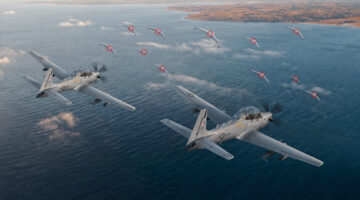
One of the world’s most versatile attack planes is taking on the counter-UAS mission
An airborne layer pushes drone engagements farther from defended assets and changes the cost-per-kill equation.
And the reason we were also proud is that we weren’t given a heads up on the attacks, and we acted from T-zero. If you were to import any system, it will be weeks before you receive it. The UAE from T-zero have intercepted [incoming threats], which shows a very high level of readiness, preparation that was planned.
But the way it [the defense] also expanded and kept current with all the tactics they’re currently using shows you that this is a technology that the UAE controls, the UAE can program and the UAE can modify.
Can you name the exact systems used in the conflict? Was Skyknight part of these systems?
Skyknight wasn’t in service. It’s going into production, so it will be in service very soon. The systems [include] SKYSHIELD and NAVCONTROL and the rest of course, is all part of the UAE inventory.
In 2024 EDGE inked an agreement to integrate its missiles on Baykar UAVs. What are the updates on this program?
We have successfully integrated to the [Turkish-made Bayratktar TB2 armed UAV], and we are busy integrating on the AKINCI. So we are at actually a stage that we call fleet embodiment, which means deployment to service, and it’s for the use of the UAE and export markets.
Of course the TB2 is a very widely spread platform, which, with the successful integration every market becomes an opportunity for integration and supply.
What cooperation are you eyeing with Turkish firms, and what other models of cooperation are hoping to integrate your technology on?
Both governments are aligned, and they’re very keen to cooperate and very flexible in the same time. What is nice about the Turkish industry is that it’s also fast. So we can actually have a fast pace to develop products that will be readily available for the market as we want.
Now, if you look at it, you have a platform-level cooperation, you have a system-level cooperation, and you have subsystem-level cooperation. And all are equally important. The model that we normally look at is always driven by, how can both gain, maximum gain, and not compromise any future business. In some cases, it might be a joint program. In some cases it might be a joint venture. In some cases it’s a contract, subcontract relationship.
So there is not really one model that we pursue, and that depends on the duration of the program and the sophistication of the program. Actually, a reason for our growth is because we’re never stuck in one model. We actually just look at what will yield results for us.
Turkish industry is very mature. The Turkish industry has no reason to import, but I think we need them, and they need us to address export markets, whether it’s Latin America or Africa, even Europe and Asia.
When we look at the strategic defense fund that is current, it’s part of EDGE, we look at investing into what potentially could be future technology that we might use the small medium enterprise is extremely important for us and for our sustainable future. Turkey’s industry is very innovative, and there are many opportunities for us now.
At the DIMDEX expo in February in Qatar the company signed an agreement with Qatari defense firm Barzan. Can you talk more about this agreement, and the scope of work for the joint venture?
We and Qatar do share the same challenges. Resources, in terms of human resources, of course, as a start limited markets, in some cases, what is very important is that we do not want to create unnecessary duplication, and we want to make sure that we are actually complementing each other in many fronts. Any country in the world has things that might suit a certain demography and certain geography. Both our geographies are limited in size, so expansion between us and Qatar would actually give us the opportunity to place different facilities in different countries that will cater for our needs.
The second they have products of their own. In many cases, they’re not even products that we have. So having a combined offering, a combined catalog, is very useful. They have been doing great job in terms of system integration for example. The system integration means you have multiple systems going. You’re creating a main system. We have been looking into sensors, and we’ve been developing many sensors, so it is just organic to have our sensors on their systems, and therefore it becomes a national product [between the UAE and Qatar].
UAE leadership announced that within two years, 50 percent of all government sector services and operations, will run on agentic AI. When it comes to the defense sector, what role is EDGE expected to take in this?
Number one, let’s take agentic AI from administration perspective. It will improve efficiency. It’s a very useful tool from a design perspective, it will surely accelerate our developments.
From an application perspective, it will stretch any asset beyond what we can obviously anticipate or imagine. When we look at it in terms of application, let’s say in mission-planning, we started seeing that AI tools in general are yielding better deployment of assets than what we think we know, or it’s giving you more options that you never thought possible. The last which is very important, adaptability, going from a feedback loop to redeployment, and this goes in the benefit of your armed forces and the operator not to take an asset for a long time out of service. So it is really playing a big role.
EDGE is in my opinion, an excellent source of use cases for AI, and there are many companies in the UAE that we deem companies that are well positioned to develop agents and tools.