WASHINGTON — The April 10 establishment of the Marine Corps’ portfolio acquisition executive will “put jet fuel” on the service’s Project Dynamis series, leading to actual acquisition decisions, according to the project’s director.
“We’re in this really cool situation where we have some key leaders in place that are big idea folks, they set culture to change things, they set culture to collaborate, guys like … PAE Marine Corps … which is, for Project Dynamis, is like literally, a gift just dropped from the sky,” Col. Arlon Smith said in an interview at the Modern Day Marine expo.
“Because a lot of the structure of this project was pre-PAE to move fast, now we’re going to be able to put jet fuel on this. When I say that, I mean in terms of our acquisition decisions coming out.”
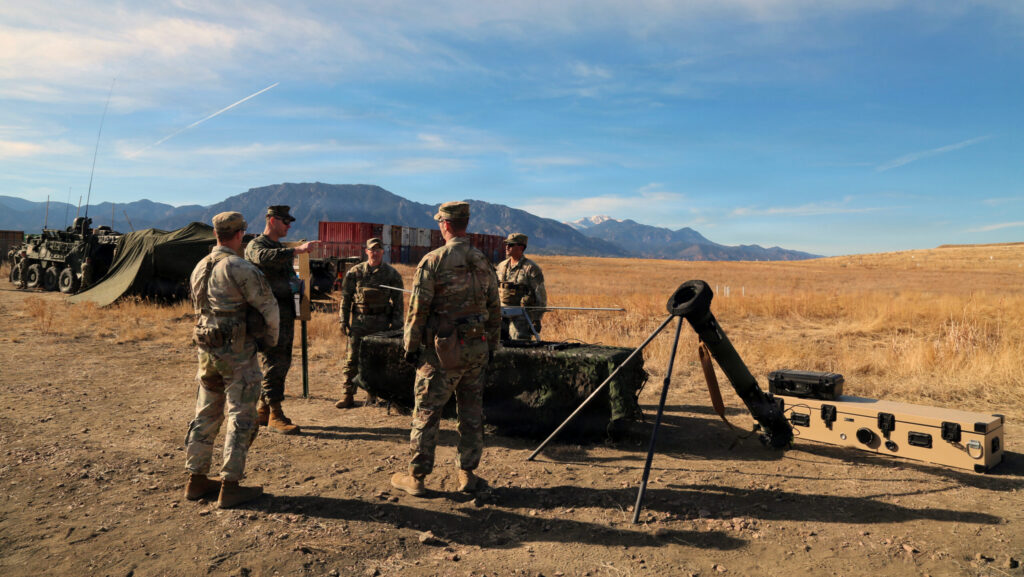
Project Dynamis is the Corps’ contribution to the Pentagon-wide Combined Joint All-Domain Command and Control effort to connect “sensors to shooters” across the entire battlespace, from all the services and key international partners. It consists of incremental events, dubbed serials, and looks at how to improve command and control using existing capabilities in new ways.
The new PAE structure will help to bridge the dreaded Valley of Death for capabilities, Smith said, given there is now a portfolio executive to look at these capabilities, break down the silos that previously existed, and make a decision. Now, with fewer silos, if a capability that is demonstrated is believed to be ready for primetime, it can be elevated to the executive level and an acquisition decision can be quickly made.
Smith said they expect to see a series of decisions on hardware and software coming out of the serials to be funded through current program of record lines.
The Dynamis series, Smith explained, is more of an acceleration venue given everything they’re working with is mature technology or an existing program. Dynamis aims to use existing funds for capabilities to inform the relevant program office how to use those capabilities differently.

How readiness stays ready: The F110 delivers power, reliability and scale for the F-15EX
GE Aerospace’s investments in the F110 are paying off in both production and delivery performance.
“I think this project is going to help us prioritize that resourcing to really get after what’s the key capabilities we need to fill, the key value proposition that we’re providing to the joint force commanders,” he said, adding they’re trying to bring concepts to life. “A marine sitting on a [Ultra-Light Tactical Vehicle], little dune buggy in the South China Sea on an island, literally has the tech they need to be able to fill that function that is so needed in the theater today.”
Smith said they had their first one-star level executive steering group meeting last week, previewing five recommendations for hardware and software capabilities, with the expectation those will go to the three-star level likely the first week of June.
While he declined to elaborate on the specifics of those capabilities recommended, as to not get ahead of any potential decisions, he noted that one area they’re looking at pertains to the burning need coming from the fleet to operate with unclassified data.
“The ability to coordinate with mission partners, the ability to take a maritime sensor, commercial radar, think, example, and ingest that data. How do we get that data into our systems so we can use that for battlespace awareness, for example,” he said.
The Marine Corps Tactical Systems Support Activity (MCTSSA), as well as the Army, have been working for years to develop what’s called a sensitive but unclassified-encrypted (SBU-E) architecture. There is a recognition that at the tactical edge, certain information is perishable, meaning even if the enemy gains access to it, it’ll be too late to act on. This frees up burdensome classification restrictions on communications, data and architectures to allow forces to communicate in an unclassified, but still encrypted, manner, which not only has blue force implications, but drastically improves interoperability with partner forces.
“I think the goodness of what he’s talking about with the SBU-E is we focus heavily on the mission partners environment and how to integrate that type of data and information, but it’s also our own unclass sensors and how do you enrich the higher echelon with some unclass sensors,” Col. Chris McGuire, director of operations at MCTSSA, said in an interview. “SBU-E could be an option to better integrate and network those devices and then publish a higher echelons C2 architecture or common operational picture with that data off of an SBU-E network.”
Breaking Defense Video