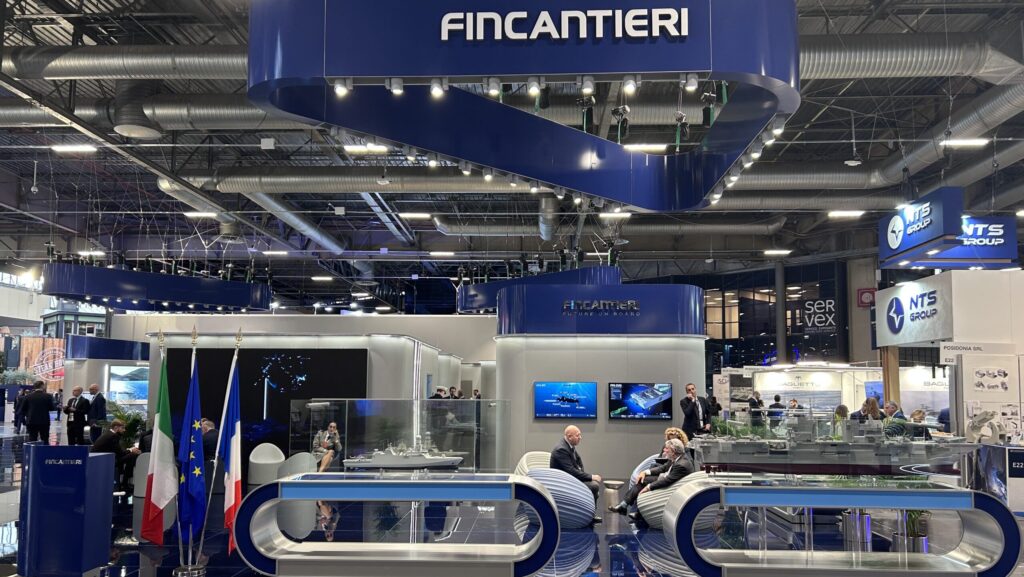
MILAN — Italian shipbuilder Fincantieri is exploring the potential of designing nuclear-powered vessels, CEO Pierroberto Folgiero said, a move that comes as the Italian military studies the possibility of developing its first nuclear-powered naval forces.
The CEO discussed nuclear propulsion during his meeting with the European Commissioner for Sustainable Transport Apostolos Tzitzikostas in Brussels on Tuesday.
“We talked about nuclear propulsion at sea, something Fincantieri is engaging a lot in – there’s nothing right around the corner, but we’ve been studying the technology, including third- and fourth-generation reactors,” Folgiero told reporters during a closed-door roundtable on the same day.
He added that the company is currently seeking partnerships not only for the reactor itself but also for the rest of the value chain and other components.
Nuclear propulsion provides naval vessels with extended endurance and eliminates the need for refueling during long-range deployments. However, building, operating and maintaining the technology is extremely expensive and requires highly specialized personnel.
In Europe, only France, the UK and Russia currently operate nuclear-powered naval vessels. But in 2023, the Italian Ministry of Defense launched the Minerva project, in which Fincantieri is also involved, to evaluate the feasibility of integrating next-generation nuclear reactors into military vessels, including surface ships and submarines, for electricity production and propulsion.
Folgiero acknowledged that while there is skepticism around this topic, “we don’t need to wait for small reactors to be a reality on land and only then start thinking about objectives for the sea… we need to be impatient when deciding the future.”

How integrated modeling and simulation accelerates Europe’s defensive edge
Lockheed Martin’s ACES platform delivers a shared virtual battlespace that strengthens readiness, interoperability, and faster decision-making through advanced, integrated modeling and simulation capabilities designed for evolving global threats.
The Italian CEO also touched on several other issues during his talk with reporters, including lessons learned from the war in Ukraine regarding the control of naval drones and the future of a common European patrol corvette.
When asked whether Fincantieri was collaborating with Ukraine’s defense industry on unmanned technologies, the company boss pivoted to what has inspired him most in this sector from the war-torn country.
“We’re very focused on surface drones, which are largely just unmanned motor boats, and looking at Ukraine in particular for this — but to me, the most interesting thing is the way they manage the systems’ satellite link and command and control and being able to do this without any telecom coverage,” Folgiero said.
Fincantieri has been working for some time on underwater telecommunications, something Folgiero expects to be a “game-changer.” The company signed an agreement in February with the Italian firm WSense to, in part, integrate WSense’s wireless technologies into Fincantieri’s DEEP underwater drone to protect critical infrastructure.
The CEO also touched on the importance of collaborative projects in Europe to share the burden of defense research, production and acquisition, and to avoid costly duplication and interoperability issues. He pointed to the European Patrol Corvette (EPC) program as one such example of beneficial collaboration. The project is in its second phase of development involving Italy, France, Spain and Greece, and is envisioned as a new corvette class of ships to replace aging patrol vessels.
“This program will be a reality and is a good exercise of joining forces between all countries involved, where alignments need to be done – at the end of the day, when we walk about seeing platforms, a ship is a ship, a corvette is a corvette… We don’t need an Italian corvette, a French, a Spanish, or a Danish one,” Folgiero said.
He added that an analogy useful in this case is that there are “no Italian waves, French waves, Spanish waves… Waves are waves, and more or less we are expected to navigate and sail the same seas.”