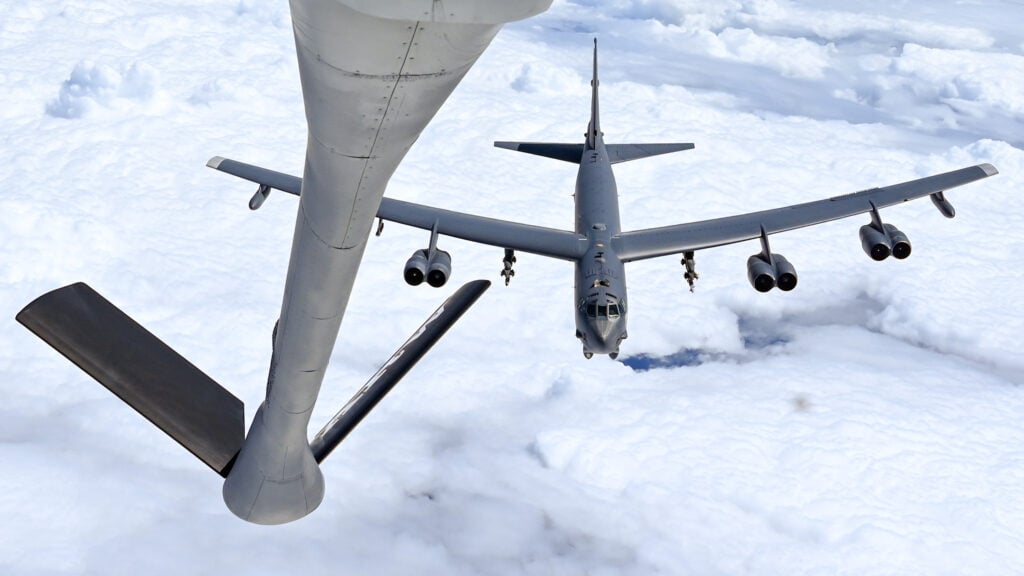
DAYTON, Ohio — The Air Force is weighing whether to pull scrapped B-52 Stratofortresses out of the boneyard, according to an Air Force official, prompted in part by the demands of operations in the Middle East.
“We can and have looked at bringing B-52s out of Arizona,” Col. Timothy Spaulding, the Air Force’s portfolio acquisition executive for bombers, said Monday in a media roundtable here at the Life Cycle Industry Days conference. Arizona is home to Davis-Monthan Air Force Base where divested aircraft, including the B-52, are sent for retirement.
“That’s not a necessarily easy thing to do, and there’s some limitation to how far you might go on that number,” Spaulding continued, adding that it was more of a “maybe” consideration for planners.
The Air Force’s bomber fleet, consisting of the Eisenhower-era B-52, B-1 Lancer and B-2 Spirit, has been in high demand in recent years, and now in particular amid war with Iran. Spaulding said ongoing operations in the Middle East have been a factor in whether to revive scrapped B-52s, whose current operational inventory consists of 76 aircraft, but stressed whether to do so has been a continuous consideration.
“I wouldn’t say in like a massive way,” Spaulding said. “It’s always been a question, and we continue to look at the cost-benefit of what it takes to regenerate” additional bombers.
Reviving a B-52 is not unprecedented. In 2016, the Air Force returned a mothballed B-52H back to service for the first time, and a second was resurrected in 2021.
The Air Force plans to keep the B-52H flying at least until the 2050s by modernizing the decades-old fleet with a new radar and updated engines, which when finished will redesignate the aircraft as the B-52J. The bomber’s Radar Modernization Program, which had already seen delays as well as cost growth, recently suffered a tragic setback on June 15 after a test aircraft for the effort crashed shortly after takeoff at Edwards Air Force Base in California, killing all eight crew on board.


Bringing real autonomy to battlefield drone swarms
Decentralized Embodied Collaborative intelligence enables better reconnaissance, logistics and combat capabilities.
The B-52 fleet was not grounded following the crash, and while officials on Monday declined to share any additional information about the event amid a safety investigation board review, Col. Spencer Turner, the B-52 system program manager, emphasized that “any indication of a fleet-wide problem” would prompt “immediate actions.”
Turner said that a second aircraft is undergoing modifications that are expected to be completed this year, but stressed that the program’s focus is on supporting the mishap investigation.
“Obviously, the crash was not in our original schedule,” he said. “So, we need to look at our schedule and adjust as necessary.”
Breaking Defense Video