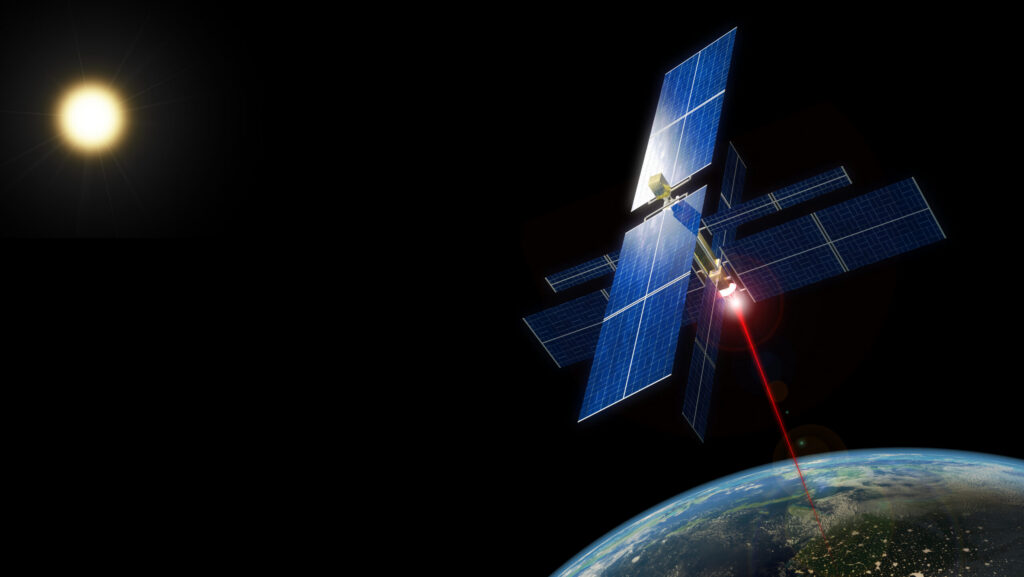
WASHINGTON ― In 1941, science fiction writer Isaac Asimov published “Reason,” a short story featuring the idea of harvesting the Sun’s rays to create electricity for use on Earth. It’s an idea that has obvious draw ― and was obviously never going to really happen.
Except, over the years, scientists have continued to poke at the concept. After all, if the technology was possible, it could in theory fuel far-flung military bases without the need for expensive, complicated and vulnerable fuel-supply convoys, while making possible “gas stations” for spacecraft voyaging to the Moon and beyond.
And now, 85 years after Asimov’s publication, the Pentagon, as well as a variety of Silicon Valley funders, are taking a much more serious look at the capability.
“While we have been informally researching the topic for a few years, Space Operational Energy is a growing focus for us,” an Air Force spokesperson told Breaking Defense. “We hope to host industry days and create avenues for collaboration with industry partners in the near future.”
The Pentagon’s renewed interest in such a capability is being buoyed by research over the past five years that has brought some of the underlying technologies to fruition, as well as its war on Iran, which showed how US adversaries can easily target Earth-based fuel logistics tails.
In May, the Air Force contracted Virginia-based startup Overview Energy for a year-long study on the use cases in which space-based solar power could supply electricity “in constrained and contested logistics environments.”
Marc Berte, Overview founder and CEO, told Breaking Defense the company is analyzing three specific scenarios in which satellites could beam energy from orbit down to US forces.

From requirement-driven to market-ready: Rethinking how defense technology reaches the warfighter
As threats continue to evolve, speed will increasingly depend on what is already available when the need emerges.
The first involves a potential future conflict zone, such as Guam — a pivotal US military hub in the western Pacific and a likely target of China in the event of war. The second scenario focuses on powering installations in areas like Alaska or Greenland, where logistics are constrained by geography, sea ice and other environmental challenges, Berte said. The final scenario looks at rapidly turning the power back on to a place that has lost electricity, “whether it be for military or for humanitarian aspects,” Berte added.
The Air Force spokesperson said the work with Overview is “early in the process” under a “small investigation contract” costing the Air Force less than $1 million. Nonetheless, the spokesperson added, the service plans “to discuss next steps based on the study’s findings.”
Berte said Overview is “continuing to talk” with DoD officials “to obtain more funding.”
And the Pentagon isn’t the only interested party.
In April Overview inked an agreement with Meta for an undisclosed amount to partner on an initial on-orbit demonstration in 2028, with the goal of beginning “commercial power delivery” in 2030. Google is funding its own space-based solar power project called Suncatcher, and SpaceX likewise is funding internal development in hopes of more easily reaping the vast amounts of electrical power needed by AI data centers, both on Earth and in space.
Advancements In Foundational Tech
Just a few years ago, Overview’s plan for a 2028 demo would have sounded wildly optimistic.
But now, the enabling tech for space-based solar power has “shifted from being vaporware to something real,” Nikolai Joseph, chief of the Space Operational Energy Division (SOED) at the Air Force’s Office of Installations, Energy and Environment, told Breaking Defense.
According to an Air Force Research Laboratory (AFRL) spokesperson, which has also been studying the concept in recent years, there are a handful of key technologies that “have continued to mature to make space-based solar power a reality” — including “mass-efficient, deployable structure concepts.”
Redwire, for example, is building new light weight, high performance foldable solar arrays that unfurl on orbit.
Other improvements making space-based solar power feasible include “increases in efficiencies of electronics; reduced mass, higher efficiency solar cells; and launch vehicle capabilities that support increased mass and volume,” the AFRL spokesperson said.
Further, the Naval Research Laboratory (NRL), the Defense Advanced Research Projects Agency (DARPA) and the California Institute of Technology over the last few years on have demonstrated the feasibility of using either microwaves or lasers to beam power directly to receivers — thus avoiding the need for batteries — in both ground- and space-based experiments. The demos were small-scale and did not involve converting solar radiation to usable radio frequency waves, but that type of beaming technology would be key to space-based solar power satellites.
Paul Jaffe, Overview’s vice president for systems engineering ― and who for the past decade has been a leading researcher on power beaming, including heading up ground-breaking experiments at both NRL and DARPA ― said beaming capabilities have grown significantly in recent years.
The two primary methods for converting solar radiation to receivers are microwaves and the near-infrared or visible light lasers. While microwave systems have the advantage of being able to transmit at long-ranges, even through the Earth’s atmosphere, they require large, specialized receiver antennas that currently are not integrated into the terrestrial power grid. Further, if not carefully designed, microwaves can pose safety risks to humans and animals. Laser beaming, on the other hand, brings no real safety concerns, though lasers are difficult to keep focused over long distances and also are subject to atmospheric distortion.
While both methods have “made tremendous advances” in recent years, Jaffe said, Overview has chosen to go with near-infrared beaming.
Berte explained this is in large part because no specialized infrastructure is needed on the ground to capture the transmissions and disseminate electrical power; Overview’s satellites will be able to directly transmit solar power to utility company facilities.
Spinning Off Project Results
The Air Force’s SOED is overseeing the Overview contract. But another area of focus for SOED has been working with the AFRL to help transition tech validated under the lab’s multi-faceted Space Solar Power Incremental Demonstrations and Research (SSPIDR) initiative to other DoD organizations, the military services and/or the private sector for further development, Joseph said.
The SSPIDR program started in 2018, and involved several sub-programs, with the primary one being an experiment called SSPRITE, for Space Solar Power Radio Frequency Integrated Transmission Experiment. SSPRITE tested tiles containing photovoltaic cells to collect solar energy and a microwave beaming system to transmit the converted energy to receiving antennas.
Northrop Grumman received a contract worth $100 million — and invested some $15 million of its own money — to build the payload and integrate SSPRITE onto the firm’s Helios bus for what was to be SSPIDR’s flagship mission, called Arachne. The mission was originally slated for launch in 2025, but was first pushed back to late 2027 and finally scrapped last year, according to AFRL officials.
Northrop Grumman did not respond to a request for comment on Arachne, with a spokesperson saying only that the company now “has the expertise and the experience to do more in this area, if the opportunity is right.”
James Winter, AFRL’s SSPIDR program manager, told Breaking Defense that in the end, AFRL decided the ground testing performed on the SSPRITE tiles was so successful there was no need for an expensive on-orbit demo.
“We did such a good job with the ground campaign and the test campaign that we got to the end of it and realized we’ve learned 99-99.5 percent of everything we set out to do,” Winter said. “And it was really a strong opinion of mine that I’d rather see us put additional resources to iterate and move the big picture forward, as opposed to utilizing those resources to actually fly it.”
Another sub-program of SSPIDR was called SPIRRAL, for Space Power InfraRed Regulation and Analysis of Lifetime. The program aimed at developing materials to withstand the huge temperature swings in space. Temperature management is critical for all satellites, but even more so for solar power-generating satellites because they will need “large arrays with minimal thermal mass; making the system’s electronics highly susceptible to damage due to extreme temperature changes in orbit,” according to an AFRL press release.
The program developed coatings called Variable Emissivity Materials, or VEMs, that change to retain heat when the temperatures drop, or radiate heat when the environment heats up. SPIRRAL flew to the International Space Station in December 2024, and is still operating, program manager Bryce Hart told Breaking Defense.
“We were scheduled to do 12 months of on orbit exposure and active testing with the samples. Through some fortunate circumstances for us, we were able to extend that, and so we’re actually going to be up there for 26 months total,” Hart said.
Hart added that AFRL has “learned now that the materials work fantastic in space.”
While the original SSPIDR program is wrapping up, Winter stressed that it not only “proved out the technology,” but also “catalyzed the commercial and industrial base to go ahead and tackle some of this, and inspired a lot of folks.”
Private Investment Riding AI Data Center Coattails
In the private sector, Silicon Valley’s current crush on AI data centers is a significant driver of the growth in the number of companies focusing on various aspects of space-based solar power.
According to the market-tracking website Factories In Space, as of last July there were 63 companies around the world — many still in the concept or early stand-up phase, but a handful with solid investment behind them — pursuing space-based solar power or related power-beaming tech.
A review by Quilty of private investment in space-based solar power at the request of Breaking Defense showed that from 2021, when the market research firm first documented a capital raise for that purpose, to the end of 2025 there was a total of $130 million put into startups alone.
That sum doesn’t count, however, the no doubt large sums of money the three Big Tech players plan to invest.
One of the startups that has raised the largest amount of funds is Florida-based Star Catcher Industries, which in May announced a $65 million Series A round — along with the addition of the former chief of the Space Force, retired Gen. Jay Raymond, to the company’s board. The firm previously raised $23 million, bringing the total raised to $88 million.
Star Catcher, however, is concentrating on building a solar power energy grid in low Earth orbit to provide electricity to other satellites rather than beaming it back to Earth. That technology could be used to power on-orbit AI data centers, for example. The company’s website states the planned Star Catcher Network will be able to deliver energy directly to the existing solar arrays on any satellite, without requiring retrofits, allowing them to generate somewhere between five and 10 times more power.
The firm last April won a Small Business Innovation Research (SBIR) Phase I grant from the Air Force’s AFWERX accelerator; and last December was awarded a follow-on Phase II grant.
Andrew Rush, Star Catcher CEO, told Breaking Defense that the AFWERX contracts are focused on “utilizing space-to-space power beaming for enhancing uptime, increasing availability of things like synthetic aperture radar assets, extending the lifetime of assets, being able to maneuver without regret, [and] being able to maneuver while sensing.”
Further, he said, the firm now has “over 43 letters of intent signed with basically every flavor of space company, including many defense primes, and we have seven power purchase agreements where people are paying us a deposit to lock in a power rate for a period of years.”
He demurred from naming any of the defense sector clients.
Rush said the next step for the firm is a demonstration of its first full-up power-beaming satellite, which will test the on-board tracking system and the system’s ability to beam power to another satellite. “Then subsequent to that, we’re moving toward operationalizing space-to-space power beaming,” Rush said. “We’ll have another mission … that’s really what the Series A is focused on.”
Rush was coy about when the demos would take place, saying only that the company has “turned over flight hardware” for the first of the two.
Rush noted that the zeitgeist around space solar power has fundamentally changed, not just because of technological advances but also shifts in DoD and investor culture with regard to the willingness to put money on space startups in general.
“This is different than five years ago,” he said. “This is the right moment to be building a space-to-space power beaming network.”
As if to confirm Rush’s words, Pulse, another startup working on laser beaming to power satellites, today announced that it has won a $40 million contract from the Space Force “to mature” it technologies for “laser-based remote power and situational awareness systems for space.”
A spokesperson for the company declined, however, to elaborate on exactly what types of systems the Bellevue, Wash.-based firm is developing under the award, citing customer “sensitivities.”
Breaking Defense Video