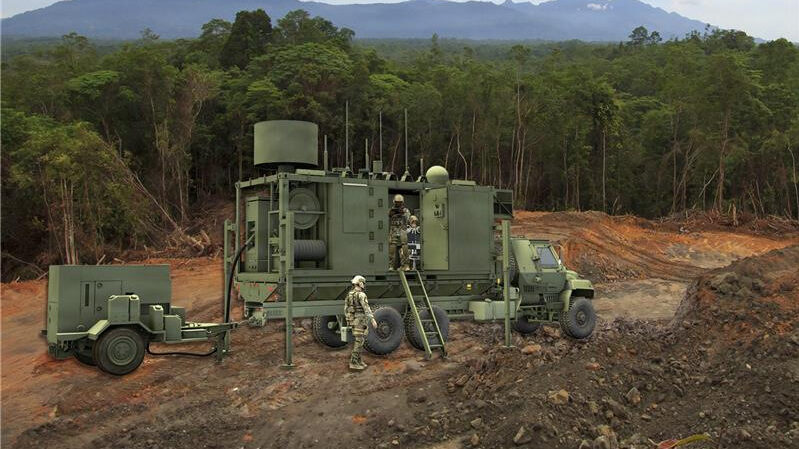
AUGUSTA, Ga. — The Army is planning for its long-range ground jammer, dubbed Terrestrial Layer System-Echelons Above Brigade (TLS-EAB), to go into production in fiscal 2027, according to service officials — years after initially awarding the concept and prototype contract.
“This is a program that was started over five years ago, and we went down a path where we were trying to get after very specific requirements and realized that the operational environment is changing rapidly and those requirements were no longer the requirements we needed,” Mark Saxon, deputy project manager for Electromagnetic Warfare & Collection, told attendees at the TechNet Augusta conference last week. “We shifted our whole mentality and went after commercial first. … [And] we’re going to be shifting to production next year.”
Army officials around 2020 initially planned TLS-EAB as a combined signals intelligence and electronic warfare capability that would be used for higher echelons such as division and corps, which operate at much longer distances and have different target sets than units at the brigade and lower level. But as early as 2023, the Army altered course, opting for a more tailored approach to the system for theater rather than a one-size-fits-all. Following that decision, it decided to split up the program into a signals intelligence variant and an EW variant. Both variants are slated for procurement next year.
Now, TLS-EW fits into a portable box and loaded onto different platforms, rather than being built into specific vehicles, Saxon told Breaking Defense in an interview on the sidelines of the Technet conference.
Additional versions of TLS-EW for use in sheltered or vehicle-based platforms such as Humvees or Joint Light Tactical Vehicles are still being prototyped, he added.
The evolution of the program towards more commercial and modular options was validated by the success of prototypes at Project Convergence and other events, particularly in the Pacific with 25th Infantry Division, Saxon said.
As the terrestrial layer progresses forward, the aerial layer of the Army’s wider EW enterprise is also going through changes. The service is hoping to complete an airborne electronic warfare appendix to existing documentation in the next couple of months, also informed by a few assets that participated with 4th ID at Project Convergence.


Three exercises that proved a new approach to C-UAS
Architecture that linked sensors, C2, RF effects, and lasers into a distributed c-UAS kill chain.
In 2025, the service decided to pivot from its main aerial EW platform, Multi-Function Electronic Warfare Air Large (MFEW-AL), and now is broadening its scope to look at a variety of approaches.
“When you talk about airborne EW, are we just talking payloads? So are we just buying payloads and then we’re slapping them onto a UAS? Well, there is your problem, right? It’s the same vehicle problem we talked about before,” Col. John Harrell, director of the EW directorate in Army Futures and Concepts Command, said in an interview at TechNet. “I don’t want to be just niche to a UAS. Because we’re going to have deep sensing. We’re going to have — so we’re looking at high altitude platforms, looking at high altitude balloons and what kind of payloads go on those. And then UAS, so small form factor, medium and large, and what kind of ranges that we can get out of those?”
One follow-on to the MFEW is the Long-Range Airborne Electronic Warfare (LRAEW) platform, a commercial solution that is modular and platform agnostic that will provide EW situational awareness as well as non-kinetic capabilities, a spokesperson for Capability Program Executive for Intelligence and Spectrum Warfare said, noting it will be housed on the Gray Eagle in the near term. Saxon said they will be delivering three LRAEW systems in the first quarter of 2027 to XVIII Airborne Corps.
Officials noted that Project Convergence was the first time units had EW capabilities at different echelons of the command and control chain, using the TLS-EAB, TLS-Manpack and other aerial capabilities to collect intelligence, monitor their signature and look for high value targets. There has been a years-long journey to provide EW kit to soldiers following significant divestment after the Cold War, in a highly dynamic environment where adversaries have proven adept at maneuver in the invisible spectrum, geolocating targets based on their emissions and denying its use for communications and precision weapons.
The danger with not having a lot of EW gear is “the commanders that [EW troops are] supporting don’t see EW as an actual key terrain feature that they can actually maneuver through, use, utilize, fight, and win with,” Harrell said. “Conceptually, I think that we saw it all finally work physically, other than just a heat map, that gave them the ability to see, and I think that will drive the demand of what it could do further across the entire portfolio, protect, sense, attack on the back end.”
UPDATED 4:56pm ET to clarify references to units in the expected LAREW fielding.