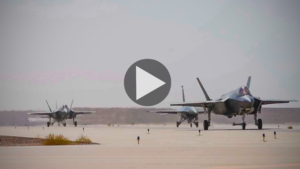
SINGAPORE — A pair of multinational exercises in the Pacific this summer offered a chance for the US military to flex its growing ship-sinking capabilities, including the ability to conduct long-range attacks from stealth bombers and drive unmanned boats into target vessels.
The capabilities were on display during the sinking exercise (SINKEX) phases at both Exercise Valiant Shield and Rim of the Pacific (RIMPAC).
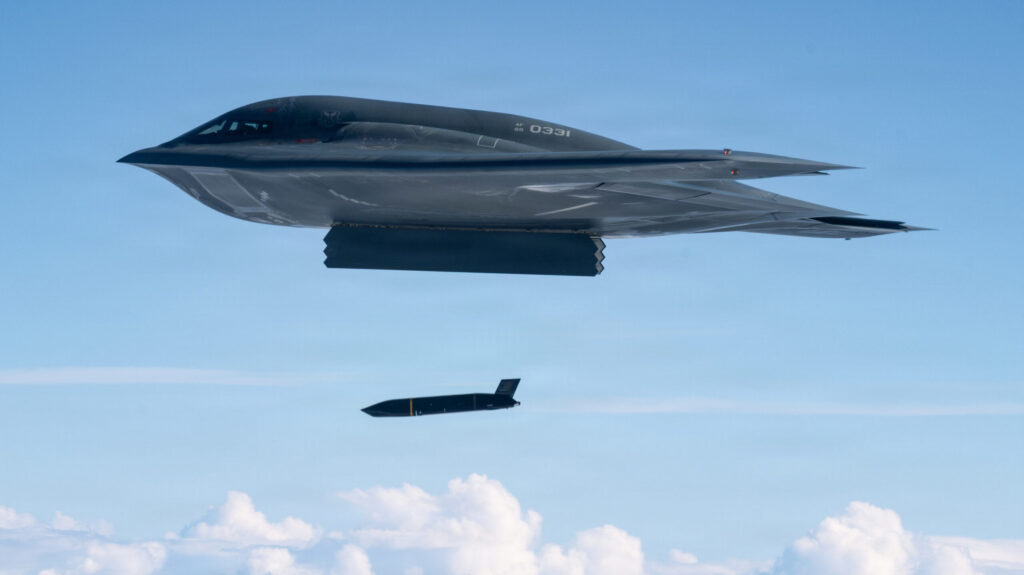
The first SINKEX took place June 27 during Valiant Shield, north of the Mariana Islands, when a US Air Force B-2 bomber launched a stealthy AGM-158C Long Range Anti-Ship Missile (LRASM) at the decommissioned amphibious transport dock Juneau, according to a news release.
The strike appeared to be the first public launch of an LRASM from a B-2, a significant development given it’s the only in-service stealth aircraft that can carry the LRASM internally. Internal bomb bays maintain the stealth aircraft’s low-radar cross-section and enable the US military to conduct stealthy, long-range anti-ship attacks, which could prove crucial in contested airspace across the vast distances of the Pacific Ocean.
“The B-2’s impressive performance underscores the U.S. military’s commitment to adaptability and flexibility in the face of emerging security challenges,” US Pacific Air Forces commander Gen. Kevin Schneider said in the news release then.
“By prioritizing counter-maritime strike operations, we can maintain a decisive edge over adversaries, protect our national interests and ensure the free and open Pacific that underpin our global security,” Schneider added.
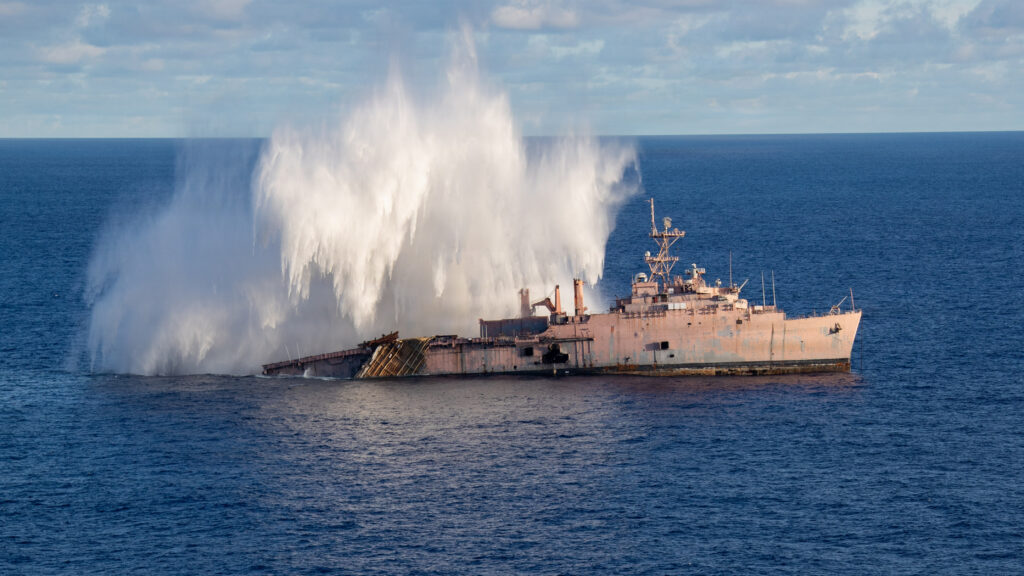
Valiant Shield, a separate Navy news release noted, also saw the US train alongside the forces of Japan, Canada, New Zealand and Australia, building “real-world proficiency in sustaining joint forces through detecting, locating, tracking, and engaging units at sea, in the air, in space, on land, and in cyberspace.”
Two further ships were sunk during RIMPAC, which took place off Hawaii from June 24 to July 31 and involved ships, submarines and aircraft from 30 nations.
On July 17, the exercise saw the decommissioned cruiser Mobile Bay and the helicopter assault ship Peleliu sunk by a combination of submarine-launched torpedoes and missiles, including LRASMs, Spike Non-Line of Sight (NLOS) missiles and Naval Strike Missiles (NSMs).
Rear Adm. Suzanne Bailey, deputy commander of the US 3rd Fleet and the commander of the RIMPAC Combined Exercise Control Group, said at a virtual media conference in the lead up to the SINKEX that these are important joint exercises to conduct with allies and partners.
“It’s the ultimate test of our kill chain, requiring our forces to work together with our allies to detect, track, target, and ultimately strike a vessel with live ordnance,” Bailey said at the time. “It’s a complex, multi-domain effort that provides really the most realistic training possible.”
Also used for the first time at RIMPAC were Unmanned Surface Vessels (USVs) called Global Autonomous Reconnaissance Craft (GARC), according to an officer involved in the exercise. A video released by the Pentagon showed at least one USV surveying the hulk of the badly damaged Peleliu before slamming into the target.
The video caption did not identify the type of USV used, but Lt. Sarah Weinstein, commanding officer of USV Division 32, identified it as a GARC built by Baltimore-based BlackSea Technologies in a social media post following the SINKEX.
“Honored that USVDIV-32 was given the opportunity to execute the Navy’s first GARC Live Fire during RIMPAC 2026,” Weinstein wrote. “It was incredible to watch my team execute with precision and we were thrilled to provide a perspective of the former USS Peleliu that often isn’t often captured in a SINKEX.”
USV Division 32 is one of the Navy’s newest units, being one of three USV divisions established in January and tasked with operating and sustaining USVs. The US Navy has already used USVs in war, with three Saronic Corsairs striking a small Iranian submarine undergoing maintenance at Bandar Abbas on July 13.
Breaking Defense Video