
Defending the US territory of Guam against a peer threat air-and-missile (AMD) attack would require the Joint Force to fight as a single force in a battlespace where their weapons, sensors, and command and control systems were never designed to operate together. Coordinating Patriot, Terminal High Altitude Area Defense (THAAD), Aegis, and fighter aircraft against simultaneous threats is an obstacle that can’t be overcome by training each service separately.
That reality is driving a new approach to live, virtual, and constructive (LVC) training that inserts simulated threats, fifth-generation fighters, and autonomous aircraft directly into the operational networks that warfighters would use in real combat.
The objective is to provide joint forces standalone training exercises that enable them to train more realistically in their own events, while allowing a seamless transition to large scale, Joint, multi-national, and/or multi-security readiness exercises at both the operational and tactical levels of war.
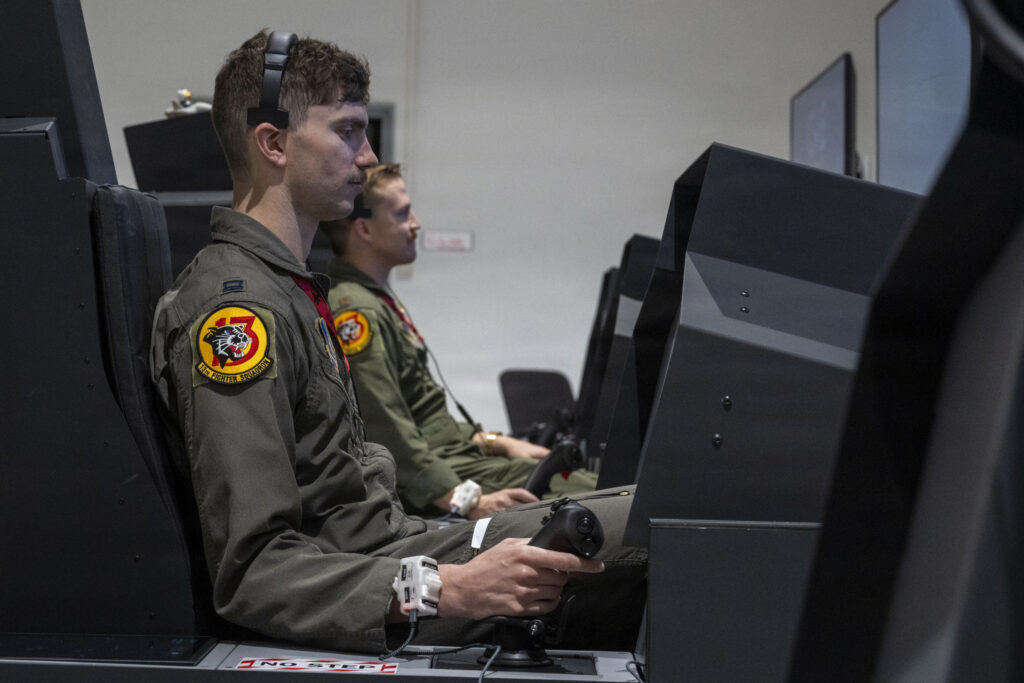
Through US Indo-Pacific Command’s Pacific Multi-Domain Training and Experimentation Capability (PMTEC) program, CAE is demonstrating how LVC is supporting joint AMD, the integration of collaborative combat aircraft (CCA) with F-35s, and operations in contested environments.
Artificial intelligence (AI) is a key element in this type of training and tackles the challenge of the time and manpower expenditures required to build complex, realistic exercises necessary to truly recreate the potential battlespace.
Guam as a joint training environment
Guam’s airfields, naval facilities, and logistics infrastructure make it a critical military hub in any potential conflict in the Indo-Pacific region. Its concentrated geography also creates an unusually difficult air-defense problem.
Traditionally, each service has trained largely within its own operational responsibilities. But defending Guam demands a common understanding of the threat, shared tactics, and the ability to coordinate engagements across service boundaries. Operators need to know not only how their own systems will respond, but how those actions affect the rest of the joint force.
“A common execution error seen in the occasional joint exercises is the duplication of targeting across services. The difficulty of doing multiple exercises means these lessons get relearned as units and personnel rotate out before being able to train again in a complex scenario,” said Matthew Martin, CAE’s lead for LVC, noting that the PMTEC program addresses that problem by bringing simulations into operational command and control networks rather than building separate systems dedicated to training.
“Enabling the ease of joint training from home station, interconnecting units across vast distances, will allow our skilled warfighters to tackle these errors and transform them into lessons applied, increasing lethality and survivability.”
During Valiant Shield, for example, CAE established a simulation cell at Andersen Air Force Base on Guam and connected it to the mission network supporting the island’s regional air-defense operations. The exercise generated simulated ballistic and cruise missiles, red aircraft, and friendly forces, feeding that information into command and control systems used by the different services.
The result was a common threat picture that Army, Navy, and Air Force operators could use to coordinate engagements against a sophisticated adversary while working through the systems and procedures they would employ in combat.
The exercise also addressed something equally important: the organizational differences that technology alone cannot resolve. Said Martin: “This was an ideal location where Army, Navy, and Air Force air defenders can train together as a joint team against that sophisticated peer threat.”
Army air-defense personnel participated in Air Force-style tactical debriefings, while Air Force battle managers worked directly with Army operators to coordinate airspace. Those interactions revealed differences in Tactics, Techniques, and Procedures (TTPs) that could complicate operations during an actual attack.
The experience reinforced an important detail about joint training. Connecting systems provide the technical foundation, but the ability to operate as a coordinated force depends on developing common TTPs and clear communication about how the services make decisions.
Bringing fifth-generation fighters and CCA into the fight
Valiant Shield also demonstrated how geographically dispersed forces could participate in the same mission environment. CAE connected F-35 simulators at Misawa Air Base in Japan to the Guam exercise, allowing pilots to conduct defensive operations guided by Air Force controllers thousands of miles away.
The exercise went further by incorporating CCA into a joint operational scenario, giving warfighters an opportunity to begin developing tactics for platforms that are still being tested and fielded. Rather than waiting for CCA to become widely available, CAE integrated the Air Force autonomy tools into the environment and injected capabilities from its CCA Academy in Texas into the exercise.
These included simulated aircraft, autonomy software associated with the Air Force’s Autonomy Government Reference Architecture, and the control interfaces that fighter pilots would use to supervise autonomous teammates. A live MQ-28 operating near Guam also participated, enabling interaction between live and virtual CCA capabilities.
That integration matters because the challenge is not simply making autonomous aircraft fly or communicate with crewed fighters. It is determining how those aircraft will be employed during complex missions, what tasks they should perform, and how much control human operators should retain.
“CCAs will undoubtedly be a permanent fixture in future representative LVC mission exercises,” said Dr. Brian Stensrud, CAE’s Technical Fellow for Artificial Intelligence, noting that this necessitates understanding the human side of autonomy.
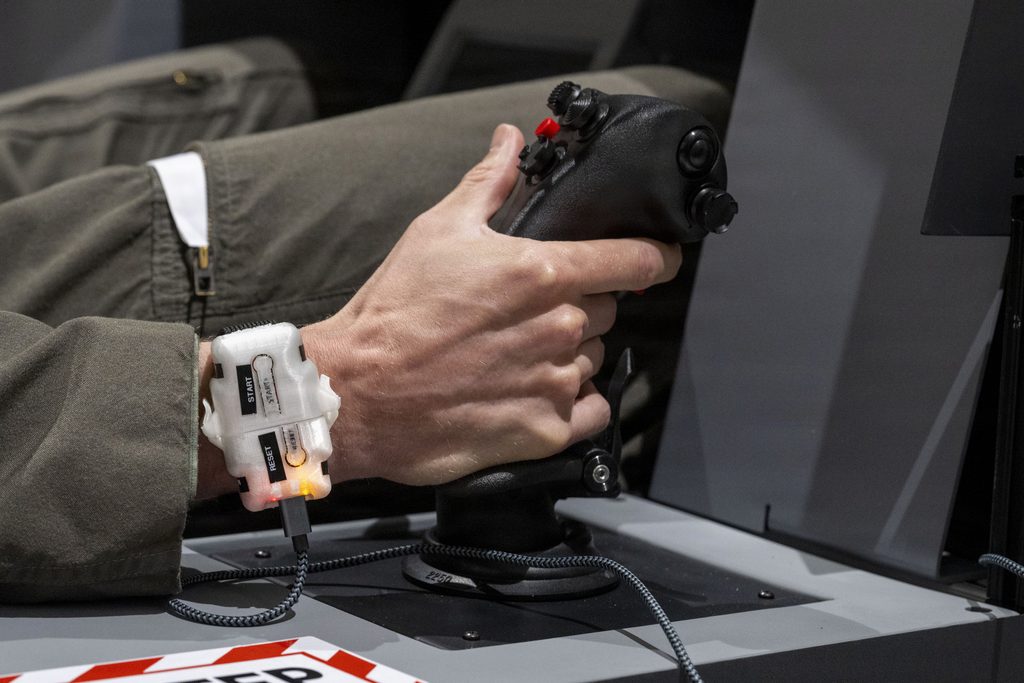
During Valiant Shield, CAE equipped F-35 pilots and air-battle managers with biometric monitoring devices, collecting physiological indicators and using cognitive classifiers designed to assess workload, situational awareness, and trust in autonomous systems.
“If the platform is completely autonomous and you have no visibility into how it’s functioning or how it’s making its decisions, then the trust level becomes very low,” Martin said, adding that the assessments are intended to help identify the balance between operator control and machine independence, providing feedback for the development of autonomous capabilities and their interfaces.
Using AI to create more realistic exercises with less manpower
The expanding scope of joint LVC training creates another challenge: the effort required to build and operate increasingly complex exercises. Every additional service, weapons system, sensor, and autonomous platform brings new requirements for simulation models, data integration, cybersecurity, and coordination. Preparing a large event can consume substantial time and manpower before operators ever begin training.
CAE is investing in an integrated mission environment intended to automate much of that work and make sophisticated LVC exercises easier to assemble, execute, and repeat. The goal is to use AI to translate a commander’s training objectives into an executable exercise, help select simulation tools, configure data sources, connect systems, and generate the forces and conditions needed for the scenario.
“We’re trying to close that loop with AI and automation, rather than relying on dozens of people involved in making it all happen,” Stensrud said.
Artificial intelligence also offers a way to make opposing forces more representative of real-world adversaries. Traditional constructive simulations often rely on scripted behaviors that require extensive preparation and limit how realistically the opposition can respond when conditions change.
AI-generated behavior can make simulated adversaries more dynamic and unpredictable, forcing operators to adapt rather than repeatedly train against predetermined actions.
The same approach applies to intelligence, surveillance, and reconnaissance training. Analysts need realistic sensor data and adversary activity to practice detecting threats, recognizing patterns, and developing assessments. AI-generated behavior, combined with simulated sensor outputs, can create more representative conditions without scripting every action.
For warfighters, the benefit is twofold: exercises can reflect a wider range of threats, while the time and manpower required to prepare them can be reduced. That could make complex joint training more practical as a recurring and more realistic capability rather than an occasional large-scale event.
Connecting training to operational networks
Making LVC available across the Pacific depends on more than just realistic simulations and AI. The underlying infrastructure must connect those capabilities to operational networks securely and reliably.
The U.S. Air Force’s Simulator Common Architecture Requirements and Standards (SCARS) program provides a foundation for that integration. Its cloud-based architecture supports cybersecurity, software updates, and the distribution of authoritative simulation data across training systems.
CAE is leveraging the SCARS architecture through the Pacific training program, hosting simulation tools within a cybersecure environment and connecting them to classified mission networks. That allows simulated threats and friendly forces to appear in operational command and control systems without constructing separate networks for every exercise. It also supports updating threat and weapons models as new capabilities and intelligence become available.
The next challenge is extending that common environment across geographically dispersed forces and allied partners.
During the US-Japan bi-lateral exercise Keen Sword in Japan, CAE expanded the capability to include Japanese air controllers, US and Japanese pilots operating F-35 simulators, and live aircraft. Link 16 connectivity and operational communications enabled virtual and live participants to train together as an allied force.
Further expansion planned for Resolute Forces Pacific 2027 this coming spring will connect locations in Japan, Guam, and Hawaii into a common air-defense environment.
That will allow warfighters to practice distributed command and control, including transferring responsibilities between command centers if an installation is attacked, damaged, or unable to communicate.
The operational implications extend beyond training personnel on their individual systems. Commanders could use the same environment to test plans, evaluate alternative courses of action, identify weaknesses, and rehearse missions before execution.
“Ultimately, that can become not just a training tool,” said Martin. “It can become a true operational capability by enabling opportunities like mission rehearsal.”
Making that vision practical will require both the integration demonstrated during recent Pacific exercises and the automation needed to generate sophisticated scenarios without extensive manual preparation.
For the military, it offers a way to prepare distributed forces for operations that cannot be adequately rehearsed through separate service training systems. For CAE, the effort brings together joint LVC integration, autonomous systems training, and AI-driven exercise development.
That would give commanders a means to refine operational plans, test how forces work together, and prepare for contested operations using the same systems they would depend on when the fight starts.